Try GOLD - Free
FASHION FORWARD
Scientific American
|July/August 2025
A rising swell of sustainable apparel practices makes getting dressed fun again

In Chile's Atacama Desert, mountain of more than 59,000 tons of clothing can now be seen from space. This so-called garment graveyard comprises fast-fashion discards inherited from the U.S., Europe and Asia. In 2024 activists, designers and NGOs organized Atacama Fashion Weekwith a fashion show atop the garment graveyardto draw attention to this growing problem.
IN NEW YORK STATE'S HUDSON VALLEY, Lilly Marsh weaves scarves, shawls, and other apparel out of fibers sourced from the Northeast. The items are beautiful and informed by historical techniques—for her Ph.D., Marsh studied contemporary North American hand knitting—but her interest in producing woven goods goes far beyond the final product. In 2017 Marsh co-founded the Hudson Valley Textile Project (HVTP), a natural-textile supply chain that aims to break free from the global fashion industry.
One big problem the HVTP set out to solve involves wool. After sheep are shorn at farms, the wool is greasy and needs to be cleaned, or scoured, before it can be worked with. For years the scouring facility closest to New York was in North Carolina, and it had a 1,000-pound minimum for processing—an amount most small farms can't reach on a yearly basis. Using money from grants and private donations, the HVTP opened Clean Fleece, a local scouring facility that washes small batches of wool and other animal fibers. “It’s enabled a ton of farmers who want to work on a small or midsize scale to get that done,” Marsh says. “That’s made a big difference in our industry.” Now farms across the region are selling socks, hats and mittens on a consistent basis—and at prices that are comparable to those of similar products from major brands.
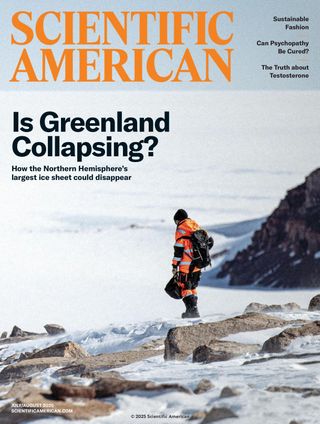

This story is from the July/August 2025 edition of Scientific American.
Subscribe to Magzter GOLD to access thousands of curated premium stories, and 10,000+ magazines and newspapers.
Already a subscriber? Sign In
MORE STORIES FROM Scientific American

Scientific American
Dirty Little Secrets
Extremophile molds are invading art museums and devouring their collections. Stigma and climate change have fueled their spread

16 mins
February 2026

Scientific American
Archaeology Is Reviving the Smell of History
How reconstructing long-lost smells connects us to the past
6 mins
February 2026

Scientific American
Heal Injuries Faster
Toss out the old advice that rest is the best recovery strategy
4 mins
February 2026

Scientific American
Can a Time Capsule Outlast Geology?
A ridiculous but instructive thought experiment involving deep time, plate tectonics, erosion and the slow death of the sun
17 mins
February 2026
Scientific American
Fiery Amoeba
A newfound organism thrives in record-breaking heat
2 mins
February 2026

Scientific American
50, 100 & 150 Years
GIANT ATOMS
3 mins
February 2026

Scientific American
Nature's Tile Shop
Life keeps evolving these geometric patterns
2 mins
February 2026
Scientific American
Battle of the Breeds
A large dataset shows that some dog stereotypes are based in reality, and others might be unfair characterizations
1 min
February 2026

Scientific American
The Milky Way's Disk Keeps Getting Weirder
The disk of our galaxy is not flat but warped and waving
5 mins
February 2026
Scientific American
A Winning Loser
If the cards shown here are rearranged to form four new poker hands of five cards each, what is the low- est possible winning or tying hand?
1 min
February 2026
Listen
Translate
Change font size