Try GOLD - Free
Fiery Amoeba
Scientific American
|February 2026
A newfound organism thrives in record-breaking heat
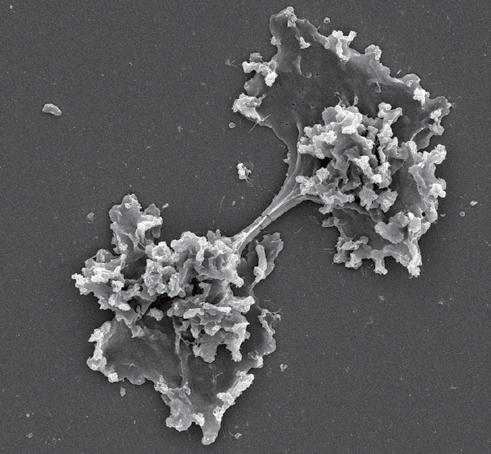
Incendiamoeba cascadensis reproducing through mitosis
A TINY AMOEBA has broken a pretty big record.
The newly discovered species of single-celled organism can divide and reproduce at a piping hot 63 degrees Celsius (145 degrees Fahrenheit), a higher temperature than possible for any other known complex form of life. The discovery, described in a preprint study on the server bioRxiv and not yet peer-reviewed, “pushes the boundaries of our understanding of life’s limits on Earth and the implications for life beyond Earth—where else and how else life might be able to take hold and thrive,” says microbial ecologist and astrobiologist Luke McKay, who was not involved with the study.
Much of the existing research into extremophiles—lifeforms that thrive at extreme temperatures, acidity levels, or other environmental conditions—has concentrated on bacteria and archaea that lack a nucleus or membrane-bound cell organelles. The record-holding organism for withstanding high temperature is an archaean, Methanopyrus kandleri

This story is from the February 2026 edition of Scientific American.
Subscribe to Magzter GOLD to access thousands of curated premium stories, and 10,000+ magazines and newspapers.
Already a subscriber? Sign In
MORE STORIES FROM Scientific American

Scientific American
Let There Be Weapons
The Department of Energy’s new Genesis Mission promises AI-accelerated discovery. Seven of its first 26 challenges focus on nuclear weapons and national security

4 mins
July/August 2026

Scientific American
How to Fix Science
The federal funding system for scientific research in the U.S. needs reform
9 mins
July/August 2026

Scientific American
Robots Can Now Fold Your Laundry
Home-helper tasks are becoming easier for robotic assistants
4 mins
July/August 2026

Scientific American
50, 100 & 150 Years
NATURAL FISSION REACTOR
3 mins
July/August 2026

Scientific American
Anna Ho
Describing the characteristics of short-lived astrophysical events
1 mins
July/August 2026
Scientific American
THE SOLILOQUY OF SCHRÖDINGER'S CAT
A MEDITATION ON LIFE AND THE VON NEUMANN–WIGNER INTERPRETATION OF QUANTUM MECHANICS
1 min
July/August 2026

Scientific American
Mikhail Kolmogorov
Developing software to reveal large genetic changes that lead to cancer
1 mins
July/August 2026

Scientific American
Jaye Gardiner
Learning how the matrix around cells and tissues impacts cancers
1 mins
July/August 2026

Scientific American
Timnit Gebru
On safeguarding independent research in the age of big tech
3 mins
July/August 2026

Scientific American
A Youthful Illusion Sharpens Memory
By making people feel as if their face is a younger version of itself, researchers can bring childhood memories into sharper focus
4 mins
July/August 2026
Listen
Translate
Change font size