Try GOLD - Free
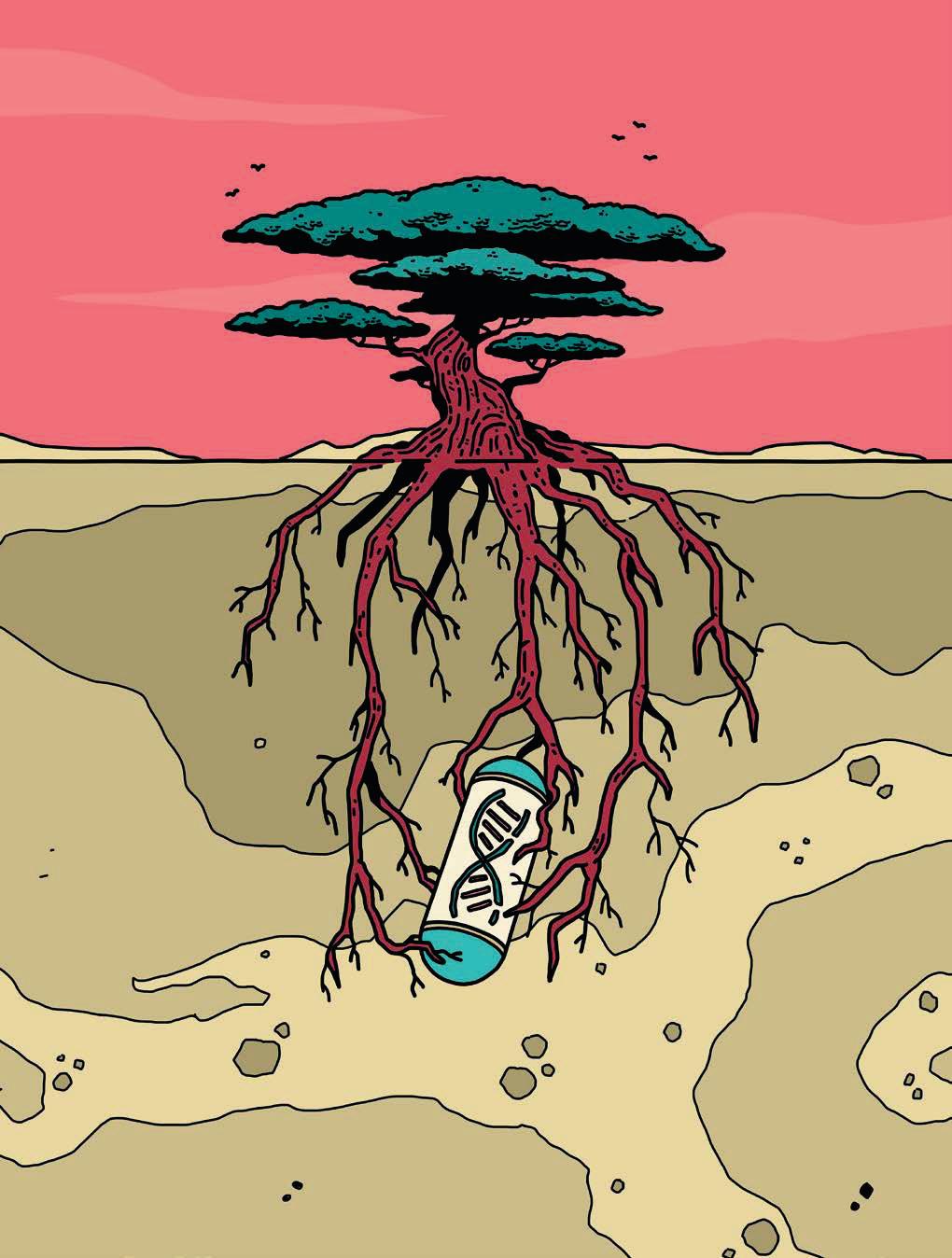
Can a Time Capsule Outlast Geology?
Scientific American
|February 2026
A ridiculous but instructive thought experiment involving deep time, plate tectonics, erosion and the slow death of the sun
STUFF IS OLD WHERE I LIVE, in greater Boston. Clapboard houses that list with age bear plaques touting the former residence of the town cordwainer or victualler. The gravestones, worn rough by New England winters, also stand crooked, bearing similarly outmoded biblical names—a Lemuel here, an Ephraim there. Old, too, are the local churches where many of these souls were commended to the great hereafter.
As for the building material that makes up these churches, well, that's a little bit older still. Roxbury puddingstone, the mottled rock quarried nearby and used for much of the old church masonry in Boston, formed 600 million years ago in violent submarine landslides off the coast of a barren volcanic microcontinent that had been rifted off Africa. This upheaval happened so long ago in the course of the perpetual wandering of continents that the whole thing took place somewhere near the South Pole. The sediments hardened to rock, then hitched a ride across a bygone ocean as part of a traveling tectonic plate before being sutured onto the rest of equatorial North America some 140 million years before the first dinosaur evolved.

This story is from the February 2026 edition of Scientific American.
Subscribe to Magzter GOLD to access thousands of curated premium stories, and 10,000+ magazines and newspapers.
Already a subscriber? Sign In
MORE STORIES FROM Scientific American

Scientific American
Let There Be Weapons
The Department of Energy’s new Genesis Mission promises AI-accelerated discovery. Seven of its first 26 challenges focus on nuclear weapons and national security

4 mins
July/August 2026

Scientific American
How to Fix Science
The federal funding system for scientific research in the U.S. needs reform
9 mins
July/August 2026

Scientific American
Robots Can Now Fold Your Laundry
Home-helper tasks are becoming easier for robotic assistants
4 mins
July/August 2026

Scientific American
50, 100 & 150 Years
NATURAL FISSION REACTOR
3 mins
July/August 2026

Scientific American
Anna Ho
Describing the characteristics of short-lived astrophysical events
1 mins
July/August 2026

Scientific American
THE SOLILOQUY OF SCHRÖDINGER'S CAT
A MEDITATION ON LIFE AND THE VON NEUMANN–WIGNER INTERPRETATION OF QUANTUM MECHANICS
1 min
July/August 2026

Scientific American
Mikhail Kolmogorov
Developing software to reveal large genetic changes that lead to cancer
1 mins
July/August 2026

Scientific American
Jaye Gardiner
Learning how the matrix around cells and tissues impacts cancers
1 mins
July/August 2026

Scientific American
Timnit Gebru
On safeguarding independent research in the age of big tech
3 mins
July/August 2026

Scientific American
A Youthful Illusion Sharpens Memory
By making people feel as if their face is a younger version of itself, researchers can bring childhood memories into sharper focus
4 mins
July/August 2026
Listen
Translate
Change font size