Try GOLD - Free
The Hardest Problem
Scientific American
|February 2026
Bruised theories. Accusations of pseudoscience. Machines that claim to be sentient. The field of consciousness research could be on the verge of a revolution— or once again be relegated to the fringe
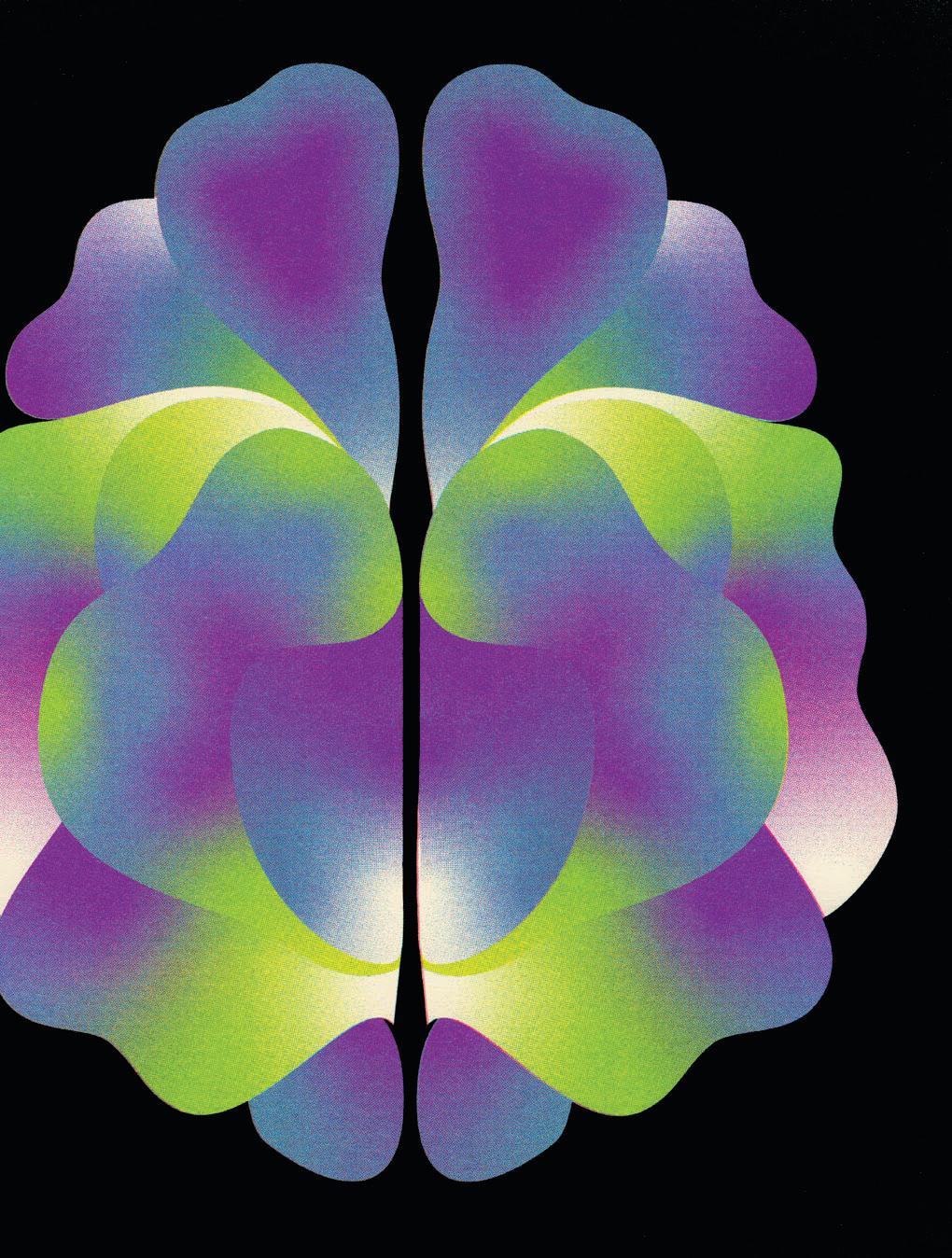
UNTIL HALF A BILLION YEARS AGO, LIFE ON EARTH WAS SLOW. The seas were home to single-celled microbes and largely stationary soft-bodied creatures. But at the dawn of the Cambrian era, some 540 million years ago, everything exploded. Bodies diversified in all directions, and many organisms developed appendages that let them move quickly around their environment. These ecosystems became competitive places full of predators and prey. And our branch of the tree of life evolved an incredible structure to navigate it all: the brain.
We don't know whether this was the moment when consciousness first arose on Earth. But it might have been when living creatures began to really need something like it to combine a barrage of sensory information into one unified experience that could guide their actions. It's because of this ability to experience that, eventually, we began to feel pain and pleasure. Eventually, we became guided not just by base needs but by curiosity, emotions and introspection. Over time we became aware of ourselves.
This last step is what we have to thank for most of art, science and philosophy—and the millennia-long quest to understand consciousness itself. This state of awareness of ourselves and our environment comes with many mysteries. Why does being awake and alive, being yourself, feel like anything at all, and where does this singular sense of awareness come from in the brain? These questions may have objective answers, but because they are about private, subjective experiences that can't be directly measured, they exist at the very boundaries of what the scientific method can reveal.
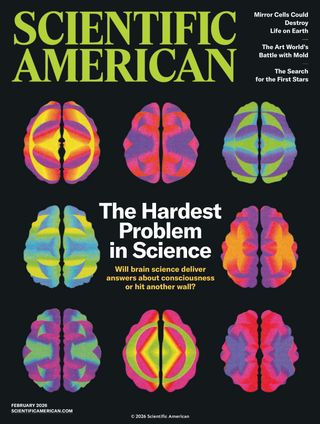

This story is from the February 2026 edition of Scientific American.
Subscribe to Magzter GOLD to access thousands of curated premium stories, and 10,000+ magazines and newspapers.
Already a subscriber? Sign In
MORE STORIES FROM Scientific American

Scientific American
Earthquake Life
Yellowstone quakes spark bursts of microbial growth underground

2 mins
March 2026

Scientific American
Sailing the Sun
By designing vertical panels that move in a gale, two Swedish inventors are unlocking a solar future for the windswept north
9 mins
March 2026
Scientific American
Covered in Bees
Ancient bees burrowed deep into discarded mammal jawbones
2 mins
March 2026
Scientific American
Fire Starters
Ancient humans were making fire 350,000 years earlier than thought
3 mins
March 2026

Scientific American
Relativity Revealed
Physicists have observed a bizarre prediction of special relativity for the first time
8 mins
March 2026

Scientific American
Everything You Wanted to Know about Polyamory (but Were Afraid to Ask
The practice is not a faddish excuse to sleep around, research shows. And it has deep roots in American culture
14 mins
March 2026

Scientific American
Let the Rivers Run
An investigation into the rights of nature
4 mins
March 2026

Scientific American
Hidden Proof
\"Effective zero knowledge\" beats long-standing cryptographic impossibilities
2 mins
March 2026

Scientific American
The Universe's Weirdest Optical Illusions
Sometimes the farther away an object is, the bigger it seems to be
4 mins
March 2026

Scientific American
Living in the COPILOT SOCIETY
The promise and peril of artificial intelligence everywhere
2 mins
March 2026
Listen
Translate
Change font size