Try GOLD - Free
Sailing the Sun
Scientific American
|March 2026
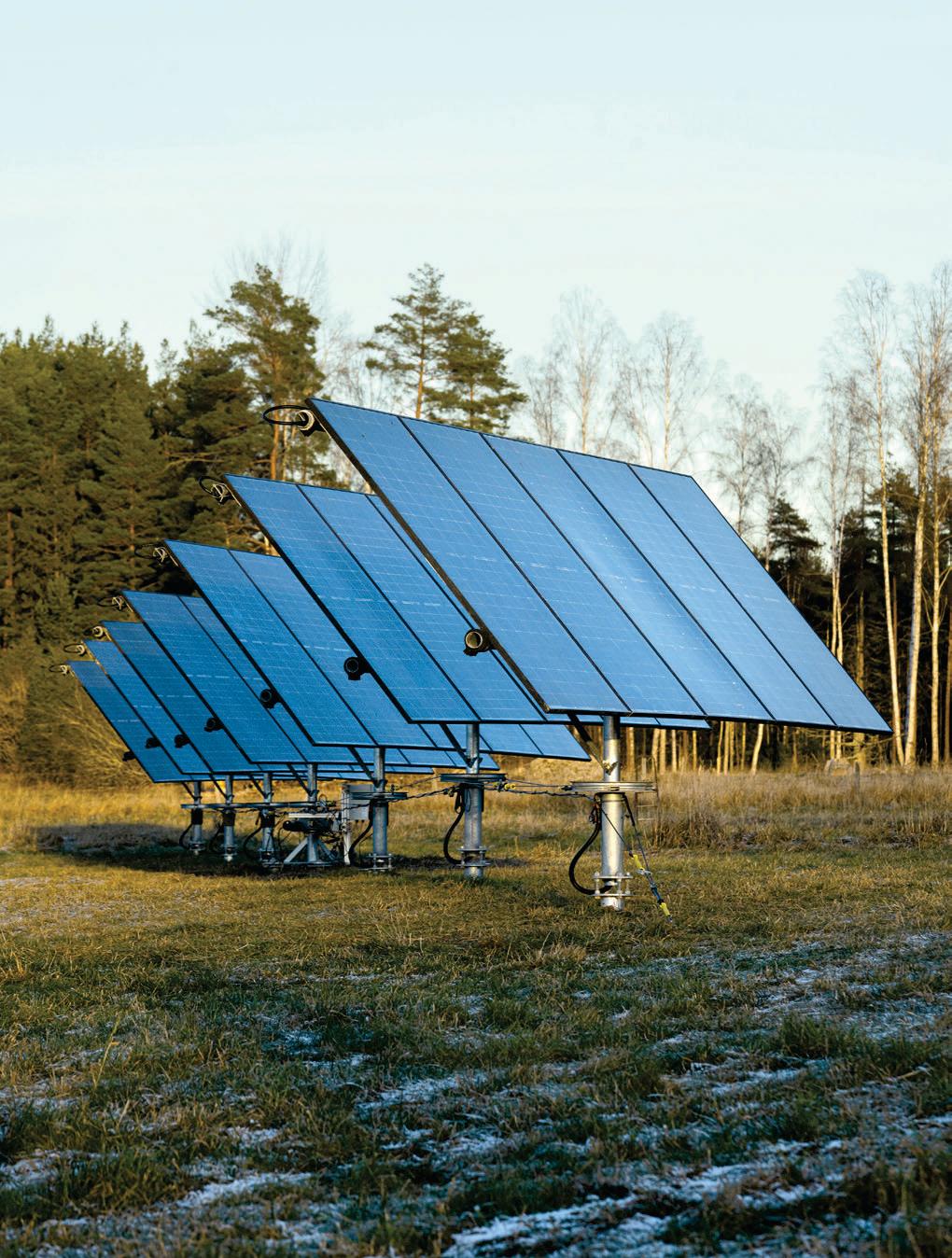
By designing vertical panels that move in a gale, two Swedish inventors are unlocking a solar future for the windswept north
-
WHEN THE 47TH SOLAR panel exploded, Henrik Eskilsson began to fear he had signed on with a madman.
In his SUV, he and Anders Olsson were accelerating across Sweden’s Lunda Airfield, towing a trailer fitted with a steel mast that suspended the panel. As they gained speed, the panel did something unusual: it floated, catching the wind like a hang glider while staying anchored to the mast. The speedometer crept toward 100 kilometers per hour. The device began vibrating. Suddenly it snapped free, tumbled through the air and shattered on the runway.
Eskilsson, who'd previously founded a company that makes eye-tracking software, stopped the car and contemplated why he'd committed to this quixotic project: to revolutionize solar power for billions of people. Many areas in the Northern Hemisphere and some in the Southern lie in zones where traditional solar fields are inefficient, especially in winter—but also in the morning and evening. When the sun sits low, its rays hit horizontal panels at a shallow, grazing angle, delivering little energy. Vertical solar panels that track the sun even as it barely clears the tree line have proved too expensive, requiring multiple motors to rotate them, too much concrete to anchor them and too much steel to keep the wind from tearing them apart.
The shattered prototype was built by Vaja, the vertical-tracking startup Olsson and Eskilsson founded several months earlier, in 2023, to solve this problem. For years Olsson had envisioned building solar systems that moved with the wind like leaves in a storm. He and Eskilsson had consulted with mechanical engineers, who said this design would be impossible. Olsson disagreed. Eskilsson trusted him, although he wondered how many more panels would first have to be destroyed.
They got out of the SUV, took brooms from the back and, in the brisk winter afternoon, began sweeping the runway.


This story is from the March 2026 edition of Scientific American.
Subscribe to Magzter GOLD to access thousands of curated premium stories, and 10,000+ magazines and newspapers.
Already a subscriber? Sign In
MORE STORIES FROM Scientific American
Scientific American
Let There Be Weapons
The Department of Energy’s new Genesis Mission promises AI-accelerated discovery. Seven of its first 26 challenges focus on nuclear weapons and national security

4 mins
July/August 2026

Scientific American
How to Fix Science
The federal funding system for scientific research in the U.S. needs reform
9 mins
July/August 2026

Scientific American
Robots Can Now Fold Your Laundry
Home-helper tasks are becoming easier for robotic assistants
4 mins
July/August 2026

Scientific American
50, 100 & 150 Years
NATURAL FISSION REACTOR
3 mins
July/August 2026

Scientific American
Anna Ho
Describing the characteristics of short-lived astrophysical events
1 mins
July/August 2026
Scientific American
THE SOLILOQUY OF SCHRÖDINGER'S CAT
A MEDITATION ON LIFE AND THE VON NEUMANN–WIGNER INTERPRETATION OF QUANTUM MECHANICS
1 min
July/August 2026

Scientific American
Mikhail Kolmogorov
Developing software to reveal large genetic changes that lead to cancer
1 mins
July/August 2026

Scientific American
Jaye Gardiner
Learning how the matrix around cells and tissues impacts cancers
1 mins
July/August 2026

Scientific American
Timnit Gebru
On safeguarding independent research in the age of big tech
3 mins
July/August 2026

Scientific American
A Youthful Illusion Sharpens Memory
By making people feel as if their face is a younger version of itself, researchers can bring childhood memories into sharper focus
4 mins
July/August 2026
Listen
Translate
Change font size