Try GOLD - Free
Relativity Revealed
Scientific American
|March 2026
Physicists have observed a bizarre prediction of special relativity for the first time
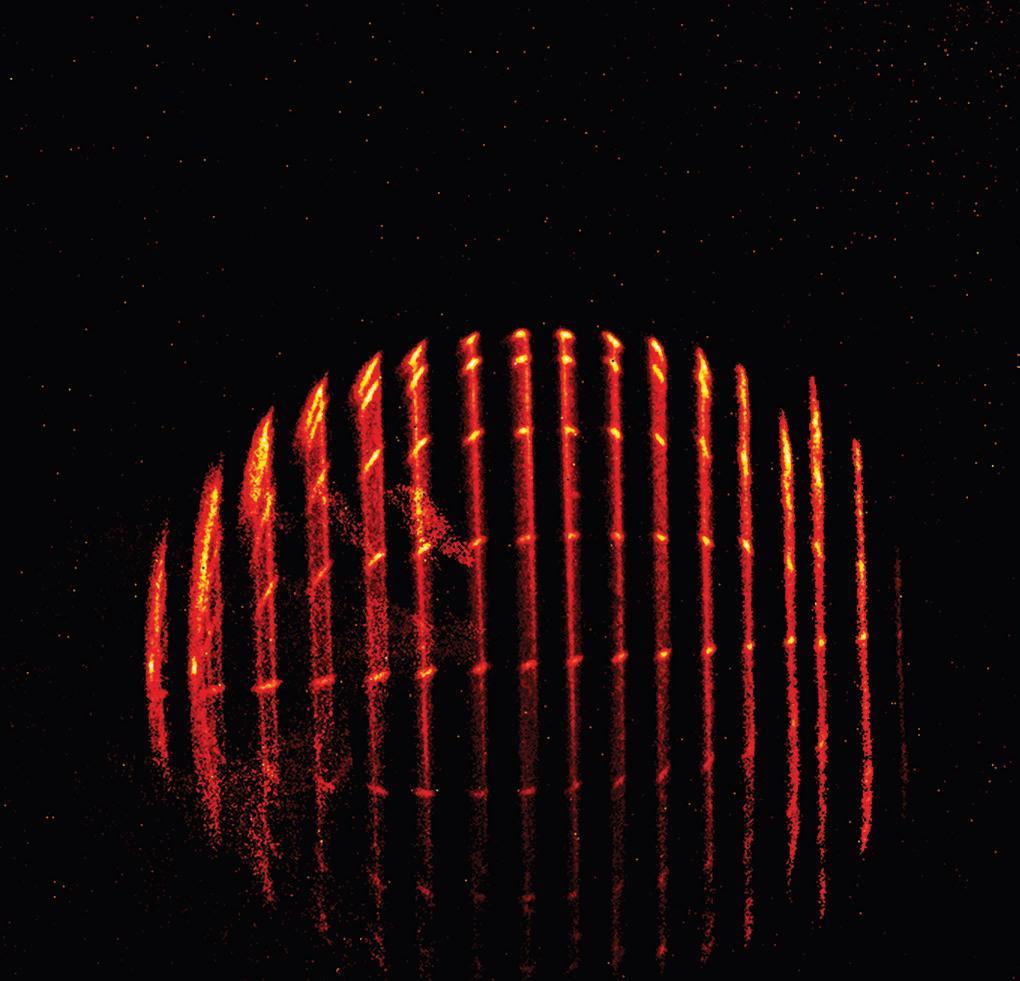
IN HIS CLASSIC SCIENCE-FICTION STORY “THE NEW ACCELERATOR,” PUBLISHED in 1901, H. G. Wells describes a drug that speeds up a person's metabolism by a factor of 1,000. For the two protagonists who valiantly test the potion, the world appears strangely slowed down, almost frozen in movement. The story got one of us (Schattschneider) thinking: If we could slow down time, could we see single photons fly through space? Could we observe relativistic phenomena? In particular, could we ever glimpse a strange prediction called the Terrell-Penrose effect?
The Terrell-Penrose effect would make objects moving at nearly the speed of light look oddly rotated. The notion seems to go against another prediction of Einstein’s special theory of relativity known as Lorentz contraction, which holds that as things go faster they will shrink. Although the Terrell-Penrose effect had been tested in thought experiments and simulated on computers, it had never been demonstrated in real life.
The prospect of real-world testing lay dormant until recently, when one of Schattschneider’s colleagues, quantum scientist Philipp Haslinger of the Vienna University of Technology, mentioned to him an experiment called the SEEC project, which aims to visualize the way light moves across surfaces. He shared a video in which a laser pulse seems to move at a speed of meters per second, only about one billionth of the speed of light. There it was again: the idea of slowing down time—Wells’s New Accelerator, this time in the form of not a magic potion but ultrafast photography.

This story is from the March 2026 edition of Scientific American.
Subscribe to Magzter GOLD to access thousands of curated premium stories, and 10,000+ magazines and newspapers.
Already a subscriber? Sign In
MORE STORIES FROM Scientific American
Scientific American
Let There Be Weapons
The Department of Energy’s new Genesis Mission promises AI-accelerated discovery. Seven of its first 26 challenges focus on nuclear weapons and national security

4 mins
July/August 2026

Scientific American
How to Fix Science
The federal funding system for scientific research in the U.S. needs reform
9 mins
July/August 2026

Scientific American
Robots Can Now Fold Your Laundry
Home-helper tasks are becoming easier for robotic assistants
4 mins
July/August 2026
Scientific American
50, 100 & 150 Years
NATURAL FISSION REACTOR
3 mins
July/August 2026

Scientific American
Anna Ho
Describing the characteristics of short-lived astrophysical events
1 mins
July/August 2026
Scientific American
THE SOLILOQUY OF SCHRÖDINGER'S CAT
A MEDITATION ON LIFE AND THE VON NEUMANN–WIGNER INTERPRETATION OF QUANTUM MECHANICS
1 min
July/August 2026

Scientific American
Mikhail Kolmogorov
Developing software to reveal large genetic changes that lead to cancer
1 mins
July/August 2026

Scientific American
Jaye Gardiner
Learning how the matrix around cells and tissues impacts cancers
1 mins
July/August 2026

Scientific American
Timnit Gebru
On safeguarding independent research in the age of big tech
3 mins
July/August 2026

Scientific American
A Youthful Illusion Sharpens Memory
By making people feel as if their face is a younger version of itself, researchers can bring childhood memories into sharper focus
4 mins
July/August 2026
Listen
Translate
Change font size