Versuchen GOLD - Frei
Relativity Revealed
Scientific American
|March 2026
Physicists have observed a bizarre prediction of special relativity for the first time
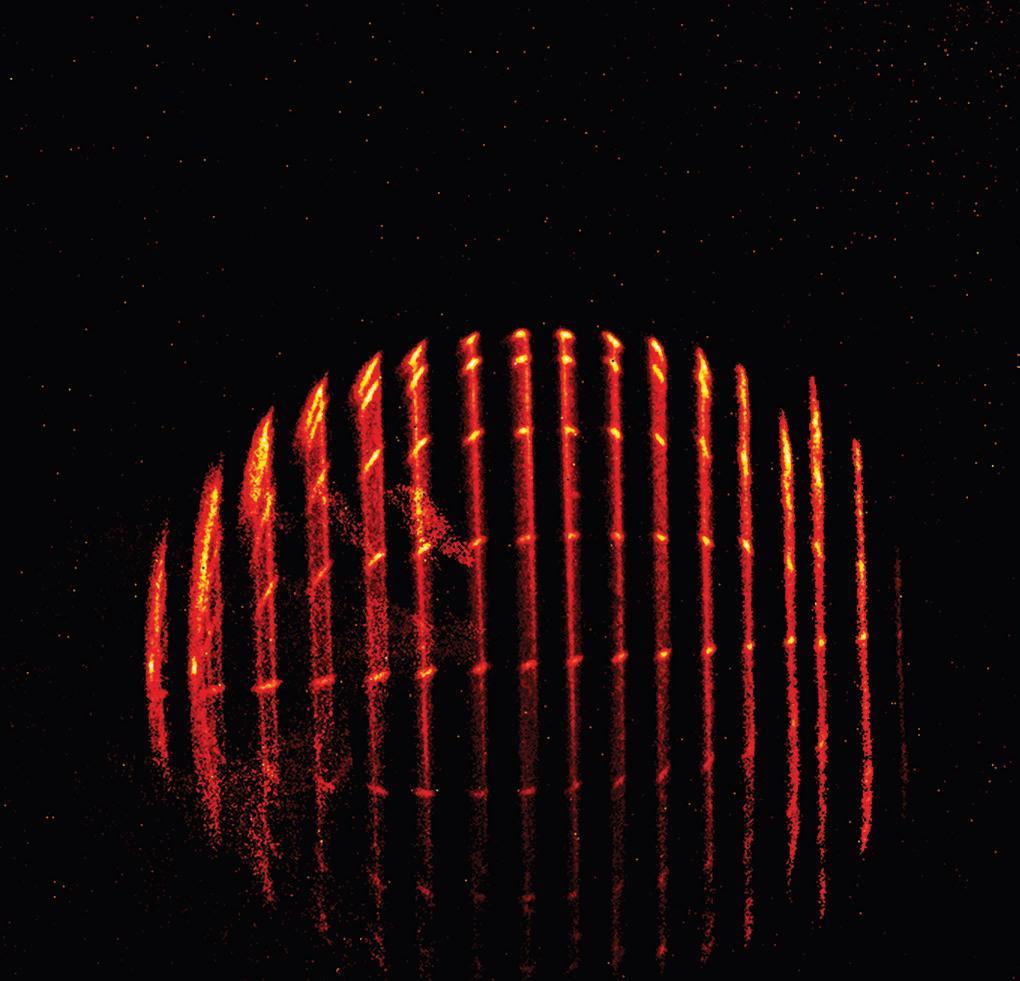
IN HIS CLASSIC SCIENCE-FICTION STORY “THE NEW ACCELERATOR,” PUBLISHED in 1901, H. G. Wells describes a drug that speeds up a person's metabolism by a factor of 1,000. For the two protagonists who valiantly test the potion, the world appears strangely slowed down, almost frozen in movement. The story got one of us (Schattschneider) thinking: If we could slow down time, could we see single photons fly through space? Could we observe relativistic phenomena? In particular, could we ever glimpse a strange prediction called the Terrell-Penrose effect?
The Terrell-Penrose effect would make objects moving at nearly the speed of light look oddly rotated. The notion seems to go against another prediction of Einstein’s special theory of relativity known as Lorentz contraction, which holds that as things go faster they will shrink. Although the Terrell-Penrose effect had been tested in thought experiments and simulated on computers, it had never been demonstrated in real life.
The prospect of real-world testing lay dormant until recently, when one of Schattschneider’s colleagues, quantum scientist Philipp Haslinger of the Vienna University of Technology, mentioned to him an experiment called the SEEC project, which aims to visualize the way light moves across surfaces. He shared a video in which a laser pulse seems to move at a speed of meters per second, only about one billionth of the speed of light. There it was again: the idea of slowing down time—Wells’s New Accelerator, this time in the form of not a magic potion but ultrafast photography.

Diese Geschichte stammt aus der March 2026-Ausgabe von Scientific American.
Abonnieren Sie Magzter GOLD, um auf Tausende kuratierter Premium-Geschichten und über 9.000 Zeitschriften und Zeitungen zuzugreifen.
Sie sind bereits Abonnent? Anmelden
WEITERE GESCHICHTEN VON Scientific American
Scientific American
Earthquake Life
Yellowstone quakes spark bursts of microbial growth underground

2 mins
March 2026
Scientific American
Sailing the Sun
By designing vertical panels that move in a gale, two Swedish inventors are unlocking a solar future for the windswept north
9 mins
March 2026
Scientific American
Covered in Bees
Ancient bees burrowed deep into discarded mammal jawbones
2 mins
March 2026
Scientific American
Fire Starters
Ancient humans were making fire 350,000 years earlier than thought
3 mins
March 2026
Scientific American
Relativity Revealed
Physicists have observed a bizarre prediction of special relativity for the first time
8 mins
March 2026

Scientific American
Everything You Wanted to Know about Polyamory (but Were Afraid to Ask
The practice is not a faddish excuse to sleep around, research shows. And it has deep roots in American culture
14 mins
March 2026
Scientific American
Let the Rivers Run
An investigation into the rights of nature
4 mins
March 2026

Scientific American
Hidden Proof
\"Effective zero knowledge\" beats long-standing cryptographic impossibilities
2 mins
March 2026
Scientific American
The Universe's Weirdest Optical Illusions
Sometimes the farther away an object is, the bigger it seems to be
4 mins
March 2026

Scientific American
Living in the COPILOT SOCIETY
The promise and peril of artificial intelligence everywhere
2 mins
March 2026
Listen
Translate
Change font size