Try GOLD - Free
The First Stars
Scientific American
|February 2026
Astronomers hope to soon spot the universe's earliest stellar inhabitants
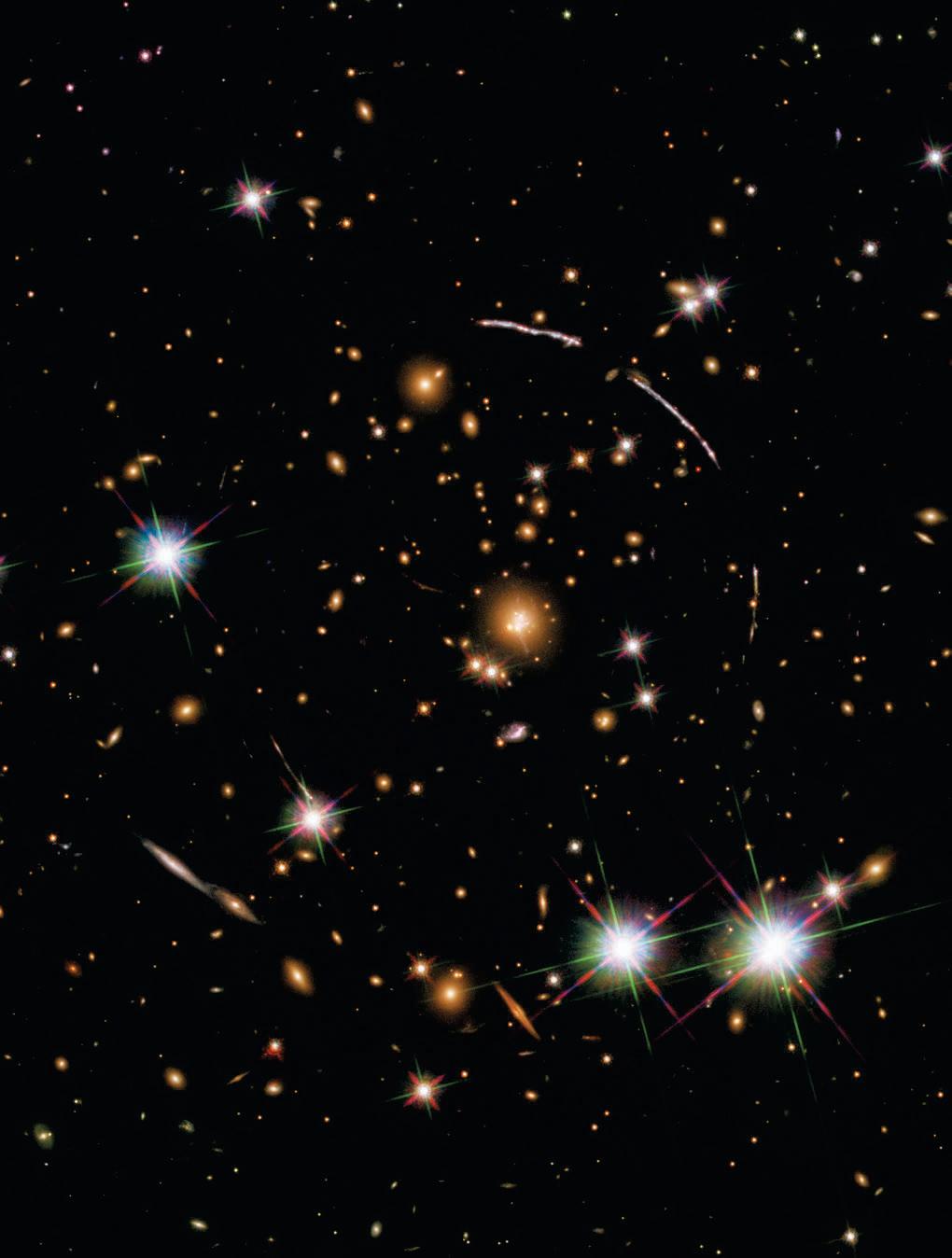
The primordial galaxy known as the Sunburst Arc appears four times in this image from the Hubble Space Telescope. The light from the galaxy, which lies 11 billion light-years away, has been distorted and magnified into curving smudges by the mass of the galaxy cluster in the center of the image. One of the oldest known stars, Godzilla (circled), is visible within this galaxy.
ON CHRISTMAS DAY 2021, alongside other astronomers, I watched the James Webb Space Telescope (JWST) launch from French Guiana and begin its month-long journey to its destination, 1.5 million kilometers from Earth. The trip was filled with many nerve-racking moments, particularly the week-long period in which the telescope's tennis-court-size sun shield array slowly unfolded like origami from its bus-size liftoff configuration.
Luckily, JWST made the trip safely and began operations in the summer of 2022. Since then, the observatory has started answering some of the biggest questions in astronomy. It's also raised many new ones.
One of the biggest surprises that has emerged is the discovery that supermassive black holes, some with masses more than a million times that of the sun, existed when the universe was no more than about 3 percent of its current age. How such massive black holes came to exist so long ago is a puzzle. Perhaps less massive black holes formed from the explosive deaths of the first stars, known as Population III stars, and those black holes later merged under the influence of gravity to form a million-solar-mass black hole.
But how could thousands of these smaller black holes have combined in the cosmically short period of hundreds of millions of years? To figure it out, we need to understand the very first stars, which, to date, no one has ever seen individually.

This story is from the February 2026 edition of Scientific American.
Subscribe to Magzter GOLD to access thousands of curated premium stories, and 10,000+ magazines and newspapers.
Already a subscriber? Sign In
MORE STORIES FROM Scientific American
Scientific American
Let There Be Weapons
The Department of Energy’s new Genesis Mission promises AI-accelerated discovery. Seven of its first 26 challenges focus on nuclear weapons and national security

4 mins
July/August 2026

Scientific American
How to Fix Science
The federal funding system for scientific research in the U.S. needs reform
9 mins
July/August 2026

Scientific American
Robots Can Now Fold Your Laundry
Home-helper tasks are becoming easier for robotic assistants
4 mins
July/August 2026
Scientific American
50, 100 & 150 Years
NATURAL FISSION REACTOR
3 mins
July/August 2026

Scientific American
Anna Ho
Describing the characteristics of short-lived astrophysical events
1 mins
July/August 2026
Scientific American
THE SOLILOQUY OF SCHRÖDINGER'S CAT
A MEDITATION ON LIFE AND THE VON NEUMANN–WIGNER INTERPRETATION OF QUANTUM MECHANICS
1 min
July/August 2026

Scientific American
Mikhail Kolmogorov
Developing software to reveal large genetic changes that lead to cancer
1 mins
July/August 2026

Scientific American
Jaye Gardiner
Learning how the matrix around cells and tissues impacts cancers
1 mins
July/August 2026

Scientific American
Timnit Gebru
On safeguarding independent research in the age of big tech
3 mins
July/August 2026
Scientific American
A Youthful Illusion Sharpens Memory
By making people feel as if their face is a younger version of itself, researchers can bring childhood memories into sharper focus
4 mins
July/August 2026
Listen
Translate
Change font size