
Mit Magzter GOLD unbegrenztes Potenzial nutzen
Erhalten Sie unbegrenzten Zugriff auf über 9.000 Zeitschriften, Zeitungen und Premium-Artikel für nur
Versuchen GOLD - Frei
The First Stars
Scientific American
|February 2026
Astronomers hope to soon spot the universe's earliest stellar inhabitants
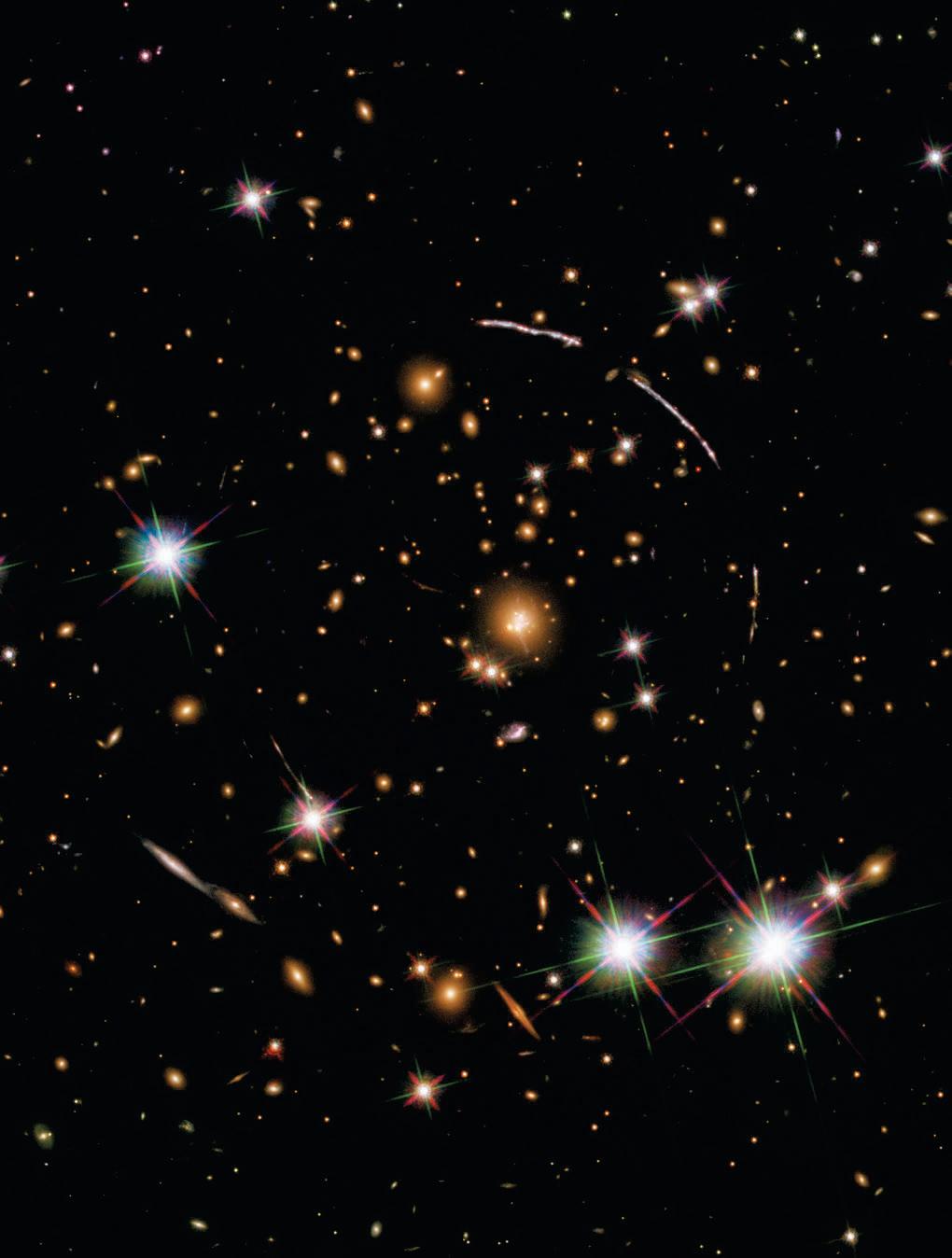
The primordial galaxy known as the Sunburst Arc appears four times in this image from the Hubble Space Telescope. The light from the galaxy, which lies 11 billion light-years away, has been distorted and magnified into curving smudges by the mass of the galaxy cluster in the center of the image. One of the oldest known stars, Godzilla (circled), is visible within this galaxy.
ON CHRISTMAS DAY 2021, alongside other astronomers, I watched the James Webb Space Telescope (JWST) launch from French Guiana and begin its month-long journey to its destination, 1.5 million kilometers from Earth. The trip was filled with many nerve-racking moments, particularly the week-long period in which the telescope's tennis-court-size sun shield array slowly unfolded like origami from its bus-size liftoff configuration.
Luckily, JWST made the trip safely and began operations in the summer of 2022. Since then, the observatory has started answering some of the biggest questions in astronomy. It's also raised many new ones.
One of the biggest surprises that has emerged is the discovery that supermassive black holes, some with masses more than a million times that of the sun, existed when the universe was no more than about 3 percent of its current age. How such massive black holes came to exist so long ago is a puzzle. Perhaps less massive black holes formed from the explosive deaths of the first stars, known as Population III stars, and those black holes later merged under the influence of gravity to form a million-solar-mass black hole.
But how could thousands of these smaller black holes have combined in the cosmically short period of hundreds of millions of years? To figure it out, we need to understand the very first stars, which, to date, no one has ever seen individually.

Diese Geschichte stammt aus der February 2026-Ausgabe von Scientific American.
Abonnieren Sie Magzter GOLD, um auf Tausende kuratierter Premium-Geschichten und über 9.000 Zeitschriften und Zeitungen zuzugreifen.
Sie sind bereits Abonnent? Anmelden
WEITERE GESCHICHTEN VON Scientific American
Scientific American
The Business of Space Weather
A company aims to offer better forecasts based on a new solar model

7 mins
April 2026
Scientific American
Mindless Sleep
Even without brains, sea anemones and jellyfish can sleep like humans do
1 min
April 2026
Scientific American
THE KIDS ARE ALL RIGHT
Young people are doing better than you think
12 mins
April 2026
Scientific American
Something in THE WATER
Pristine alpine lakes are being choked by algal blooms. The culprit is in the air
9 mins
April 2026
Scientific American
A Dose of Prevention
New alert systems and biomarkers are spotting drug- induced kidney damage early, before irreversible harm
6 mins
April 2026

Scientific American
Life on the Edge
Kidney damage can progress for years without symptoms. The newly diagnosed cope with everything from restrictive diets to the emotional and logistical toll of dialysis
9 mins
April 2026
Scientific American
Stopping an Autoimmune Attack
IgA nephropathy, a frequent cause of kidney failure, is underdiagnosed. New treatments mean it's more important now to find those who will benefit
8 mins
April 2026
Scientific American
Mindless Sleep
Even without brains, sea anemones and jellyfish can sleep like humans do
4 mins
April 2026
Scientific American
Microbes Afloat
BACTERIA AND THE VIRUSES that infect them are perpetually at war. Their deadly clashes push both kinds of microbes to evolve new traits that meet the challenges of every environment they inhabit, from the human digestive tract to the seafloor’s hydrothermal vents— and even the harsh conditions of space.
2 mins
April 2026
Scientific American
The Strangest Bloom
Research reveals how the corpse flower came by its peculiar traits
9 mins
April 2026
Listen
Translate
Change font size