
Magzter GOLD ile Sınırsız Olun
Sadece 9.000'den fazla dergi, gazete ve Premium hikayeye sınırsız erişim elde edin
Denemek ALTIN - Özgür
The First Stars
Scientific American
|February 2026
Astronomers hope to soon spot the universe's earliest stellar inhabitants
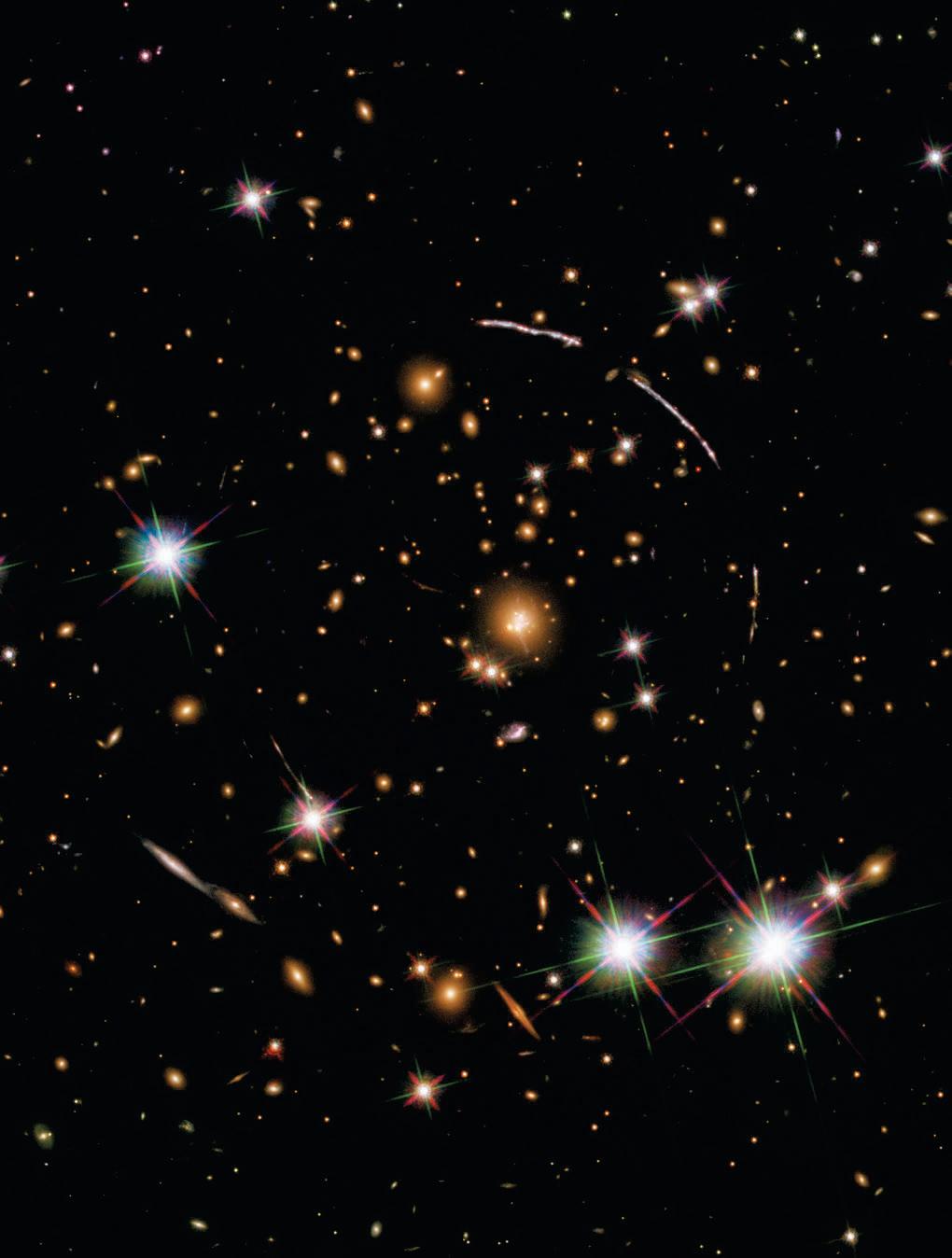
The primordial galaxy known as the Sunburst Arc appears four times in this image from the Hubble Space Telescope. The light from the galaxy, which lies 11 billion light-years away, has been distorted and magnified into curving smudges by the mass of the galaxy cluster in the center of the image. One of the oldest known stars, Godzilla (circled), is visible within this galaxy.
ON CHRISTMAS DAY 2021, alongside other astronomers, I watched the James Webb Space Telescope (JWST) launch from French Guiana and begin its month-long journey to its destination, 1.5 million kilometers from Earth. The trip was filled with many nerve-racking moments, particularly the week-long period in which the telescope's tennis-court-size sun shield array slowly unfolded like origami from its bus-size liftoff configuration.
Luckily, JWST made the trip safely and began operations in the summer of 2022. Since then, the observatory has started answering some of the biggest questions in astronomy. It's also raised many new ones.
One of the biggest surprises that has emerged is the discovery that supermassive black holes, some with masses more than a million times that of the sun, existed when the universe was no more than about 3 percent of its current age. How such massive black holes came to exist so long ago is a puzzle. Perhaps less massive black holes formed from the explosive deaths of the first stars, known as Population III stars, and those black holes later merged under the influence of gravity to form a million-solar-mass black hole.
But how could thousands of these smaller black holes have combined in the cosmically short period of hundreds of millions of years? To figure it out, we need to understand the very first stars, which, to date, no one has ever seen individually.

Bu hikaye Scientific American dergisinin February 2026 baskısından alınmıştır.
Binlerce özenle seçilmiş premium hikayeye ve 9.000'den fazla dergi ve gazeteye erişmek için Magzter GOLD'a abone olun.
Zaten abone misiniz? Oturum aç
Scientific American'den DAHA FAZLA HİKAYE
Scientific American
Earthquake Life
Yellowstone quakes spark bursts of microbial growth underground

2 mins
March 2026
Scientific American
Sailing the Sun
By designing vertical panels that move in a gale, two Swedish inventors are unlocking a solar future for the windswept north
9 mins
March 2026
Scientific American
Covered in Bees
Ancient bees burrowed deep into discarded mammal jawbones
2 mins
March 2026
Scientific American
Fire Starters
Ancient humans were making fire 350,000 years earlier than thought
3 mins
March 2026
Scientific American
Relativity Revealed
Physicists have observed a bizarre prediction of special relativity for the first time
8 mins
March 2026

Scientific American
Everything You Wanted to Know about Polyamory (but Were Afraid to Ask
The practice is not a faddish excuse to sleep around, research shows. And it has deep roots in American culture
14 mins
March 2026

Scientific American
Let the Rivers Run
An investigation into the rights of nature
4 mins
March 2026

Scientific American
Hidden Proof
\"Effective zero knowledge\" beats long-standing cryptographic impossibilities
2 mins
March 2026
Scientific American
The Universe's Weirdest Optical Illusions
Sometimes the farther away an object is, the bigger it seems to be
4 mins
March 2026

Scientific American
Living in the COPILOT SOCIETY
The promise and peril of artificial intelligence everywhere
2 mins
March 2026
Listen
Translate
Change font size