Try GOLD - Free
Nerves Do Regenerate
Scientific American
|September 2025
Neurons, once thought to be irreparable, can grow anew—even in the brain
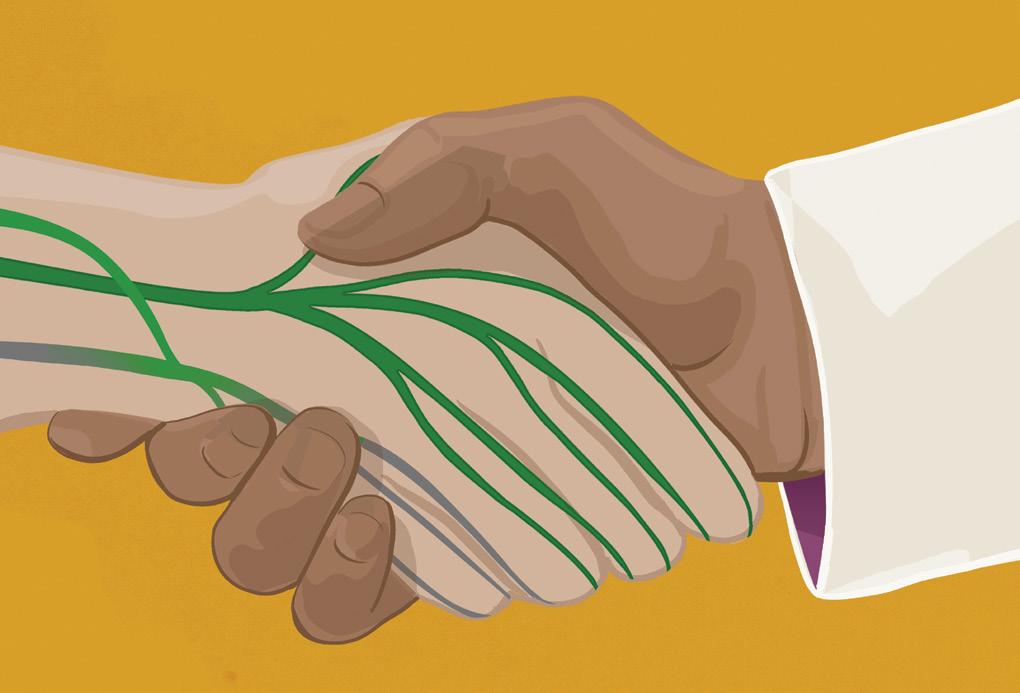
BILLIONS OF NERVE CELLS send signals coursing through our bodies, serving as conduits through which the brain performs its essential functions. For millennia physicians thought damage to nerves was irreversible. In ancient Greece, founders of modern medicine such as Hippocrates and Galen refused to operate on damaged nerves for fear of causing pain, convulsions or even death.
The dogma stood relatively still until the past two centuries, during which surgeons and scientists found evidence that neurons in the body and brain can repair themselves and regenerate after injury and that new nerve cells can grow throughout the lifespan. In recent decades this knowledge has inspired promising treatments for nerve injuries and has led researchers to investigate interventions for neurodegenerative disease.
In humans and other vertebrates, the nervous system is split into two parts: the central nervous system, composed of the spinal cord and brain, and the peripheral nervous system, which connects the brain to the rest of the body.
Attempts to suture together the ends of damaged neurons in the peripheral nervous system date back to the seventh century. It was only in the late 1800s, however, that scientists began to understand how, exactly, nerves regenerate. Through his experiments on frogs, British physiologist Augustus Waller described in detail what happens to a peripheral nerve after injury. Then, in the 1900s, the influential Spanish neuroanatomist Santiago Ramón y Cajal provided insight into how nerve regeneration occurs at the cellular level. Still, there remained fierce debate about whether stitching nerves together would harm more than help.


This story is from the September 2025 edition of Scientific American.
Subscribe to Magzter GOLD to access thousands of curated premium stories, and 10,000+ magazines and newspapers.
Already a subscriber? Sign In
MORE STORIES FROM Scientific American

Scientific American
The Quiet Math Problem That Runs the Planet
How Diffie-Hellman key exchange secures everything from your text messages to government secrets

7 mins
May 2026

Scientific American
The Fog of Science
Did an adversary just invent a world-changing weapon, or are they making it up? DARPA is building an AI to instantly call their bluff
4 mins
May 2026
Scientific American
The Hubble Space Telescope Is Still Awesome
Hubble is going strong despite its decades in space and next-generation successors
4 mins
May 2026

Scientific American
Meet America's Native Bees
Scientists estimate there are about 4,000 species of native bees in the U.S.
5 mins
May 2026

Scientific American
The Chemistry of Desire
Inside the secretive laboratories where scientists build novel molecules to make luxury fragrance feel like pure emotion
5 mins
May 2026

Scientific American
Scanning the Stone
As ore gets harder to find, the mining industry is turning to subatomic-particle sensors to push deep underground
8 mins
May 2026

Scientific American
YOUR HEART IN FLAMES
Inflammation may be the true cause of cardiovascular diseaseand there's a drug to treat it
13 mins
May 2026

Scientific American
Ancient Lexicon
Stone Age art may reveal a 40,000-year-old precursor to writing
2 mins
May 2026

Scientific American
Thermal Breakthrough
A new super heat conductor challenges fundamental physics
2 mins
May 2026
Scientific American
How to Vacation in Space
Planned orbital hotels promise luxury, but can they deliver?
4 mins
May 2026
Listen
Translate
Change font size