Versuchen GOLD - Frei
Nerves Do Regenerate
Scientific American
|September 2025
Neurons, once thought to be irreparable, can grow anew—even in the brain
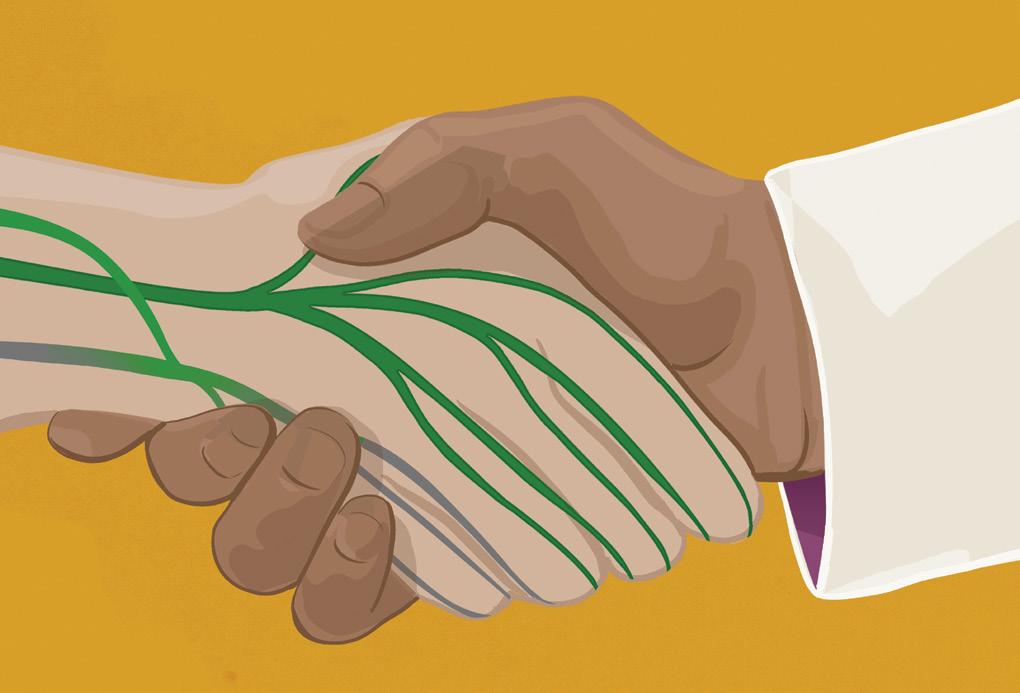
BILLIONS OF NERVE CELLS send signals coursing through our bodies, serving as conduits through which the brain performs its essential functions. For millennia physicians thought damage to nerves was irreversible. In ancient Greece, founders of modern medicine such as Hippocrates and Galen refused to operate on damaged nerves for fear of causing pain, convulsions or even death.
The dogma stood relatively still until the past two centuries, during which surgeons and scientists found evidence that neurons in the body and brain can repair themselves and regenerate after injury and that new nerve cells can grow throughout the lifespan. In recent decades this knowledge has inspired promising treatments for nerve injuries and has led researchers to investigate interventions for neurodegenerative disease.
In humans and other vertebrates, the nervous system is split into two parts: the central nervous system, composed of the spinal cord and brain, and the peripheral nervous system, which connects the brain to the rest of the body.
Attempts to suture together the ends of damaged neurons in the peripheral nervous system date back to the seventh century. It was only in the late 1800s, however, that scientists began to understand how, exactly, nerves regenerate. Through his experiments on frogs, British physiologist Augustus Waller described in detail what happens to a peripheral nerve after injury. Then, in the 1900s, the influential Spanish neuroanatomist Santiago Ramón y Cajal provided insight into how nerve regeneration occurs at the cellular level. Still, there remained fierce debate about whether stitching nerves together would harm more than help.


Diese Geschichte stammt aus der September 2025-Ausgabe von Scientific American.
Abonnieren Sie Magzter GOLD, um auf Tausende kuratierter Premium-Geschichten und über 9.000 Zeitschriften und Zeitungen zuzugreifen.
Sie sind bereits Abonnent? Anmelden
WEITERE GESCHICHTEN VON Scientific American

Scientific American
Earthquake Life
Yellowstone quakes spark bursts of microbial growth underground

2 mins
March 2026

Scientific American
Sailing the Sun
By designing vertical panels that move in a gale, two Swedish inventors are unlocking a solar future for the windswept north
9 mins
March 2026
Scientific American
Covered in Bees
Ancient bees burrowed deep into discarded mammal jawbones
2 mins
March 2026
Scientific American
Fire Starters
Ancient humans were making fire 350,000 years earlier than thought
3 mins
March 2026
Scientific American
Relativity Revealed
Physicists have observed a bizarre prediction of special relativity for the first time
8 mins
March 2026

Scientific American
Everything You Wanted to Know about Polyamory (but Were Afraid to Ask
The practice is not a faddish excuse to sleep around, research shows. And it has deep roots in American culture
14 mins
March 2026

Scientific American
Let the Rivers Run
An investigation into the rights of nature
4 mins
March 2026

Scientific American
Hidden Proof
\"Effective zero knowledge\" beats long-standing cryptographic impossibilities
2 mins
March 2026

Scientific American
The Universe's Weirdest Optical Illusions
Sometimes the farther away an object is, the bigger it seems to be
4 mins
March 2026

Scientific American
Living in the COPILOT SOCIETY
The promise and peril of artificial intelligence everywhere
2 mins
March 2026
Listen
Translate
Change font size