कोशिश गोल्ड - मुक्त
Nerves Do Regenerate
Scientific American
|September 2025
Neurons, once thought to be irreparable, can grow anew—even in the brain
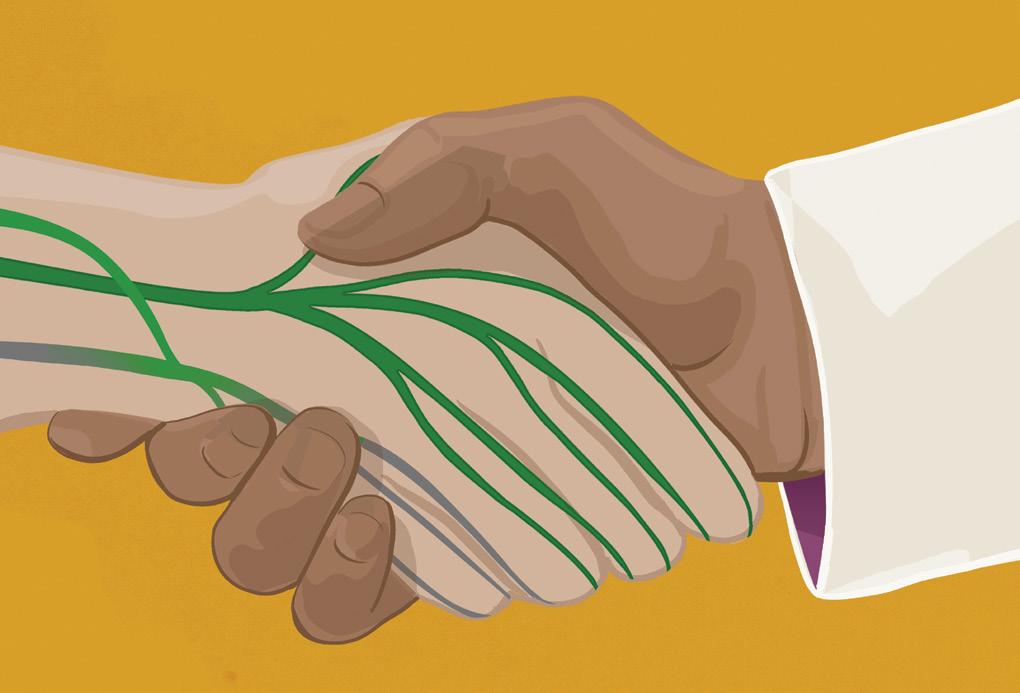
BILLIONS OF NERVE CELLS send signals coursing through our bodies, serving as conduits through which the brain performs its essential functions. For millennia physicians thought damage to nerves was irreversible. In ancient Greece, founders of modern medicine such as Hippocrates and Galen refused to operate on damaged nerves for fear of causing pain, convulsions or even death.
The dogma stood relatively still until the past two centuries, during which surgeons and scientists found evidence that neurons in the body and brain can repair themselves and regenerate after injury and that new nerve cells can grow throughout the lifespan. In recent decades this knowledge has inspired promising treatments for nerve injuries and has led researchers to investigate interventions for neurodegenerative disease.
In humans and other vertebrates, the nervous system is split into two parts: the central nervous system, composed of the spinal cord and brain, and the peripheral nervous system, which connects the brain to the rest of the body.
Attempts to suture together the ends of damaged neurons in the peripheral nervous system date back to the seventh century. It was only in the late 1800s, however, that scientists began to understand how, exactly, nerves regenerate. Through his experiments on frogs, British physiologist Augustus Waller described in detail what happens to a peripheral nerve after injury. Then, in the 1900s, the influential Spanish neuroanatomist Santiago Ramón y Cajal provided insight into how nerve regeneration occurs at the cellular level. Still, there remained fierce debate about whether stitching nerves together would harm more than help.


यह कहानी Scientific American के September 2025 संस्करण से ली गई है।
हजारों चुनिंदा प्रीमियम कहानियों और 10,000 से अधिक पत्रिकाओं और समाचार पत्रों तक पहुंचने के लिए मैगज़्टर गोल्ड की सदस्यता लें।
क्या आप पहले से ही ग्राहक हैं? साइन इन करें
Scientific American से और कहानियाँ

Scientific American
War in Plain Sight
Near-real-time satellite coverage means militaries can no longer hide. So they are learning to lie better

4 mins
June 2026

Scientific American
A Bridge-Crossing Puzzle Led to New Math
Are you smarter than an 18th-century Prussian?
5 mins
June 2026
Scientific American
Nocturnal Navigation
These ants use a sophisticated lunar compass
2 mins
June 2026
Scientific American
Early Plates
Scientists found the oldest direct evidence for Earth’s tectonic motion
3 mins
June 2026

Scientific American
Mating Arm
Reproduction in octopuses is even weirder than you think
3 mins
June 2026

Scientific American
Battleship Science
Game-playing AI can show us how to do science better
2 mins
June 2026

Scientific American
WHAT’S A QUANTUM COMPUTER GOOD FOR, ANYWAY?
Quantum computing promises profound power in cryptography, materials design, telecommunications, and much more. But those dreams won’t become reality overnight—if ever
11 mins
June 2026

Scientific American
Atomic Snowflakes
Could each atom in the universe be unique?
2 mins
June 2026

Scientific American
The New Moon Race
The triumphant Artemis II mission marks a new era of lunar exploration and science. Here’s how it went down and what comes next
7 mins
June 2026

Scientific American
What’s Wrong with Quantum Mechanics
A 100-year-old theory might explain the confusion
6 mins
June 2026
Listen
Translate
Change font size