Try GOLD - Free
Meet America's Native Bees
Scientific American
|May 2026
Scientists estimate there are about 4,000 species of native bees in the U.S.
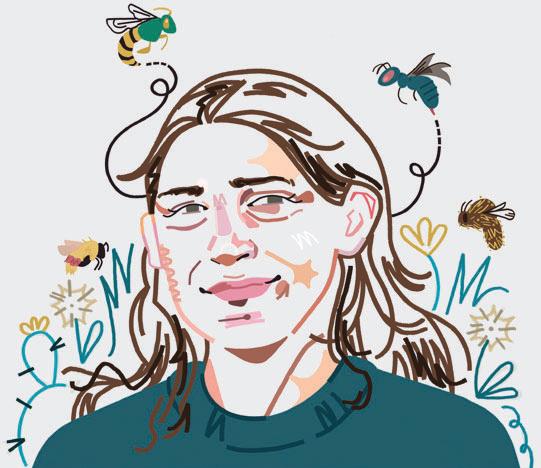
SPRING HAS ARRIVED IN THE U.S., bringing its bright spectacle of budding trees and migrating birds, along with more subtle but equally important changes— among them the annual emergence of native bees.
But “native bees” doesn’t include the insect most of us picture when we hear the word “bee.” That yellow-and-black-striped, hive-living, honey-making critter—formally Apis mellifera—hails from Europe. Farmers rely on these tiny imports as, essentially, livestock animals that pollinate food crops and produce honey. But their wild, native counterparts are something completely different.
To celebrate spring, SCIENTIFIC AMERICAN spoke with Shumar about North American native bee species’ variety, differences from honeybees and importance in their ecosystem.
An edited transcript of the interview follows.
Do I have it right that there are more than 4,000 native bee species in the U.S.? How is that number so big?
The reason there are so many native bees is that you have all these different little things evolving to pollinate particular groups or species of plants. So they all have very different characteristics. When you look at pictures of our native bees, they look totally different than a honeybee, and you have huge ranges of color, size, how they collect pollen and how they nest.
What are they like, and how do they live?
There are no native bees in North America that live in a hive or produce honey. Most of them live in very small family units; you could think of it more like an apartment where you might have families aggregating together.


This story is from the May 2026 edition of Scientific American.
Subscribe to Magzter GOLD to access thousands of curated premium stories, and 10,000+ magazines and newspapers.
Already a subscriber? Sign In
MORE STORIES FROM Scientific American

Scientific American
Let There Be Weapons
The Department of Energy’s new Genesis Mission promises AI-accelerated discovery. Seven of its first 26 challenges focus on nuclear weapons and national security

4 mins
July/August 2026

Scientific American
How to Fix Science
The federal funding system for scientific research in the U.S. needs reform
9 mins
July/August 2026

Scientific American
Robots Can Now Fold Your Laundry
Home-helper tasks are becoming easier for robotic assistants
4 mins
July/August 2026

Scientific American
50, 100 & 150 Years
NATURAL FISSION REACTOR
3 mins
July/August 2026

Scientific American
Anna Ho
Describing the characteristics of short-lived astrophysical events
1 mins
July/August 2026
Scientific American
THE SOLILOQUY OF SCHRÖDINGER'S CAT
A MEDITATION ON LIFE AND THE VON NEUMANN–WIGNER INTERPRETATION OF QUANTUM MECHANICS
1 min
July/August 2026

Scientific American
Mikhail Kolmogorov
Developing software to reveal large genetic changes that lead to cancer
1 mins
July/August 2026

Scientific American
Jaye Gardiner
Learning how the matrix around cells and tissues impacts cancers
1 mins
July/August 2026

Scientific American
Timnit Gebru
On safeguarding independent research in the age of big tech
3 mins
July/August 2026

Scientific American
A Youthful Illusion Sharpens Memory
By making people feel as if their face is a younger version of itself, researchers can bring childhood memories into sharper focus
4 mins
July/August 2026
Listen
Translate
Change font size