Try GOLD - Free
Fast Fashion Needs a Green Makeover
Scientific American
|October 2025
A more circular economy in textiles will look good on everyone
-
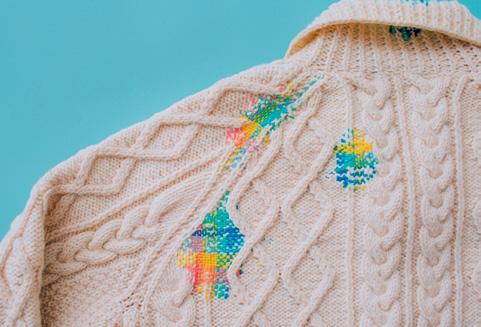
PEOPLE IN THE U.S. throw away at least 17 million tons of textiles every year—about 100 pounds of clothing per person. At the same time, unsold blouses, jackets, and other fashion-industry leftovers end up in dumps such as the one in Chile’s Atacama Desert, so vast as to be visible from space. Many of these items are fast fashion—made quickly, sold cheaply, and in style for too short a time because the industry relies on novelty to keep consumers buying.
Fashion poses more than an aesthetic problem, however. Every year the global garment industry emits up to 10 percent of the world’s greenhouse gas output and uses enough water to fill at least 37 million Olympic-size swimming pools, as an article in this magazine noted this past July. Cotton farming can involve massive quantities of pesticides, and yarn dyeing pollutes waterways with toxic chemicals. Synthetic polymers such as nylon are made with fossil fuels and shed microfibers with every wash.
It’s time to embrace a circular economy in fashion—one that reuses clothes, fabrics and yarn; recycles to the extent possible; and encourages producers and retailers to choose textiles and processes that minimize the input of raw resources such as cotton or synthetic polymers. Our choices as consumers matter as well. How we select fashion and follow trends is one accessible way we can make a dent in climate change.
Almost one third of the clothes produced every season are never sold and may go straight to landfills.

This story is from the October 2025 edition of Scientific American.
Subscribe to Magzter GOLD to access thousands of curated premium stories, and 10,000+ magazines and newspapers.
Already a subscriber? Sign In
MORE STORIES FROM Scientific American
Scientific American
Let There Be Weapons
The Department of Energy’s new Genesis Mission promises AI-accelerated discovery. Seven of its first 26 challenges focus on nuclear weapons and national security

4 mins
July/August 2026

Scientific American
How to Fix Science
The federal funding system for scientific research in the U.S. needs reform
9 mins
July/August 2026

Scientific American
Robots Can Now Fold Your Laundry
Home-helper tasks are becoming easier for robotic assistants
4 mins
July/August 2026

Scientific American
50, 100 & 150 Years
NATURAL FISSION REACTOR
3 mins
July/August 2026

Scientific American
Anna Ho
Describing the characteristics of short-lived astrophysical events
1 mins
July/August 2026

Scientific American
THE SOLILOQUY OF SCHRÖDINGER'S CAT
A MEDITATION ON LIFE AND THE VON NEUMANN–WIGNER INTERPRETATION OF QUANTUM MECHANICS
1 min
July/August 2026

Scientific American
Mikhail Kolmogorov
Developing software to reveal large genetic changes that lead to cancer
1 mins
July/August 2026

Scientific American
Jaye Gardiner
Learning how the matrix around cells and tissues impacts cancers
1 mins
July/August 2026

Scientific American
Timnit Gebru
On safeguarding independent research in the age of big tech
3 mins
July/August 2026

Scientific American
A Youthful Illusion Sharpens Memory
By making people feel as if their face is a younger version of itself, researchers can bring childhood memories into sharper focus
4 mins
July/August 2026
Listen
Translate
Change font size