
Gå ubegrenset med Magzter GOLD
Få ubegrenset tilgang til over 9000 magasiner, aviser og premiumhistorier for bare
Risky Genes
Scientific American
|November 2025
As genetic risk scores get integrated into clinical care, experts expect patients to gain earlier access to therapies and enjoy better outcomes
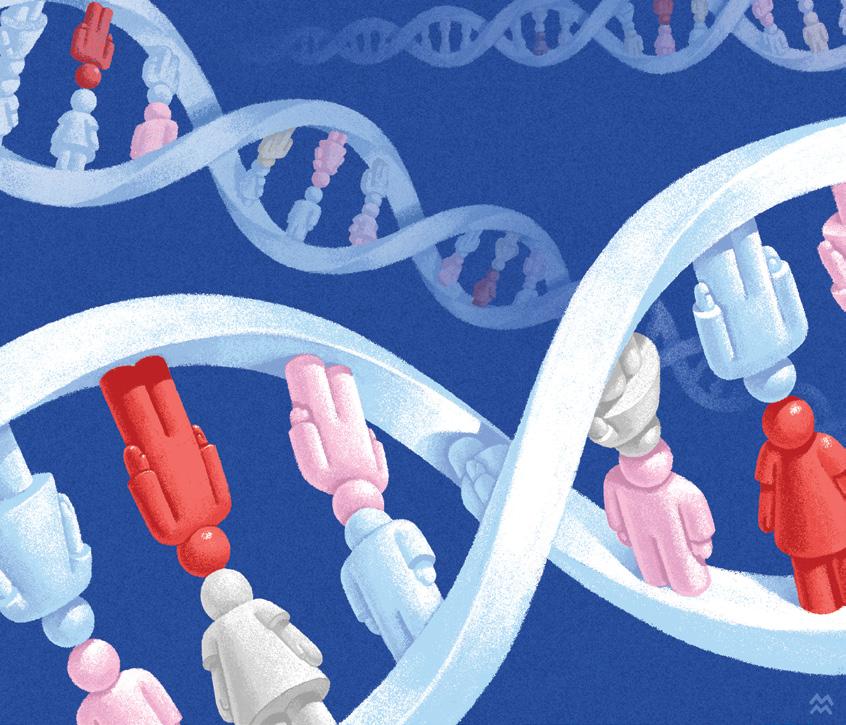
IN 2024 STEPHEN RICH and his colleagues published a study in which they assessed the genetic risk of developing type 1 diabetes for more than 3,800 children from across Virginia. Almost immediately Rich, a genetic epidemiologist at the University of Virginia, was inundated by emails and calls from parents who had read the article and wanted their kids tested, too. Unfortunately the study was over, so Rich couldn't help them. But the experience exemplified the growing interest in genetic risk tests for the disease, he says.
There is currently no cure for type 1 diabetes, a chronic condition in which the body's immune system attacks and kills insulin-producing beta cells in the pancreas. Knowing someone's genetic predisposition to type 1 diabetes, however, can help doctors identify whom to flag for followup tests. It can also lead to earlier adoption of therapeutics to manage the disease or delay its onset. "There's tremendous power in terms of understanding the genetics of type 1 diabetes," says Todd Brusko, director of the Diabetes Institute at the University of Florida. As more therapies become available, he adds, the eventual hope is to use genetic profiling to determine who will respond best to one drug versus another.
Recent advances in genetic screening tools have not only revealed an intricate interaction between a person's genes and their immune system but also made it possible to imagine a future in which every newborn is screened for type 1 diabetes risk. Some healthcare authorities are already beginning to consider universal screening. “It’s very exciting times,” says Maria Jose Redondo, a physician and professor of pediatric diabetes and endocrinology at the Baylor College of Medicine. “A lot of progress has been made, and now we're at the point of applying it.”

Denne historien er fra November 2025-utgaven av Scientific American.
Abonner på Magzter GOLD for å få tilgang til tusenvis av kuraterte premiumhistorier og over 9000 magasiner og aviser.
Allerede abonnent? Logg på
FLERE HISTORIER FRA Scientific American

Scientific American
Probiotic Hope and Hype
Despite their popularity, supplements with billions of \"good\" microbes help only a few illnesses, research shows

3 mins
January 2026

Scientific American
Mondays Really Are More Stressful
The start of the workweek can be a biologically measurable stressor, with consequences for long-term health that can stretch into retirement
4 mins
January 2026
Scientific American
Tiny Display
An e-paper breakthrough brings extremely high-resolution color
2 mins
January 2026
Scientific American
Fine-Feathered Snack
A bat's tracker documents a dramatic midair hunt
2 mins
January 2026

Scientific American
OUR ROBOTIC PICTURE
Will mechanical helpers ever be commonplace at home, at work and beyond?
11 mins
January 2026

Scientific American
"Use Your Words" Can Be Good for Kids' Health
Writing or expressing feelings can help adults mentally and physically. Kids are no different
5 mins
January 2026

Scientific American
Distant Diplomacy
Unrelated species “talk” and understand one another to avoid threats
2 mins
January 2026
Scientific American
Behind the Nobel
A 2025 winner reflects on the mysterious T cells that won him the prize
5 mins
January 2026

Scientific American
A Suite of Killers
Heart ailments, kidney diseases and type 2 diabetes actually may be part of just one condition. It's called CKM syndrome
10 mins
January 2026
Scientific American
Static Launch
Tiny worms leap toward their fruit fly hosts with an electric “tractor beam”
3 mins
January 2026
Listen
Translate
Change font size