Prøve GULL - Gratis
A Suite of Killers
Scientific American
|January 2026
Heart ailments, kidney diseases and type 2 diabetes actually may be part of just one condition. It's called CKM syndrome

AMY BIES WAS RECOVERING in the hospital from injuries inflicted during a car accident in May 2007 when routine laboratory tests showed that her blood glucose and cholesterol were both dangerously high.
Doctors ultimately sent her home with prescriptions for two standard drugs, metformin for what turned out to be type 2 diabetes and a statin to control her cholesterol levels and the heart disease risk they posed.
The combo, however, didn't prevent a heart attack in 2013. And by 2019 she was on 12 different prescriptions to manage her continued high cholesterol and her diabetes and to reduce her heart risk. The resulting cocktail left her feeling so terrible that she considered going on medical leave from work. "I couldn't even get through my day. I was so nauseated," she said. "I would come out to my car in my lunch hour and pray that I could just not do this anymore."
Medical researchers now think Bies's conditions were not unfortunate co-occurrences. Rather they stem from the same biological mechanisms. The medical problem frequently begins in fat cells and ends in a dangerous cycle that damages seemingly unrelated organs and body systems: the heart and blood vessels, the kidneys, and insulin regulation and the pancreas. Harm to one organ creates ailments that assault the other two, prompting further illnesses that circle back to damage the original body part.
Diseases of these three organs and systems are "tremendously interrelated," says Chiadi Ndumele, a preventive cardiologist at Johns Hopkins University. The ties are so strong that in 2023 the American Heart Association grouped the conditions under one name: cardio-kidney-metabolic syndrome (CKM), with “metabolic syndrome” referring to diabetes and obesity.
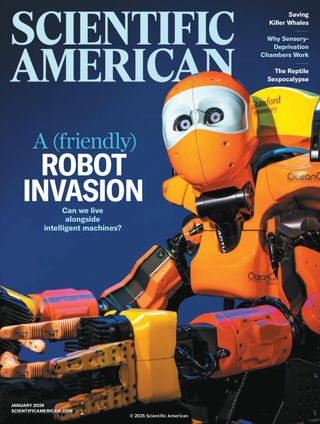

Denne historien er fra January 2026-utgaven av Scientific American.
Abonner på Magzter GOLD for å få tilgang til tusenvis av kuraterte premiumhistorier og over 9000 magasiner og aviser.
Allerede abonnent? Logg på
FLERE HISTORIER FRA Scientific American

Scientific American
Probiotic Hope and Hype
Despite their popularity, supplements with billions of \"good\" microbes help only a few illnesses, research shows

3 mins
January 2026

Scientific American
Mondays Really Are More Stressful
The start of the workweek can be a biologically measurable stressor, with consequences for long-term health that can stretch into retirement
4 mins
January 2026
Scientific American
Tiny Display
An e-paper breakthrough brings extremely high-resolution color
2 mins
January 2026
Scientific American
Fine-Feathered Snack
A bat's tracker documents a dramatic midair hunt
2 mins
January 2026

Scientific American
OUR ROBOTIC PICTURE
Will mechanical helpers ever be commonplace at home, at work and beyond?
11 mins
January 2026

Scientific American
"Use Your Words" Can Be Good for Kids' Health
Writing or expressing feelings can help adults mentally and physically. Kids are no different
5 mins
January 2026

Scientific American
Distant Diplomacy
Unrelated species “talk” and understand one another to avoid threats
2 mins
January 2026

Scientific American
Behind the Nobel
A 2025 winner reflects on the mysterious T cells that won him the prize
5 mins
January 2026

Scientific American
A Suite of Killers
Heart ailments, kidney diseases and type 2 diabetes actually may be part of just one condition. It's called CKM syndrome
10 mins
January 2026

Scientific American
Static Launch
Tiny worms leap toward their fruit fly hosts with an electric “tractor beam”
3 mins
January 2026
Listen
Translate
Change font size