Prøve GULL - Gratis
OUR ROBOTIC PICTURE
Scientific American
|January 2026
Will mechanical helpers ever be commonplace at home, at work and beyond?
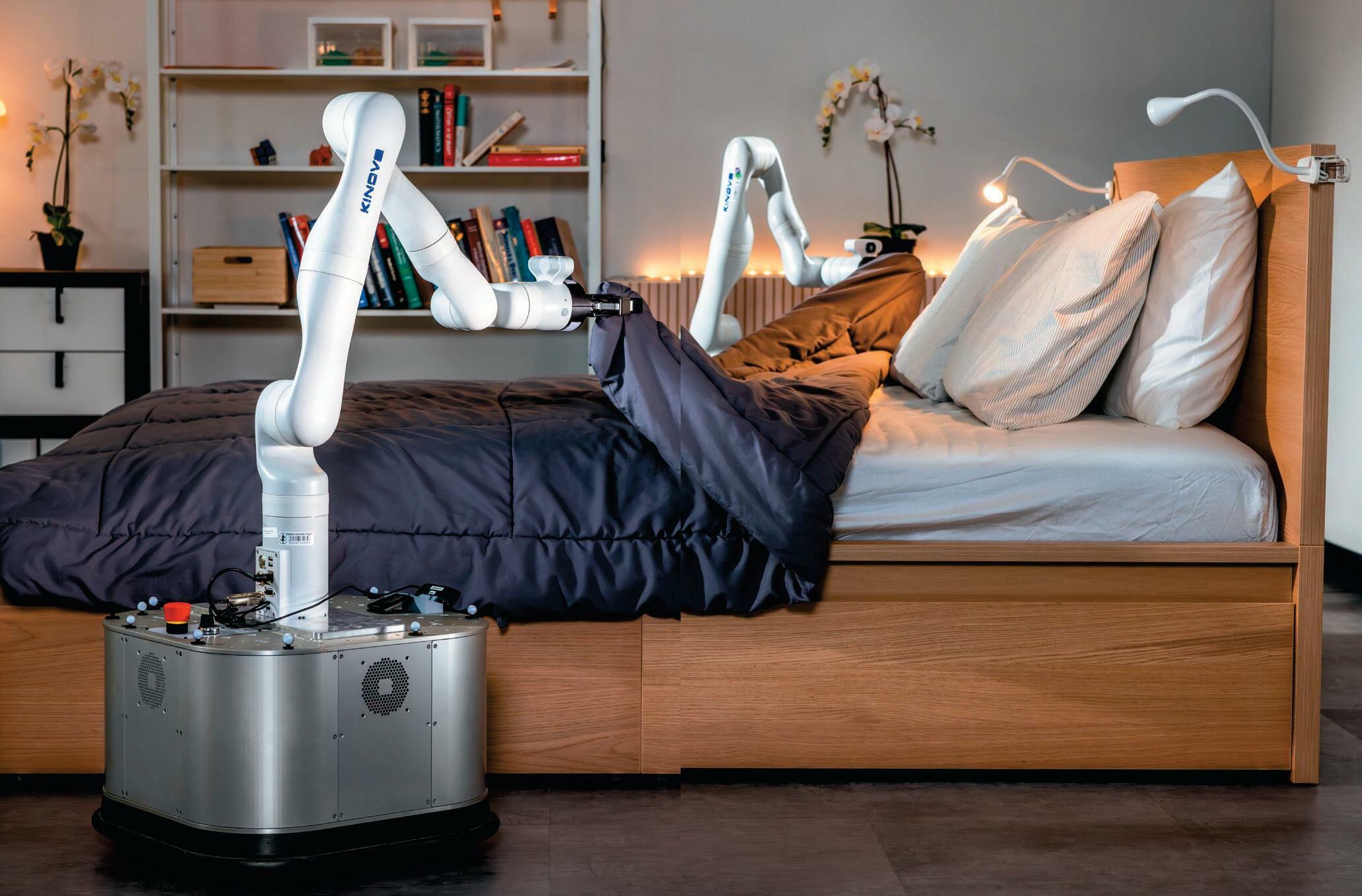
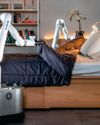
Bed making is one household task that could eventually be outsourced to robots such as TidyBot, a project led by Stanford University computer scientist Jeannette Bohg.
IN THE FUTURE, A CAREGIVING MACHINE MIGHT GENTLY LIFT AN ELDERLY PERSON out of bed in the morning and help them get dressed. A cleaning bot could trundle through a child's room, picking up scattered objects, depositing toys on shelves and tucking away dirty laundry. And in a factory, mechanical hands may assemble a next-generation smartphone from its first fragile component to the finishing touch.
These are glimpses of a possible time when humans and robots will live and work side by side. Some of these machines already exist as prototypes, and some are still theoretical. In situations where people experience friction, inconvenience or wasted effort, engineers see opportunity—for robots to perform chores, do tasks we are unable to do or go places where we cannot.
Realizing such a future poses immense difficulties, however, not the least of which is us. Human beings are wild and unpredictable. Robots, beholden as they are to the rules of their programming, do not handle chaos well. Any robot collaborating or even coexisting with humans must be flexible. It must navigate messes and handle sudden changes in the environment. It must operate safely around excitable small children or delicate older people. Its limbs or manipulators must be sturdy, dexterous and attached to a stable body chassis that provides a source of power. And to truly become a part of our daily lives, these mechanical helpers will need to be affordable. All told, it's a steep challenge.
Ben Guarino is a freelance journalist with a soft spot for big ideas and tiny critters. He was formerly an associate technology editor at Scientific American.
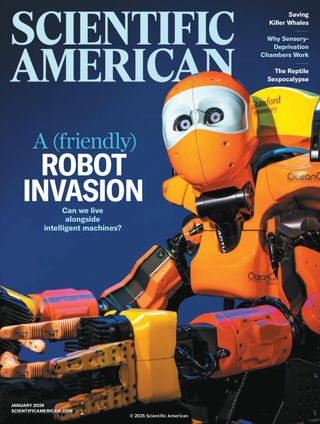

Denne historien er fra January 2026-utgaven av Scientific American.
Abonner på Magzter GOLD for å få tilgang til tusenvis av kuraterte premiumhistorier og over 9000 magasiner og aviser.
Allerede abonnent? Logg på
FLERE HISTORIER FRA Scientific American

Scientific American
Probiotic Hope and Hype
Despite their popularity, supplements with billions of \"good\" microbes help only a few illnesses, research shows

3 mins
January 2026
Scientific American
Mondays Really Are More Stressful
The start of the workweek can be a biologically measurable stressor, with consequences for long-term health that can stretch into retirement
4 mins
January 2026
Scientific American
Tiny Display
An e-paper breakthrough brings extremely high-resolution color
2 mins
January 2026
Scientific American
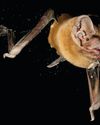
Fine-Feathered Snack
A bat's tracker documents a dramatic midair hunt
2 mins
January 2026
Scientific American
OUR ROBOTIC PICTURE
Will mechanical helpers ever be commonplace at home, at work and beyond?
11 mins
January 2026

Scientific American
"Use Your Words" Can Be Good for Kids' Health
Writing or expressing feelings can help adults mentally and physically. Kids are no different
5 mins
January 2026

Scientific American
Distant Diplomacy
Unrelated species “talk” and understand one another to avoid threats
2 mins
January 2026
Scientific American
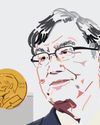
Behind the Nobel
A 2025 winner reflects on the mysterious T cells that won him the prize
5 mins
January 2026

Scientific American
A Suite of Killers
Heart ailments, kidney diseases and type 2 diabetes actually may be part of just one condition. It's called CKM syndrome
10 mins
January 2026
Scientific American
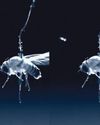
Static Launch
Tiny worms leap toward their fruit fly hosts with an electric “tractor beam”
3 mins
January 2026
Listen
Translate
Change font size