Versuchen GOLD - Frei
Risky Genes
Scientific American
|November 2025
As genetic risk scores get integrated into clinical care, experts expect patients to gain earlier access to therapies and enjoy better outcomes
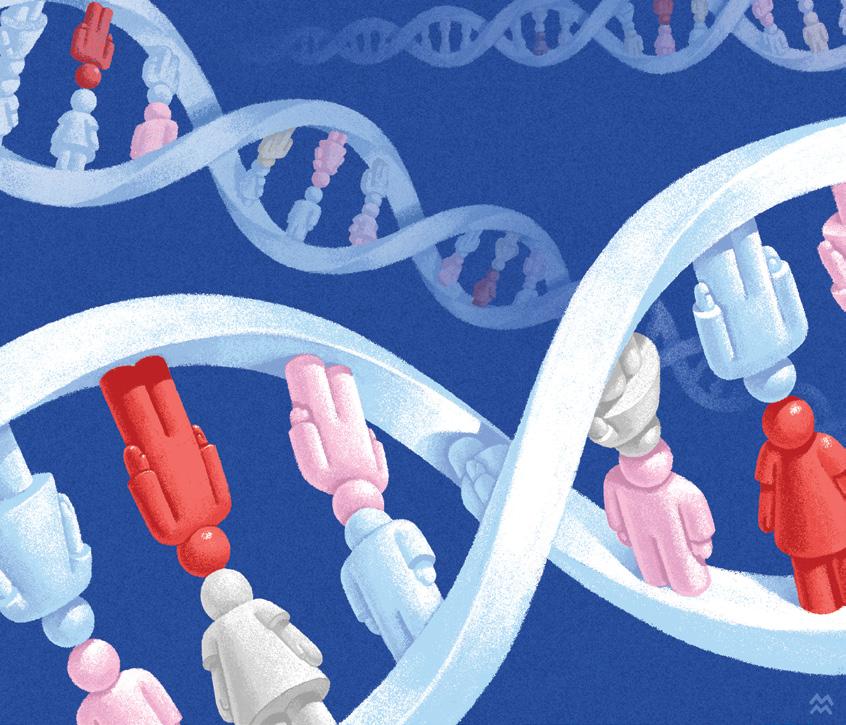
IN 2024 STEPHEN RICH and his colleagues published a study in which they assessed the genetic risk of developing type 1 diabetes for more than 3,800 children from across Virginia. Almost immediately Rich, a genetic epidemiologist at the University of Virginia, was inundated by emails and calls from parents who had read the article and wanted their kids tested, too. Unfortunately the study was over, so Rich couldn't help them. But the experience exemplified the growing interest in genetic risk tests for the disease, he says.
There is currently no cure for type 1 diabetes, a chronic condition in which the body's immune system attacks and kills insulin-producing beta cells in the pancreas. Knowing someone's genetic predisposition to type 1 diabetes, however, can help doctors identify whom to flag for followup tests. It can also lead to earlier adoption of therapeutics to manage the disease or delay its onset. "There's tremendous power in terms of understanding the genetics of type 1 diabetes," says Todd Brusko, director of the Diabetes Institute at the University of Florida. As more therapies become available, he adds, the eventual hope is to use genetic profiling to determine who will respond best to one drug versus another.
Recent advances in genetic screening tools have not only revealed an intricate interaction between a person's genes and their immune system but also made it possible to imagine a future in which every newborn is screened for type 1 diabetes risk. Some healthcare authorities are already beginning to consider universal screening. “It’s very exciting times,” says Maria Jose Redondo, a physician and professor of pediatric diabetes and endocrinology at the Baylor College of Medicine. “A lot of progress has been made, and now we're at the point of applying it.”

Diese Geschichte stammt aus der November 2025-Ausgabe von Scientific American.
Abonnieren Sie Magzter GOLD, um auf Tausende kuratierter Premium-Geschichten und über 9.000 Zeitschriften und Zeitungen zuzugreifen.
Sie sind bereits Abonnent? Anmelden
WEITERE GESCHICHTEN VON Scientific American

Scientific American
Earthquake Life
Yellowstone quakes spark bursts of microbial growth underground

2 mins
March 2026

Scientific American
Sailing the Sun
By designing vertical panels that move in a gale, two Swedish inventors are unlocking a solar future for the windswept north
9 mins
March 2026
Scientific American
Covered in Bees
Ancient bees burrowed deep into discarded mammal jawbones
2 mins
March 2026
Scientific American
Fire Starters
Ancient humans were making fire 350,000 years earlier than thought
3 mins
March 2026
Scientific American
Relativity Revealed
Physicists have observed a bizarre prediction of special relativity for the first time
8 mins
March 2026

Scientific American
Everything You Wanted to Know about Polyamory (but Were Afraid to Ask
The practice is not a faddish excuse to sleep around, research shows. And it has deep roots in American culture
14 mins
March 2026

Scientific American
Let the Rivers Run
An investigation into the rights of nature
4 mins
March 2026

Scientific American
Hidden Proof
\"Effective zero knowledge\" beats long-standing cryptographic impossibilities
2 mins
March 2026

Scientific American
The Universe's Weirdest Optical Illusions
Sometimes the farther away an object is, the bigger it seems to be
4 mins
March 2026

Scientific American
Living in the COPILOT SOCIETY
The promise and peril of artificial intelligence everywhere
2 mins
March 2026
Listen
Translate
Change font size