Prøve GULL - Gratis
Huntington's Hopes
Scientific American
|January 2026
After years of heartbreak, a new treatment slows this devastating disease
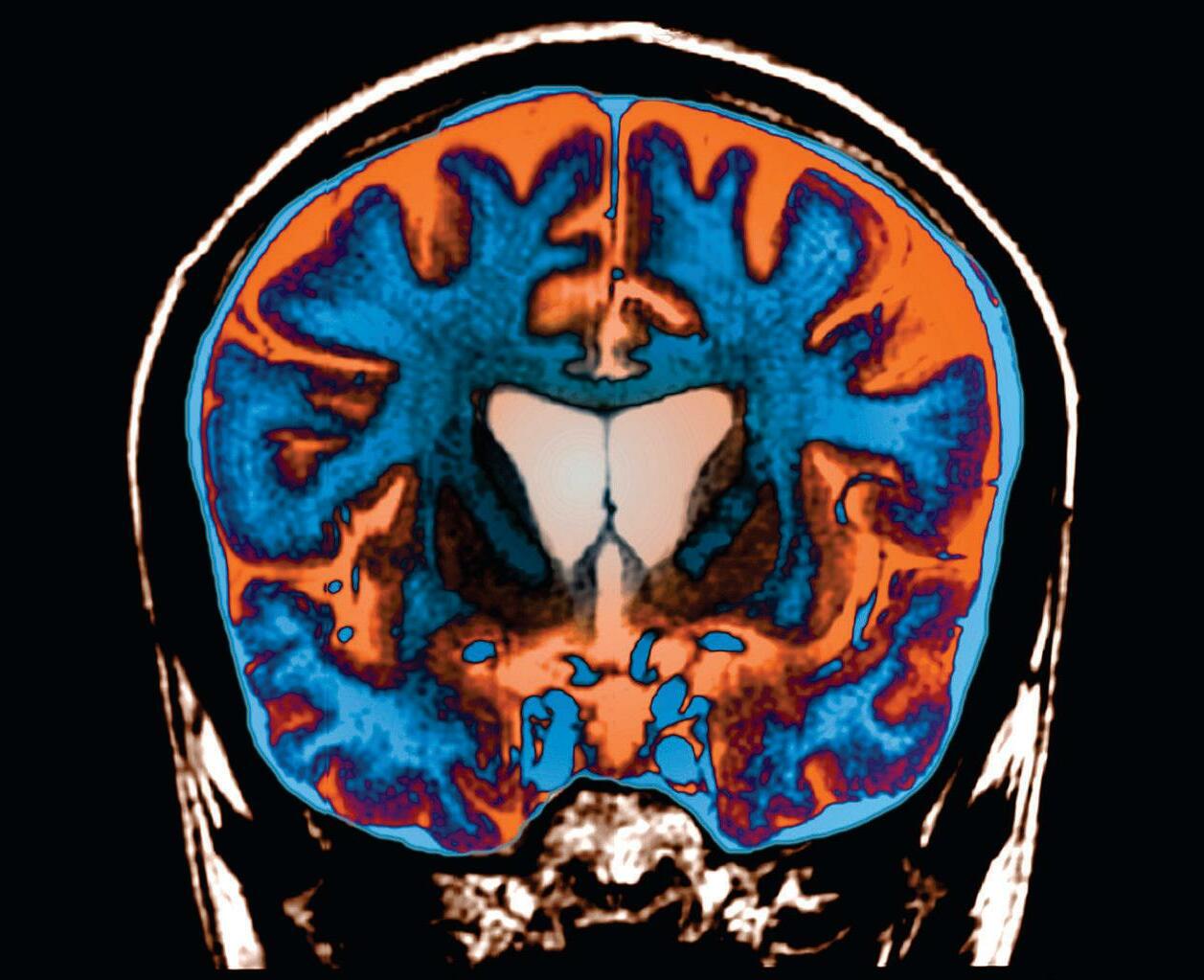
This MRI shows Huntington's signature brain atrophy, which a new treatment may slow.
EVERY WEEK neurologist Victor Sung sees people with Huntington's disease, a rare and deadly neurodegenerative disorder, at his clinic at the University of Alabama at Birmingham. But a Wednesday last September was a day unlike any other. "I cried with every single patient," Sung says. The results of crucial phase 1/2 clinical trials had finally been released: an experimental gene therapy drug was the first treatment that appeared to slow the progression of Huntington's.
The treatment, known as AMT-130, is delivered deep into the brain during a surgery that lasts more than eight hours. The trials were small, with the three-year follow-up results including just 24 participants who received either a high or a low dose of treatment.
These results showed that a high dose reduced the rate of disease progression by 75 percent compared with rates in an external control group, according to the new therapy's developer, uniQure, which posted the results ahead of their review by the Food and Drug Administration. The company hopes to receive accelerated approval from the FDA, which, according to a uniQure spokesperson, could allow the drug to be approved by the end of 2026 without the need for phase 3 trials.
Sung's patients probably won't receive the drug anytime soon. But this early success has given the Huntington's community measured hope after years of disappointments. "We've had so many failures," Sung says, "and there's been a lot of heartbreak over many years in this community." Other researchers also praised the development. "This news has really buoyed everyone's expectations of what might be possible," says Rachel Harding, a toxicologist at the University of Toronto. Harding, who wasn't involved in the trials, researches the underlying cause of Huntington's.

Denne historien er fra January 2026-utgaven av Scientific American.
Abonner på Magzter GOLD for å få tilgang til tusenvis av kuraterte premiumhistorier og over 9000 magasiner og aviser.
Allerede abonnent? Logg på
FLERE HISTORIER FRA Scientific American

Scientific American
Probiotic Hope and Hype
Despite their popularity, supplements with billions of \"good\" microbes help only a few illnesses, research shows

3 mins
January 2026

Scientific American
Mondays Really Are More Stressful
The start of the workweek can be a biologically measurable stressor, with consequences for long-term health that can stretch into retirement
4 mins
January 2026
Scientific American
Tiny Display
An e-paper breakthrough brings extremely high-resolution color
2 mins
January 2026
Scientific American
Fine-Feathered Snack
A bat's tracker documents a dramatic midair hunt
2 mins
January 2026

Scientific American
OUR ROBOTIC PICTURE
Will mechanical helpers ever be commonplace at home, at work and beyond?
11 mins
January 2026

Scientific American
"Use Your Words" Can Be Good for Kids' Health
Writing or expressing feelings can help adults mentally and physically. Kids are no different
5 mins
January 2026

Scientific American
Distant Diplomacy
Unrelated species “talk” and understand one another to avoid threats
2 mins
January 2026
Scientific American
Behind the Nobel
A 2025 winner reflects on the mysterious T cells that won him the prize
5 mins
January 2026

Scientific American
A Suite of Killers
Heart ailments, kidney diseases and type 2 diabetes actually may be part of just one condition. It's called CKM syndrome
10 mins
January 2026

Scientific American
Static Launch
Tiny worms leap toward their fruit fly hosts with an electric “tractor beam”
3 mins
January 2026
Listen
Translate
Change font size