
Mit Magzter GOLD unbegrenztes Potenzial nutzen
Erhalten Sie unbegrenzten Zugriff auf über 9.000 Zeitschriften, Zeitungen und Premium-Artikel für nur
Versuchen GOLD - Frei
Huntington's Hopes
Scientific American
|January 2026
After years of heartbreak, a new treatment slows this devastating disease
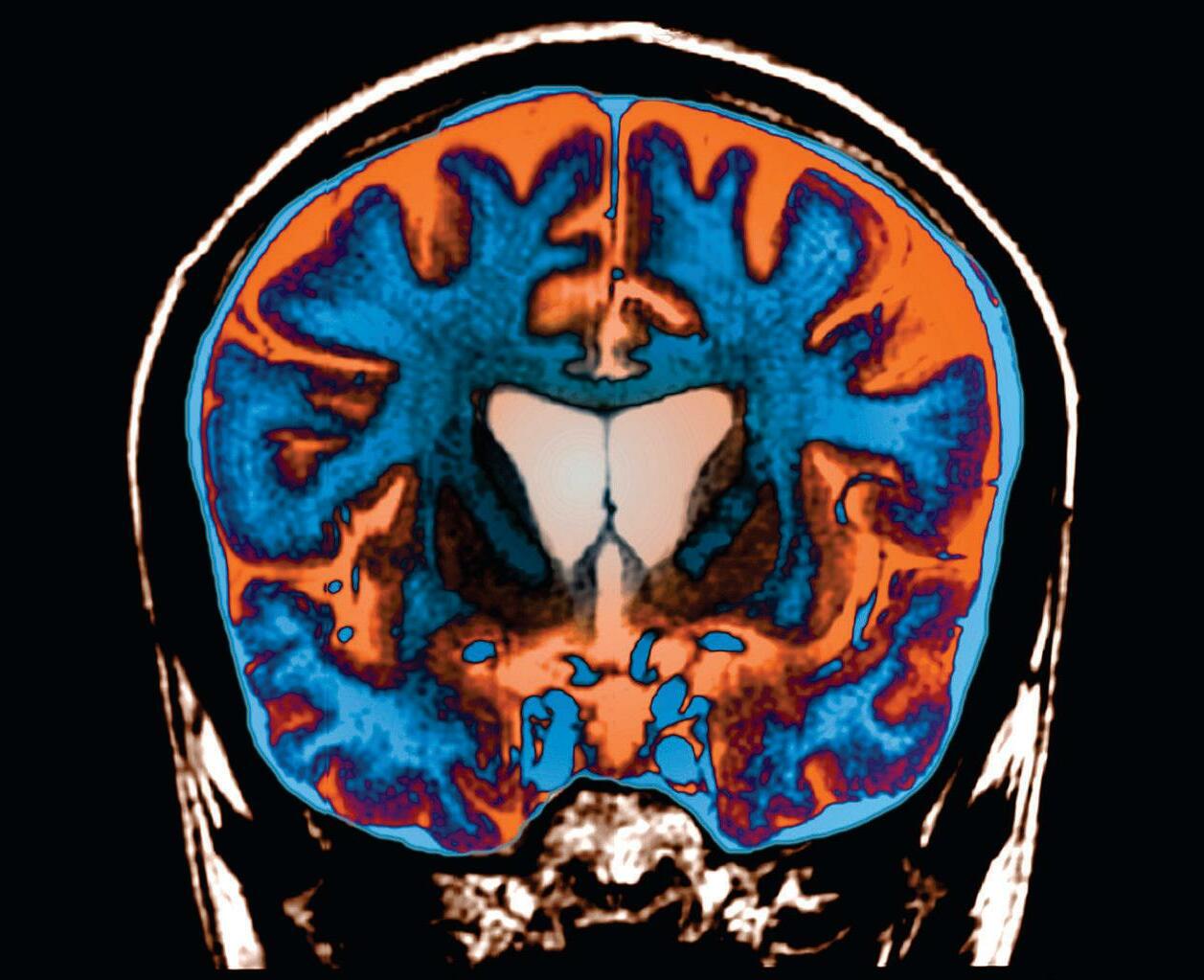
This MRI shows Huntington's signature brain atrophy, which a new treatment may slow.
EVERY WEEK neurologist Victor Sung sees people with Huntington's disease, a rare and deadly neurodegenerative disorder, at his clinic at the University of Alabama at Birmingham. But a Wednesday last September was a day unlike any other. "I cried with every single patient," Sung says. The results of crucial phase 1/2 clinical trials had finally been released: an experimental gene therapy drug was the first treatment that appeared to slow the progression of Huntington's.
The treatment, known as AMT-130, is delivered deep into the brain during a surgery that lasts more than eight hours. The trials were small, with the three-year follow-up results including just 24 participants who received either a high or a low dose of treatment.
These results showed that a high dose reduced the rate of disease progression by 75 percent compared with rates in an external control group, according to the new therapy's developer, uniQure, which posted the results ahead of their review by the Food and Drug Administration. The company hopes to receive accelerated approval from the FDA, which, according to a uniQure spokesperson, could allow the drug to be approved by the end of 2026 without the need for phase 3 trials.
Sung's patients probably won't receive the drug anytime soon. But this early success has given the Huntington's community measured hope after years of disappointments. "We've had so many failures," Sung says, "and there's been a lot of heartbreak over many years in this community." Other researchers also praised the development. "This news has really buoyed everyone's expectations of what might be possible," says Rachel Harding, a toxicologist at the University of Toronto. Harding, who wasn't involved in the trials, researches the underlying cause of Huntington's.

Diese Geschichte stammt aus der January 2026-Ausgabe von Scientific American.
Abonnieren Sie Magzter GOLD, um auf Tausende kuratierter Premium-Geschichten und über 9.000 Zeitschriften und Zeitungen zuzugreifen.
Sie sind bereits Abonnent? Anmelden
WEITERE GESCHICHTEN VON Scientific American

Scientific American
Earthquake Life
Yellowstone quakes spark bursts of microbial growth underground

2 mins
March 2026

Scientific American
Sailing the Sun
By designing vertical panels that move in a gale, two Swedish inventors are unlocking a solar future for the windswept north
9 mins
March 2026
Scientific American
Covered in Bees
Ancient bees burrowed deep into discarded mammal jawbones
2 mins
March 2026
Scientific American
Fire Starters
Ancient humans were making fire 350,000 years earlier than thought
3 mins
March 2026

Scientific American
Relativity Revealed
Physicists have observed a bizarre prediction of special relativity for the first time
8 mins
March 2026

Scientific American
Everything You Wanted to Know about Polyamory (but Were Afraid to Ask
The practice is not a faddish excuse to sleep around, research shows. And it has deep roots in American culture
14 mins
March 2026

Scientific American
Let the Rivers Run
An investigation into the rights of nature
4 mins
March 2026

Scientific American
Hidden Proof
\"Effective zero knowledge\" beats long-standing cryptographic impossibilities
2 mins
March 2026

Scientific American
The Universe's Weirdest Optical Illusions
Sometimes the farther away an object is, the bigger it seems to be
4 mins
March 2026

Scientific American
Living in the COPILOT SOCIETY
The promise and peril of artificial intelligence everywhere
2 mins
March 2026
Listen
Translate
Change font size