Prøve GULL - Gratis
Mercury returns to twilight
BBC Sky at Night Magazine
|April 2023
The inner wanderer graces our evening skies once again this month.

When most beginners start out in planetary astronomy, it's easy to default to the holy trinity' of Jupiter, Saturn and our neighbour Mars. Each boasts unique and relatively easy to observe features, from Saturn's rings and Jupiter's bands and Great Red Spot, to Mars's dusty surface. But why stop there? There are eight planets in our Solar System and many can be appreciated with beginner setups. The 'inner planets', Mercury and Venus, present new and exciting challenges to planetary astronomers. We explored Venus in last month's issue and now it's Mercury's turn for the spotlight.
Due to its proximity to the Sun, extra care must be taken to observe Mercury safely, which adds to the challenge. There are particular times that are best to view this elusive, mysterious planet, and this April we can seize the opportunity. Get ready to enjoy one of the Solar System's unsung heroes.
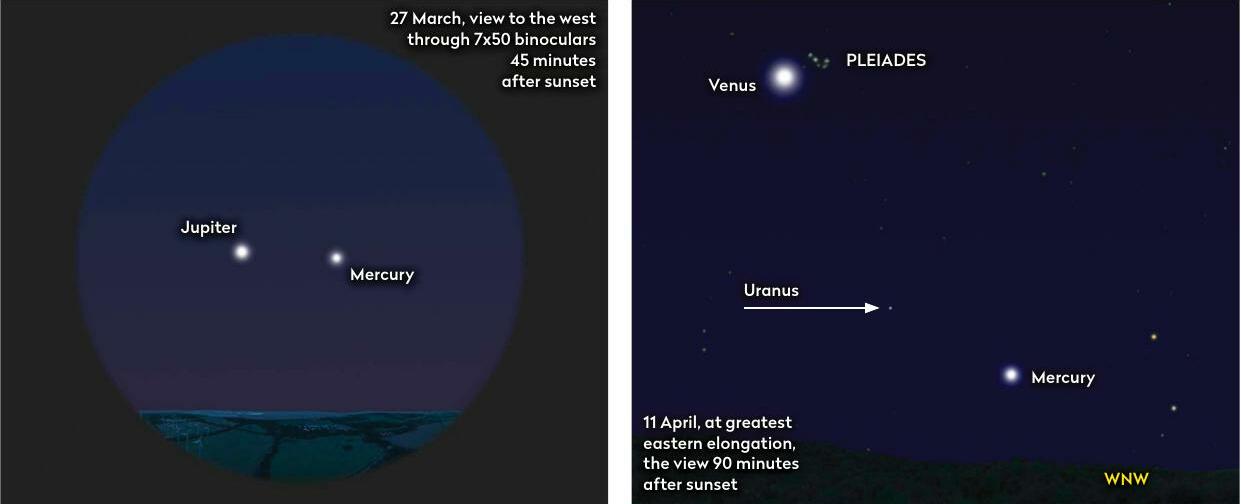
Following Mercury's path
The fastest planet in the Solar System, Mercury is named after the messenger of the Greek gods, renowned for speed. And time is certainly of the essence with this planet. To catch Mercury, we need to understand how its position relative to the Sun affects its visibility.
Mercury is 0.4 astronomical units (AU) away from the Sun and orbits at speeds of up to 47km per second, compared to Earth's relaxed pace of 30km per second. When it reaches its closest point to the Sun, Mercury is at its fastest and it then slows down slightly the further away it gets. As the innermost planet, it also has the shortest year, taking 88 Earth days to circle the Sun.

Denne historien er fra April 2023-utgaven av BBC Sky at Night Magazine.
Abonner på Magzter GOLD for å få tilgang til tusenvis av kuraterte premiumhistorier og over 9000 magasiner og aviser.
Allerede abonnent? Logg på
FLERE HISTORIER FRA BBC Sky at Night Magazine
BBC Sky at Night Magazine
The Milky Way as you've never seen it before
This is the largest low-frequency radio colour image of our Galaxy ever assembled

1 min
January 2026
BBC Sky at Night Magazine
Merger of ‘impossibly' massive black holes explained
Scientists discover how enormous, fast-spinning black holes can exist after all
1 mins
January 2026
BBC Sky at Night Magazine
The Universe's expansion may be slowing down
New study suggests current theories of dark energy could be wrong
1 mins
January 2026
BBC Sky at Night Magazine
Largest-ever flare from a black hole spotted
The star-shredding event blazes with the power of 10 trillion Suns
1 min
January 2026
BBC Sky at Night Magazine
Earth-sized planets found orbiting double stars
Two new worlds force a rethink of planet formation in extreme systems
1 mins
January 2026

BBC Sky at Night Magazine
To sleep among the stars
The rhythms of the night sky can help you wash the worries of the day away and find a restful night's sleep
2 mins
January 2026
BBC Sky at Night Magazine
Star's death captured as it happened
Fast action meant the supernova shockwave was revealed in a way never seen before
1 min
January 2026
BBC Sky at Night Magazine
Blue Origin lands reusable orbital booster
New Glenn delivers Mars-bound payload and nails landing on its second-ever flight
1 min
January 2026
BBC Sky at Night Magazine
How do black holes grow so large?
New Euclid study shows galaxy collisions feed the giants
2 mins
January 2026

BBC Sky at Night Magazine
Space junk strands astronauts on space station
Chinese crew couldn't risk re-entry after capsule damaged by debris
1 min
January 2026
Translate
Change font size