يحاول ذهب - حر
Mercury returns to twilight
April 2023
|BBC Sky at Night Magazine
The inner wanderer graces our evening skies once again this month.

When most beginners start out in planetary astronomy, it's easy to default to the holy trinity' of Jupiter, Saturn and our neighbour Mars. Each boasts unique and relatively easy to observe features, from Saturn's rings and Jupiter's bands and Great Red Spot, to Mars's dusty surface. But why stop there? There are eight planets in our Solar System and many can be appreciated with beginner setups. The 'inner planets', Mercury and Venus, present new and exciting challenges to planetary astronomers. We explored Venus in last month's issue and now it's Mercury's turn for the spotlight.
Due to its proximity to the Sun, extra care must be taken to observe Mercury safely, which adds to the challenge. There are particular times that are best to view this elusive, mysterious planet, and this April we can seize the opportunity. Get ready to enjoy one of the Solar System's unsung heroes.
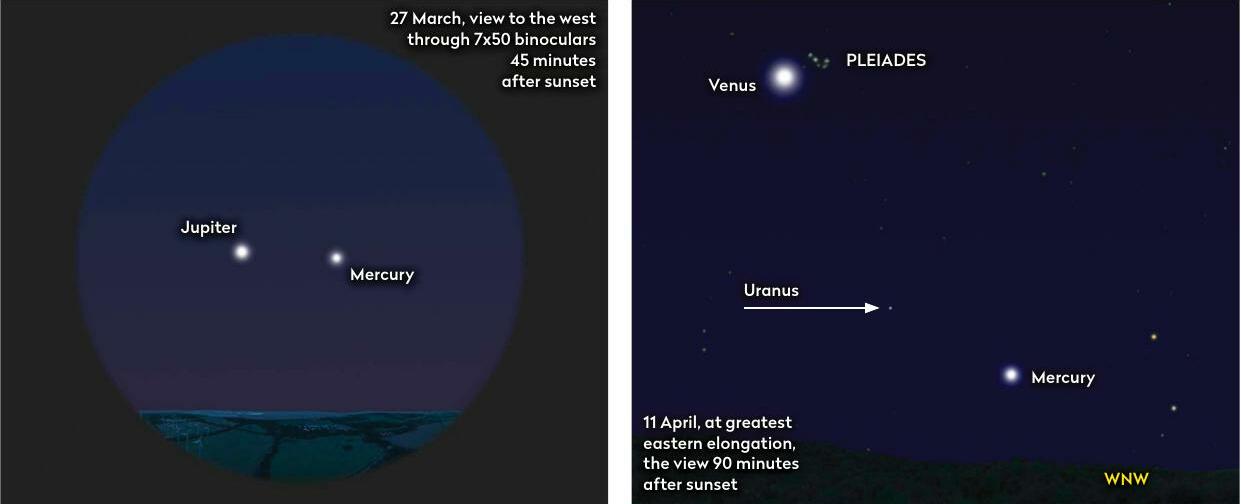
Following Mercury's path
The fastest planet in the Solar System, Mercury is named after the messenger of the Greek gods, renowned for speed. And time is certainly of the essence with this planet. To catch Mercury, we need to understand how its position relative to the Sun affects its visibility.
Mercury is 0.4 astronomical units (AU) away from the Sun and orbits at speeds of up to 47km per second, compared to Earth's relaxed pace of 30km per second. When it reaches its closest point to the Sun, Mercury is at its fastest and it then slows down slightly the further away it gets. As the innermost planet, it also has the shortest year, taking 88 Earth days to circle the Sun.

هذه القصة من طبعة April 2023 من BBC Sky at Night Magazine.
اشترك في Magzter GOLD للوصول إلى آلاف القصص المتميزة المنسقة، وأكثر من 9000 مجلة وصحيفة.
هل أنت مشترك بالفعل؟ تسجيل الدخول
المزيد من القصص من BBC Sky at Night Magazine

BBC Sky at Night Magazine
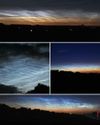
Capture NLCs with a smartphone
Make this the summer that you nail a shot of beautiful night-shining clouds

3 mins
July 2026

BBC Sky at Night Magazine
ZWO Seestar S30 Pro smart telescope
ZWO Seestar S30 Pro smart telescope
4 mins
July 2026
BBC Sky at Night Magazine
The speed of light
The Universe has a speed limit - and it underpins everything we know about it. We explain the speed of light and its far-reaching implications for astronomy
2 mins
July 2026
BBC Sky at Night Magazine
COMETS AND ASTEROIDS
Can you spot dim, barely moving Pluto?
1 min
July 2026
BBC Sky at Night Magazine
THE SKY GUIDE CHALLENGE
What's the youngest Moon you can photograph? Try our ‘impossible’ challenge
2 mins
July 2026

BBC Sky at Night Magazine
Q&A WITH A SCIENCE COMMUNICATOR
As we find more planets in the habitable zones around other suns, we ask Neil deGrasse Tyson what would happen if we did meet intelligent alien life
3 mins
July 2026
BBC Sky at Night Magazine
Make an all-sky camera
How to set up an always-watching system to catch fleeting sky events
3 mins
July 2026
BBC Sky at Night Magazine
The Universe doesn't need a multiverse
The Universe doesn't need a multiverse The idea that there are many universes seems to solve our most stubborn cosmic mysteries. But, argues Brian Clegg, it's no substitute for hard evidence
2 mins
July 2026
BBC Sky at Night Magazine
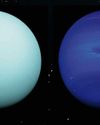
Planets of mystery
Uranus and Neptune – visited just once, 40 years ago – are the least-known planets in our Solar System. Now 21st-century science has revealed they may not even be the ‘ice giants’ we thought. Joseph Phelan investigates
6 mins
July 2026
BBC Sky at Night Magazine
THE BIG THREE
The top sights to observe or image this month
4 mins
July 2026
Translate
Change font size