
Vuélvete ilimitado con Magzter GOLD
Obtenga acceso ilimitado a más de 9000 revistas, periódicos e historias Premium por solo
Intentar ORO - Gratis
Power paradox
Down To Earth
|September 01, 2025
In drought-prone districts of Karnataka, solar parks promise prosperity but deliver displacement, exposing the fault lines of India's renewable energy transition
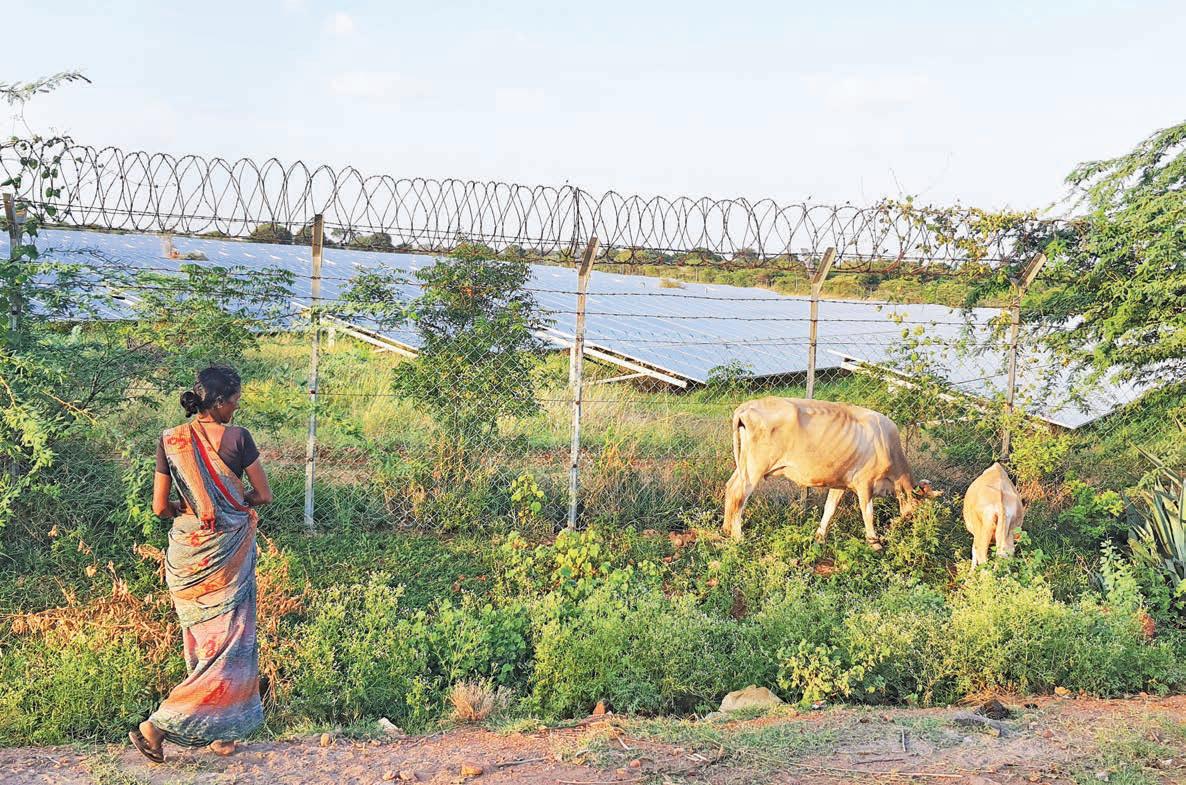
IN KARNATAKA'S drought-prone Chitradurga district, the sun now illuminates two sharply contrasting futures. For large landowners, solar parks that have mushroomed across many villages have meant lease cheques, cars and freedom from farming's uncertainties. For smallholders, landless labourers and pastoralists, however, the same gleaming panels have brought displacement, vanishing livelihoods and deepening precarity.
“Farming has always been a gamble. Only when rain, labour and prices aligned could we make any income,” says Soma Shekhar Reddy, a groundnut farmer from Bedareddyhalli village, who also raised silkworms on his 15 hectares (ha). Today, his fields lie behind fences, covered by solar panels spread across 101 ha. In 2016, he leased his land to a private company under a 28-year contract worth ₹17 lakh a year, with payments increased by 10 per cent every five years. In neighbouring Vaddikere village, Tippeswamy B V, who owns 8 ha, is still waiting for such an opportunity. “For the last 20 years, I have farmed only 2-2.4 ha. The rest has turned into wasteland," he says. "There is no profit. If a solar company comes tomorrow, I will lease it all," he says.
This desperation has turned drought-hit regions into prime locations for solar projects. "All these projects are coming up in places where human development indicators such as maternal and infant mortality or education levels remain poor," says Bhargavi Rao, a researcher who has studied solar parks in Karnataka. Instead of investing in long-promised irrigation facilities, politicians are pushing solar projects. In India, solar and wind park development is exempt from environmental and social impact assessments under the 2006 Environment Impact Assessment Notification, which mandates such assessments under the Environment (Protection) Act, 1986.

Esta historia es de la edición September 01, 2025 de Down To Earth.
Suscríbete a Magzter GOLD para acceder a miles de historias premium seleccionadas y a más de 9000 revistas y periódicos.
¿Ya eres suscriptor? Iniciar sesión
MÁS HISTORIAS DE Down To Earth
Down To Earth
CONSERVED BY COMMUNITY
How a desire to make snow leopard tourism sustainable helped a small Ladakhi settlement became the region's first Community Conserved Area

4 mins
May 16, 2026

Down To Earth
An 'open' and 'shut' case of Al's risky trajectory
Elon Musk's lawsuit against Sam Altman, OpenAl, Microsoft is crucially about open-source versus closed technology for corporate profit
4 mins
May 16, 2026
Down To Earth
Burden of transition
Clean energy transition is once again shifting environmental, human costs to the Global South, finds a UN university investigation
4 mins
May 16, 2026
Down To Earth
One step closer
India attains criticality in fast breeder reactor technology, reaching the second stage of the country's three- stage nuclear programme towards energy security
4 mins
May 16, 2026

Down To Earth
ZESTY SEEDS
Coriander seeds are a traditional antidote to summer heat
3 mins
May 16, 2026

Down To Earth
Sahyadri gets a bird village
Residents of Maharashtra's Pisavare village have embarked on a mission to protect birds in their vicinity through simple practices such as documenting species and building nests
2 mins
May 16, 2026

Down To Earth
CONFLICT IN THE BACKYARD
Across India, farmers are abandoning their fields as conflict with wild and stray animals intensifies. Conservation policy must move beyond protection alone to restore a workable coexistence between people and animals.
18 mins
May 16, 2026
Down To Earth
Capital punishment
Adequate compensation and proper rehabilitation remain a mirage for many displaced by the construction of Chhattisgarh's new capital, Nava Raipur, even two decades after the project began
3 mins
May 16, 2026
Down To Earth
Migrant workers are assets
MIGRATION HAS turned into a potent tool of political warfare across the world. For over a decade, domestic electoral politics across regions, from Europe and North America to Asia and Africa, have fuelled anti-immigration sentiments. This is also increasingly fuelling anti-immigrant vigilantism, as seen widely across Europe in 2015-16, coinciding with the refugee crisis.
2 mins
May 16, 2026

Down To Earth
Petri dish to plate
Synthetic meat production has seen a rise globally, even as environmental benefits of growing foods in laboratory remain debatable
10 mins
May 16, 2026
Listen
Translate
Change font size