يحاول ذهب - حر
Power paradox
September 01, 2025
|Down To Earth
In drought-prone districts of Karnataka, solar parks promise prosperity but deliver displacement, exposing the fault lines of India's renewable energy transition
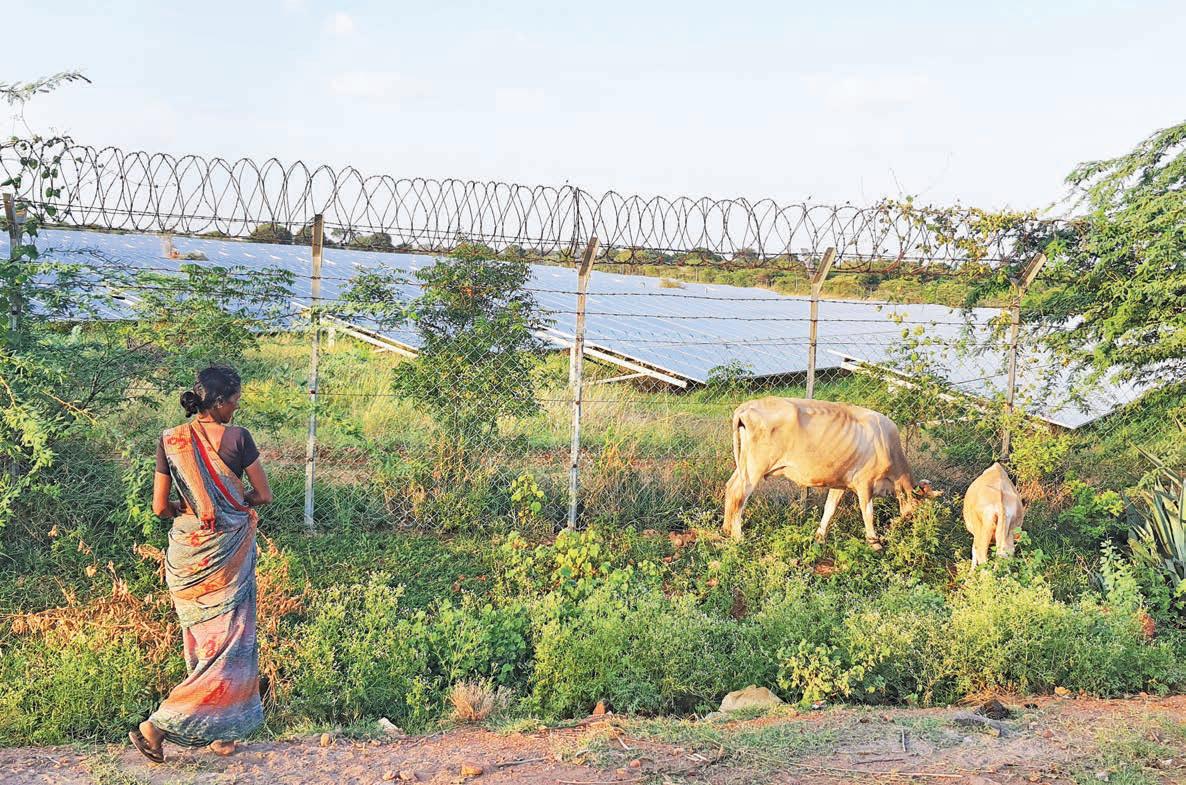
IN KARNATAKA'S drought-prone Chitradurga district, the sun now illuminates two sharply contrasting futures. For large landowners, solar parks that have mushroomed across many villages have meant lease cheques, cars and freedom from farming's uncertainties. For smallholders, landless labourers and pastoralists, however, the same gleaming panels have brought displacement, vanishing livelihoods and deepening precarity.
“Farming has always been a gamble. Only when rain, labour and prices aligned could we make any income,” says Soma Shekhar Reddy, a groundnut farmer from Bedareddyhalli village, who also raised silkworms on his 15 hectares (ha). Today, his fields lie behind fences, covered by solar panels spread across 101 ha. In 2016, he leased his land to a private company under a 28-year contract worth ₹17 lakh a year, with payments increased by 10 per cent every five years. In neighbouring Vaddikere village, Tippeswamy B V, who owns 8 ha, is still waiting for such an opportunity. “For the last 20 years, I have farmed only 2-2.4 ha. The rest has turned into wasteland," he says. "There is no profit. If a solar company comes tomorrow, I will lease it all," he says.
This desperation has turned drought-hit regions into prime locations for solar projects. "All these projects are coming up in places where human development indicators such as maternal and infant mortality or education levels remain poor," says Bhargavi Rao, a researcher who has studied solar parks in Karnataka. Instead of investing in long-promised irrigation facilities, politicians are pushing solar projects. In India, solar and wind park development is exempt from environmental and social impact assessments under the 2006 Environment Impact Assessment Notification, which mandates such assessments under the Environment (Protection) Act, 1986.

هذه القصة من طبعة September 01, 2025 من Down To Earth.
اشترك في Magzter GOLD للوصول إلى آلاف القصص المتميزة المنسقة، وأكثر من 9000 مجلة وصحيفة.
هل أنت مشترك بالفعل؟ تسجيل الدخول
المزيد من القصص من Down To Earth
Down To Earth
Popular distrust
THE WORLD seems to be going through a period of stasis despite facing an unfathomable polycrisis.

2 mins
February 01, 2026
Down To Earth
CONSERVE OR PERISH
Periyar Tiger Reserve has rewritten Indian conservation by turning poachers into protectors and conflict into coexistence
5 mins
February 01, 2026

Down To Earth
'Rivers need to run free'
From Tibet to West Bengal, the Brahmaputra is the pulse of communities and ecosystems along its course. But what are the risks the river faces through human interventions, particularly dams, discusses journalist, author and filmmaker SANJOY HAZARIKA in his new book, River Traveller.
4 mins
February 01, 2026

Down To Earth
India is facing up to its innovation lag
There are signs now that India is acknowledging the superior strides made by China in a frontier technology like Al
4 mins
February 01, 2026

Down To Earth
Competing concerns
What are the repercussions of the EU-Mercosur pact that have made European farmers protest against the free trade agreement?
4 mins
February 01, 2026

Down To Earth
From fryer to flight
Sustainable fuel made from used cooking oil can play a pivotal role in helping India achieve its aviation emission reduction goals. Measures to collect this oil must be revamped
4 mins
February 01, 2026

Down To Earth
ACCESS OPEN
An amendment to India's nodal forest conservation law opens up forests across India to commercial exploitation by the paper industry
6 mins
February 01, 2026
Down To Earth
DRINK FROM TAP CAN BE A REALITY
As cities across India struggle to supply safe piped water, Odisha offers a success story
2 mins
February 01, 2026
Down To Earth
GREAT DRYING
The Earth is hotter than at any point in the past 100,000 years, with 2023-25 becoming the warmest three-year period on record and also breaching the 1.5°C threshold for the first time. One fallout is dwindling freshwater.
22 mins
February 01, 2026

Down To Earth
Green redemption
Restoration of grasslands of Kerala's Pampadum Shola National Park, once dominated by invasive Australian wattles, see a return of streams and native species
1 mins
February 01, 2026
Listen
Translate
Change font size