कोशिश गोल्ड - मुक्त
Power paradox
Down To Earth
|September 01, 2025
In drought-prone districts of Karnataka, solar parks promise prosperity but deliver displacement, exposing the fault lines of India's renewable energy transition
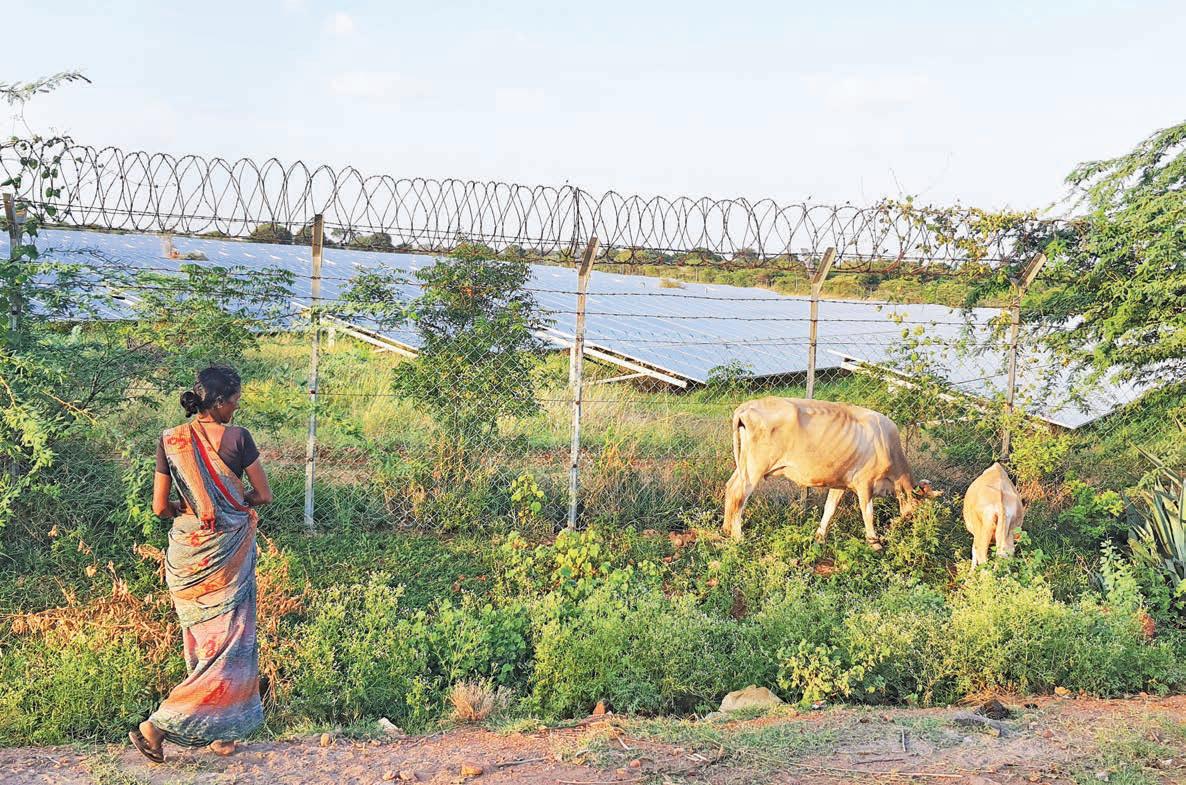
IN KARNATAKA'S drought-prone Chitradurga district, the sun now illuminates two sharply contrasting futures. For large landowners, solar parks that have mushroomed across many villages have meant lease cheques, cars and freedom from farming's uncertainties. For smallholders, landless labourers and pastoralists, however, the same gleaming panels have brought displacement, vanishing livelihoods and deepening precarity.
“Farming has always been a gamble. Only when rain, labour and prices aligned could we make any income,” says Soma Shekhar Reddy, a groundnut farmer from Bedareddyhalli village, who also raised silkworms on his 15 hectares (ha). Today, his fields lie behind fences, covered by solar panels spread across 101 ha. In 2016, he leased his land to a private company under a 28-year contract worth ₹17 lakh a year, with payments increased by 10 per cent every five years. In neighbouring Vaddikere village, Tippeswamy B V, who owns 8 ha, is still waiting for such an opportunity. “For the last 20 years, I have farmed only 2-2.4 ha. The rest has turned into wasteland," he says. "There is no profit. If a solar company comes tomorrow, I will lease it all," he says.
This desperation has turned drought-hit regions into prime locations for solar projects. "All these projects are coming up in places where human development indicators such as maternal and infant mortality or education levels remain poor," says Bhargavi Rao, a researcher who has studied solar parks in Karnataka. Instead of investing in long-promised irrigation facilities, politicians are pushing solar projects. In India, solar and wind park development is exempt from environmental and social impact assessments under the 2006 Environment Impact Assessment Notification, which mandates such assessments under the Environment (Protection) Act, 1986.

यह कहानी Down To Earth के September 01, 2025 संस्करण से ली गई है।
हजारों चुनिंदा प्रीमियम कहानियों और 10,000 से अधिक पत्रिकाओं और समाचार पत्रों तक पहुंचने के लिए मैगज़्टर गोल्ड की सदस्यता लें।
क्या आप पहले से ही ग्राहक हैं? साइन इन करें
Down To Earth से और कहानियाँ

Down To Earth
THE GREAT PIVOT
China's moves to transition to clean energy offer critical lessons to India

4 mins
March 01, 2026

Down To Earth
COAL V CORRIDOR
A proposal to mine coal along a corridor that links two tiger reserves in central India is a step away from getting final clearance. The move could affect movement and genetic diversity of tiger populations in the region
8 mins
March 01, 2026

Down To Earth
India's challenging AI predicament
Hobbled by lack of innovation and AI skills in its crucial technology sector, India is focusing on a ruinous plan to host data centres
4 mins
March 01, 2026
Down To Earth
China to implement zero tariffs across Africa
CHINA ON February 14 announced that it will implement zero tariffs for imports from all the 53 African nations it has diplomatic relations with, starting from May 1.
1 min
March 01, 2026
Down To Earth
Poverty, sans the threshold
MEASUREMENT OF poverty is a fundamental exercise, needed to direct development programmes.
2 mins
March 01, 2026

Down To Earth
A bridge across forever
For two decades, a Chhattisgarh village remains stuck in a loop of building temporary river crossings to access markets and sell forest produce
4 mins
March 01, 2026
Down To Earth
Liveable cities need a new model
CRY FOR my Delhi. This is my city—my family records many generations who have lived here.
3 mins
March 01, 2026

Down To Earth
Real impacts of the changing seasons
This refers to the article \"1,500 days, and an alarm for new climate\" (1-15 December, 2025).
1 mins
March 01, 2026

Down To Earth
‘It’s a systematic effort by US to dismantle climate policy’
The US, the world's largest historical emitter of greenhouse gases, has overturned its “endangerment finding”, the legal foundation for regulating emissions under the Clean Air Act since 2009.
4 mins
March 01, 2026
Down To Earth
Amazon turned carbon source in 2023 drought
EXTREME DROUGHT and a prolonged heatwave in 2023 pushed parts of the Amazon rainforest from acting as a carbon sink to becoming a carbon source for three months, according to a February 13 study published in the journal AGU Advances of the American Geophysical Union.
1 min
March 01, 2026
Listen
Translate
Change font size