試す 金 - 無料
Power paradox
Down To Earth
|September 01, 2025
In drought-prone districts of Karnataka, solar parks promise prosperity but deliver displacement, exposing the fault lines of India's renewable energy transition
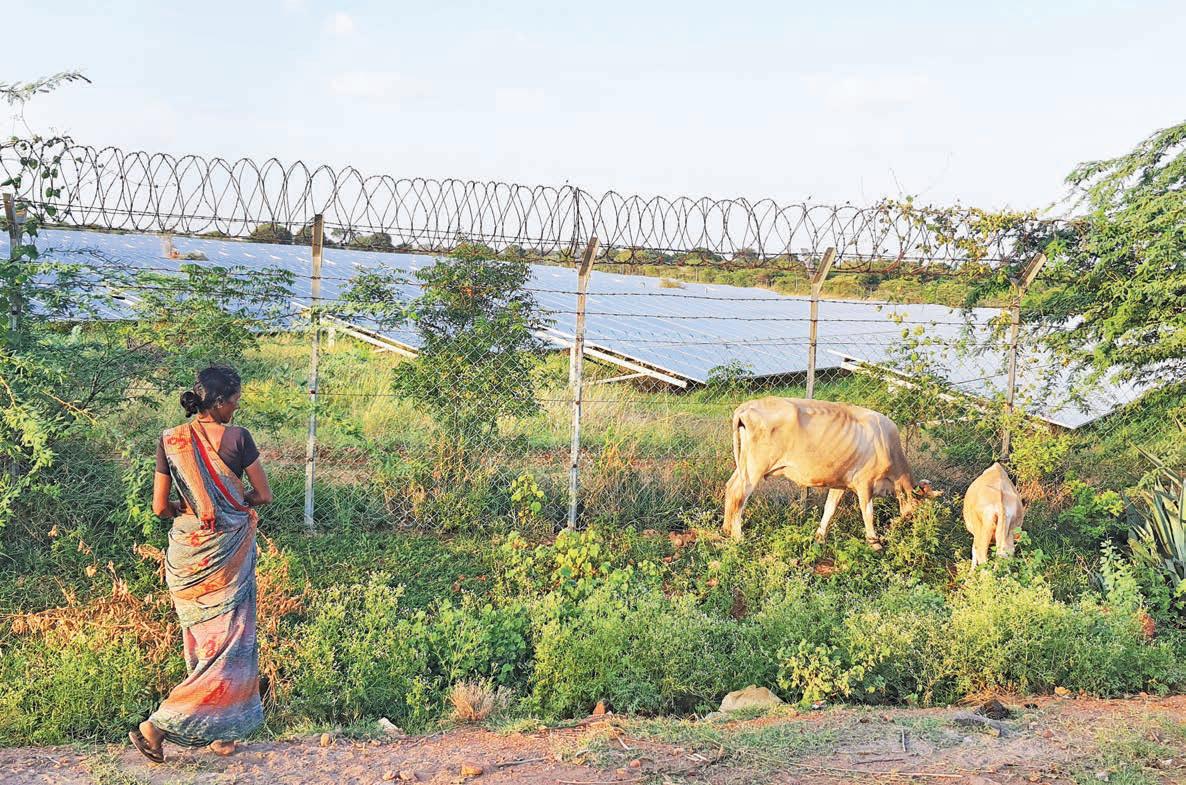
IN KARNATAKA'S drought-prone Chitradurga district, the sun now illuminates two sharply contrasting futures. For large landowners, solar parks that have mushroomed across many villages have meant lease cheques, cars and freedom from farming's uncertainties. For smallholders, landless labourers and pastoralists, however, the same gleaming panels have brought displacement, vanishing livelihoods and deepening precarity.
“Farming has always been a gamble. Only when rain, labour and prices aligned could we make any income,” says Soma Shekhar Reddy, a groundnut farmer from Bedareddyhalli village, who also raised silkworms on his 15 hectares (ha). Today, his fields lie behind fences, covered by solar panels spread across 101 ha. In 2016, he leased his land to a private company under a 28-year contract worth ₹17 lakh a year, with payments increased by 10 per cent every five years. In neighbouring Vaddikere village, Tippeswamy B V, who owns 8 ha, is still waiting for such an opportunity. “For the last 20 years, I have farmed only 2-2.4 ha. The rest has turned into wasteland," he says. "There is no profit. If a solar company comes tomorrow, I will lease it all," he says.
This desperation has turned drought-hit regions into prime locations for solar projects. "All these projects are coming up in places where human development indicators such as maternal and infant mortality or education levels remain poor," says Bhargavi Rao, a researcher who has studied solar parks in Karnataka. Instead of investing in long-promised irrigation facilities, politicians are pushing solar projects. In India, solar and wind park development is exempt from environmental and social impact assessments under the 2006 Environment Impact Assessment Notification, which mandates such assessments under the Environment (Protection) Act, 1986.

このストーリーは、Down To Earth の September 01, 2025 版からのものです。
Magzter GOLD を購読すると、厳選された何千ものプレミアム記事や、10,000 以上の雑誌や新聞にアクセスできます。
すでに購読者ですか? サインイン
Down To Earth からのその他のストーリー
Down To Earth
MAJESTIC SARUS STAGES COMEBACK
Involvement of farmers in conservation helps the sarus crane population soar in eastern Uttar Pradesh over the past decade

5 mins
June 16, 2026

Down To Earth
Global resistance to AI data centres hardens
India must learn how to regulate environmentally disastrous data centres that guzzle more water and power than entire nations
4 mins
June 16, 2026

Down To Earth
SUMMER SMOG
Ground-level ozone is one of the national capital's least appreciated public health threat
1 mins
June 16, 2026

Down To Earth
A FOREST IN WAIT
For five decades, Abujhmad in Chhattisgarh was closed to the country. Now, as the region opens up, ANIL ASHWANI SHARMA travels to villages in its dense forests to see how isolation has impacted the people and development
6 mins
June 16, 2026

Down To Earth
DON'T WASTE THE FUTURE
Policymakers may need to focus less on expanding programmes and more on improving their effectiveness and reach, suggests the latest NFHS-6 data
3 mins
June 16, 2026
Down To Earth
NEED A FOREST TRIBUNAL
A tribunal will provide people a dedicated independent forum where they will have a statutory right to approach
2 mins
June 16, 2026
Down To Earth
Moment or movement
ONE DEFINITION of the word metamorphosis in the dictionary is “a striking alteration in appearance, character, or circumstances”.
2 mins
June 16, 2026

Down To Earth
El Niño, amplified
As a possible super El Niño looms in 2026, scientists warn of devastations that may extend into 2027
6 mins
June 16, 2026

Down To Earth
A mindless denial
District level bodies are increasingly refusing tribal population's rights over resources guaranteed by the forest rights Act
5 mins
June 16, 2026

Down To Earth
TOOR TOUR
What makes pigeon pea so ubiquitous across cuisines in India
4 mins
June 16, 2026
Listen
Translate
Change font size