Intentar ORO - Gratis
Asylum
Outlook
|August 21, 2025
Although the how, where and when to treat mental illness are now better understood in India, the 'why' continues to be obscure

IN a damning criticism of the colonial government, a prominent psychiatrist pointed out in 1937 that “it would be difficult for the most jingoistic to affirm that, in the matter of provision for mental disorder in India, in India, the British ‘bearing of the white man’s burden’ has been quite adequate.” But have we, as an independent nation, done a better job?
The mentally ill have always been with us; and every known historical account recounts those who behaved in a mad manner. For millennia, the ‘why’ of ‘why do people go mad’ was debated, and in the absence of any other obvious observable evidence, it was assumed that it was the work of the Devil, or the consequence of moral or religious transgression. All societies and religions assumed that only these could cause a fall from grace, which altered a person in thought and deed to the extent that they could be considered beyond the pale, devoid of humanness, and thus lose their place in society.
It was only a few hundred years ago—prompted by the dramatic change in our thinking about the natural world—that sickness and disease began to be understood as a natural phenomenon. The laws of physics, chemistry and biology, and the instruments that were invented (thermometer, microscope, stethoscope, etc.) could help record the temperature of the body, measure gases in respired air, and even detect bacteria in pus. The mythical fear of illness vanished, and it simply became a problem to be solved. The appearance of doctors, who practised this new natural science in hospitals, where the sick could be treated, was thus a recent modern invention.
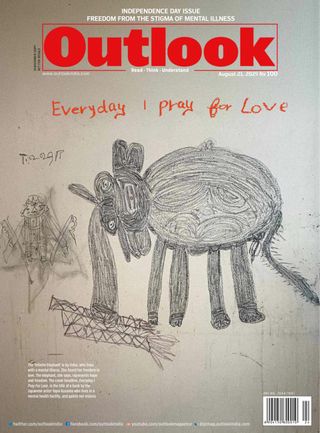

Esta historia es de la edición August 21, 2025 de Outlook.
Suscríbete a Magzter GOLD para acceder a miles de historias premium seleccionadas y a más de 9000 revistas y periódicos.
¿Ya eres suscriptor? Iniciar sesión
MÁS HISTORIAS DE Outlook

Outlook
The Spectacle of the Woman Accused
Media narratives—especially when women are involved—can end up amplifying suspicion and weaponising gender

7 mins
March 11, 2026

Outlook
The Stink of Epstein
Why are the rich and powerful of the world scared of what lies buried in the Jeffrey Epstein files?
6 mins
March 11, 2026

Outlook
Passing the Watermelon
Narendra Modi's presence in Israel is being read not just as a bilateral engagement, but as an endorsement of Israeli action in Gaza and the West Bank
5 mins
March 11, 2026

Outlook
For Phoolan, Who Wasn't a Devi
“Whether or not it is the Truth is no longer relevant. The point is that it will, (if it hasn’t already) - become the Truth. Phoolan Devi, the woman has ceased to be important. (Yes of course she exists. She has eyes, ears, limbs, hair etc. Even an address now) But she is suffering from a case of Legenditis. She’s only a version of herself. There are other versions of her that are jostling for attention. Particularly Shekhar Kapur’s “Truthful” one, which we are currently being bludgeoned into believing.”–Arundhati Roy in ‘The Great Indian Rape-Trick I’, on the film Bandit Queen by Shekhar Kapur based on Phoolan, whom he never met because he didn’t think he needed to meet her. The film was based on journalist Mala Sen’s book India’s Bandit Queen: The True Story of Phoolan Devi.
5 mins
March 11, 2026

Outlook
The Chic Cartel
Women are not just victims or side characters in recent crime-and-power OTT dramas. They are complex forces-capable of empathy, strategy and ruthlessness-whose narratives demand both recognition and reckoning
5 mins
March 11, 2026

Outlook
The Hierarchy of Sympathy
In crimes against women, justice is shaped not only in courtrooms but in newsrooms where narrative determines whose suffering becomes national conscience and whose fades into procedural silence
5 mins
March 11, 2026

Outlook
Dasyu Sundari
Media accounts simultaneously cast her as victim and avenger, until a life shaped by caste violence and gendered oppression was repackaged into a consumable myth of dishonour and revenge
8 mins
March 11, 2026

Outlook
Prince Pervert
Are rumours of the death of the rule of law vastly exaggerated?
4 mins
March 11, 2026
Outlook
Together, Apart
Poonam Saxena's translations of Mannu Bhandari and Rajendra Yadav's memoirs present a portrait of the trailblazing Hindi writer-couple's marriage and of newly independent India
3 mins
March 11, 2026

Outlook
The Great Indian Rape Trick'
The trope of transforming sexual violence against women into a springboard for rage that can only be channelled through counter-violence has long served as a popular framework in cinema, both globally and in India
6 mins
March 11, 2026
Listen
Translate
Change font size