Try GOLD - Free
Language Affects Kids’ Interest in Science
Scientific American
|July/August 2025
As children get older, their understanding of science and of being a scientist changes. The words adults use are a critical part of keeping them engaged in discovery
ONE OF THE BEST PARTS of being a parent has to be watching children discover the world around them. After all, kids are endlessly curious, and part of the fun is seeing the wonder on their faces as they learn about even simple objects and ideas. “What’s that in your hand? Is it—a ball? Do you think it will roll down this hill?” you might ask your toddler. Then you get to enjoy their shouts of delight as they explore just that. This is science in action—making an observation, testing an idea, seeing what happens and then asking the next question.
Yet over time parents may find that their child is becoming less interested in exploring the world around them and less likely to investigate the underlying “why” of things—that is, less curious about science. Why does this shift happen?
There are, of course, a number of different factors at play, but in the research my colleagues and I have done, we have found something that might surprise some folks: this loss of interest may be partly the result of subtle language cues children hear. And these cues don’t come just from parents; they can also come from media kids consume or from schoolteachers or curricula that treat science as an identity rather than a process.
All youngsters can do science, but over time they begin to think of being a scientist as something reserved for only certain kinds of kids. Based on what my colleagues and I have learned, however, there are some steps you can take to keep the curiosity alive and the science flowing.
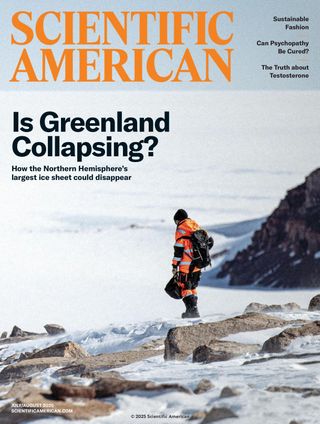

This story is from the July/August 2025 edition of Scientific American.
Subscribe to Magzter GOLD to access thousands of curated premium stories, and 10,000+ magazines and newspapers.
Already a subscriber? Sign In
MORE STORIES FROM Scientific American

Scientific American
Earthquake Life
Yellowstone quakes spark bursts of microbial growth underground

2 mins
March 2026
Scientific American
Sailing the Sun
By designing vertical panels that move in a gale, two Swedish inventors are unlocking a solar future for the windswept north
9 mins
March 2026
Scientific American
Covered in Bees
Ancient bees burrowed deep into discarded mammal jawbones
2 mins
March 2026
Scientific American
Fire Starters
Ancient humans were making fire 350,000 years earlier than thought
3 mins
March 2026
Scientific American
Relativity Revealed
Physicists have observed a bizarre prediction of special relativity for the first time
8 mins
March 2026

Scientific American
Everything You Wanted to Know about Polyamory (but Were Afraid to Ask
The practice is not a faddish excuse to sleep around, research shows. And it has deep roots in American culture
14 mins
March 2026

Scientific American
Let the Rivers Run
An investigation into the rights of nature
4 mins
March 2026

Scientific American
Hidden Proof
\"Effective zero knowledge\" beats long-standing cryptographic impossibilities
2 mins
March 2026
Scientific American
The Universe's Weirdest Optical Illusions
Sometimes the farther away an object is, the bigger it seems to be
4 mins
March 2026

Scientific American
Living in the COPILOT SOCIETY
The promise and peril of artificial intelligence everywhere
2 mins
March 2026
Listen
Translate
Change font size