Try GOLD - Free
How Big Can Black Holes Get?
Scientific American
|December 2025
There may be an upper limit to their growth
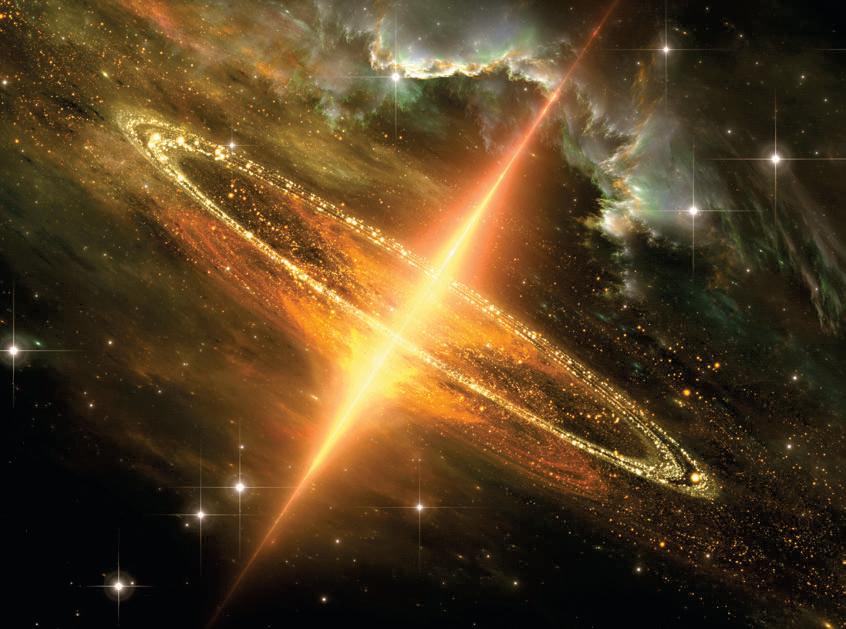
Black holes like the one shown * in this illustration can grow astonishingly massive by feeding on immense amounts of matter.
IN THE EARLY 1960S ASTRONOMERS DISCOVERED a monster. Something in the constellation of Virgo was pouring out radio waves, but no counterpart in visible light was seen initially. After a lengthy effort, that changed when observers glimpsed a faint blue “star” sitting at the radio source’s exact position. Eventually they were able to determine that this object, called 3C 273, was not a star at all but rather something much stranger located a staggering two billion light-years from Earth.
To be visible across such a vast stretch of space, the “quasi-stellar object” (quasar for short) 3C 273 had to be overwhelmingly bright. Scientists ultimately settled on a feeding black hole at the heart of a far-distant galaxy as the most likely engine for 3C 273’s ridiculous luminosity. And it wasn’t just any black hole but a positively Brobdingnagian one, with a mass that was probably 900 million times that of our sun.
Since that time, we’ve found many more such supermassive black holes. In fact, by the 1980s astronomers were starting to suspect that every big galaxy had a supermassive black hole in its center. Thanks to observations from the Hubble Space Telescope and other facilities, we now know that is true—which means there could be as many as a trillion such giants in the observable universe.
And “supermassive” is definitely the right name for them. Many have been found with a billion times the sun’s mass, and the beefiest can be even heavier than that. This fact naturally raises the question: Just how hefty can one get?


This story is from the December 2025 edition of Scientific American.
Subscribe to Magzter GOLD to access thousands of curated premium stories, and 10,000+ magazines and newspapers.
Already a subscriber? Sign In
MORE STORIES FROM Scientific American
Scientific American
Flashes in the Night
Celestial transients shine furiously and briefly. Astronomers are just beginning to understand them.

13 mins
January 2026

Scientific American
The Imperiled Orcas of the Salish Sea
The southern resident killer whales are on the brink. Now the scientists who study them are, too
17 mins
January 2026
Scientific American
The Reptile Sexpocalypse
The sex of many turtles, crocodilians, and other reptiles is determined by the temperature at which their eggs incubate. Global warming could doom them
11 mins
January 2026

Scientific American
A Suite of Killers
Heart ailments, kidney diseases and type 2 diabetes actually may be part of just one condition. It's called CKM syndrome
10 mins
January 2026
Scientific American
A Good Night's Sleep
Psychological data and brain scans show all the ways sleep can improve our lives, our bodies and our relationships
1 mins
January 2026

Scientific American
Behind the Nobel
A 2025 winner reflects on the mysterious T cells that won him the prize
5 mins
January 2026
Scientific American
Cable Quakes
Fiber optics that connect the world can detect its earthquakes, too
2 mins
January 2026
Scientific American
Inside Asteroid Family Trees
Asteroid origins can be hard to trace
4 mins
January 2026
Scientific American
Think Again
Chimpanzees can weigh evidence and update their beliefs like humans do.
3 mins
January 2026
Scientific American
Cracking the World's Most Famous Code
Solving the CIA's Kryptos puzzle took three parts math and one part sleuthing
6 mins
January 2026
Listen
Translate
Change font size