Try GOLD - Free
Inside Asteroid Family Trees
Scientific American
|January 2026
Asteroid origins can be hard to trace
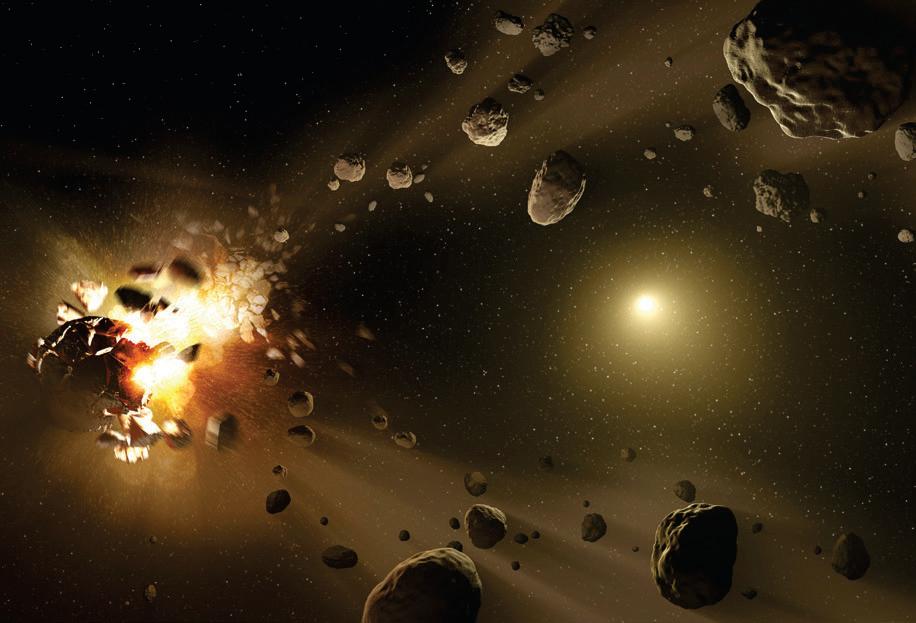
WE'VE ALL SEEN THIS HAPPEN in a science-fiction movie: our plucky heroes jump into their ramshackle spaceship and escape the bad guys by flying through the treacherous asteroid belt, where huge rocks tumble and spin so close together that the crew has to constantly dodge, duck, dip and dive to avoid being smashed to atoms.
It's exciting, but it's wrong: asteroids so close together would grind one another to dust in short order, making it extremely unlikely that you'd ever find such a situation near a star. In our solar system, the odds are pretty good that you could stand on the surface of an asteroid and not even be able to see another one! Big ones tend to be many millions of kilometers apart.
Yet they do interact if they are given enough time. Even in the sprawling main asteroid belt between the orbits of Mars and Jupiter, collisions are inevitable. In fact, we've managed to see some small asteroid smashups; bigger rocks are far more rare, so larger collisions are proportionally less common. But they do still happen—spacecraft reconnaissance of large asteroids shows that they are riddled with ancient impact craters. And when two space rocks go “bump” in the main belt, their high orbital speeds mean they can have collision velocities far higher than that of a rifle Shrapnel is inevitable because big impacts blow lots of asteroidal real estate out into space.
What happens to that ejected debris? In many cases, these fragments stay on much the same orbital path as the parent asteroid, although they gradually separate from it because of slight velocity differences. After millennia the ejecta might be clear across the sun from its source. You might think this outcome must be problematic for anyone trying to track down different types of asteroids to figure out how they all fit together—and it is! But this problem of orbital mechanics provides its own solution.

This story is from the January 2026 edition of Scientific American.
Subscribe to Magzter GOLD to access thousands of curated premium stories, and 10,000+ magazines and newspapers.
Already a subscriber? Sign In
MORE STORIES FROM Scientific American
Scientific American
Let There Be Weapons
The Department of Energy’s new Genesis Mission promises AI-accelerated discovery. Seven of its first 26 challenges focus on nuclear weapons and national security

4 mins
July/August 2026

Scientific American
How to Fix Science
The federal funding system for scientific research in the U.S. needs reform
9 mins
July/August 2026

Scientific American
Robots Can Now Fold Your Laundry
Home-helper tasks are becoming easier for robotic assistants
4 mins
July/August 2026
Scientific American
50, 100 & 150 Years
NATURAL FISSION REACTOR
3 mins
July/August 2026

Scientific American
Anna Ho
Describing the characteristics of short-lived astrophysical events
1 mins
July/August 2026
Scientific American
THE SOLILOQUY OF SCHRÖDINGER'S CAT
A MEDITATION ON LIFE AND THE VON NEUMANN–WIGNER INTERPRETATION OF QUANTUM MECHANICS
1 min
July/August 2026

Scientific American
Mikhail Kolmogorov
Developing software to reveal large genetic changes that lead to cancer
1 mins
July/August 2026

Scientific American
Jaye Gardiner
Learning how the matrix around cells and tissues impacts cancers
1 mins
July/August 2026

Scientific American
Timnit Gebru
On safeguarding independent research in the age of big tech
3 mins
July/August 2026

Scientific American
A Youthful Illusion Sharpens Memory
By making people feel as if their face is a younger version of itself, researchers can bring childhood memories into sharper focus
4 mins
July/August 2026
Listen
Translate
Change font size