
Magzter GOLDで無制限に
10,000以上の雑誌、新聞、プレミアム記事に無制限にアクセスできます。
Inside Asteroid Family Trees
Scientific American
|January 2026
Asteroid origins can be hard to trace
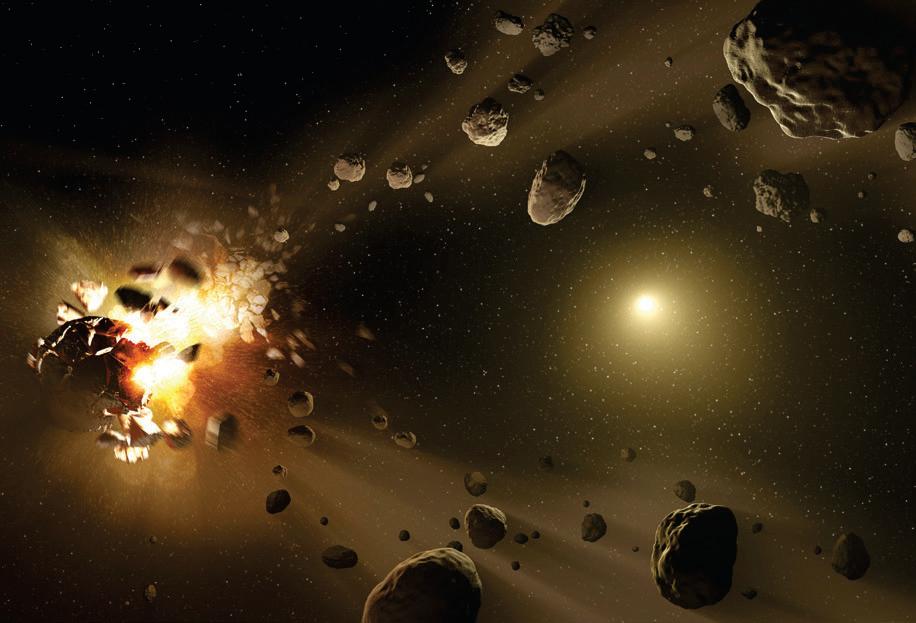
WE'VE ALL SEEN THIS HAPPEN in a science-fiction movie: our plucky heroes jump into their ramshackle spaceship and escape the bad guys by flying through the treacherous asteroid belt, where huge rocks tumble and spin so close together that the crew has to constantly dodge, duck, dip and dive to avoid being smashed to atoms.
It's exciting, but it's wrong: asteroids so close together would grind one another to dust in short order, making it extremely unlikely that you'd ever find such a situation near a star. In our solar system, the odds are pretty good that you could stand on the surface of an asteroid and not even be able to see another one! Big ones tend to be many millions of kilometers apart.
Yet they do interact if they are given enough time. Even in the sprawling main asteroid belt between the orbits of Mars and Jupiter, collisions are inevitable. In fact, we've managed to see some small asteroid smashups; bigger rocks are far more rare, so larger collisions are proportionally less common. But they do still happen—spacecraft reconnaissance of large asteroids shows that they are riddled with ancient impact craters. And when two space rocks go “bump” in the main belt, their high orbital speeds mean they can have collision velocities far higher than that of a rifle Shrapnel is inevitable because big impacts blow lots of asteroidal real estate out into space.
What happens to that ejected debris? In many cases, these fragments stay on much the same orbital path as the parent asteroid, although they gradually separate from it because of slight velocity differences. After millennia the ejecta might be clear across the sun from its source. You might think this outcome must be problematic for anyone trying to track down different types of asteroids to figure out how they all fit together—and it is! But this problem of orbital mechanics provides its own solution.

このストーリーは、Scientific American の January 2026 版からのものです。
Magzter GOLD を購読すると、厳選された何千ものプレミアム記事や、10,000 以上の雑誌や新聞にアクセスできます。
すでに購読者ですか? サインイン
Scientific American からのその他のストーリー
Scientific American
Flashes in the Night
Celestial transients shine furiously and briefly. Astronomers are just beginning to understand them.

13 mins
January 2026

Scientific American
The Imperiled Orcas of the Salish Sea
The southern resident killer whales are on the brink. Now the scientists who study them are, too
17 mins
January 2026
Scientific American
The Reptile Sexpocalypse
The sex of many turtles, crocodilians, and other reptiles is determined by the temperature at which their eggs incubate. Global warming could doom them
11 mins
January 2026

Scientific American
A Suite of Killers
Heart ailments, kidney diseases and type 2 diabetes actually may be part of just one condition. It's called CKM syndrome
10 mins
January 2026
Scientific American
A Good Night's Sleep
Psychological data and brain scans show all the ways sleep can improve our lives, our bodies and our relationships
1 mins
January 2026
Scientific American
Behind the Nobel
A 2025 winner reflects on the mysterious T cells that won him the prize
5 mins
January 2026
Scientific American
Cable Quakes
Fiber optics that connect the world can detect its earthquakes, too
2 mins
January 2026
Scientific American
Inside Asteroid Family Trees
Asteroid origins can be hard to trace
4 mins
January 2026

Scientific American
Think Again
Chimpanzees can weigh evidence and update their beliefs like humans do.
3 mins
January 2026
Scientific American
Cracking the World's Most Famous Code
Solving the CIA's Kryptos puzzle took three parts math and one part sleuthing
6 mins
January 2026
Listen
Translate
Change font size