Versuchen GOLD - Frei
How Big Can Black Holes Get?
Scientific American
|December 2025
There may be an upper limit to their growth
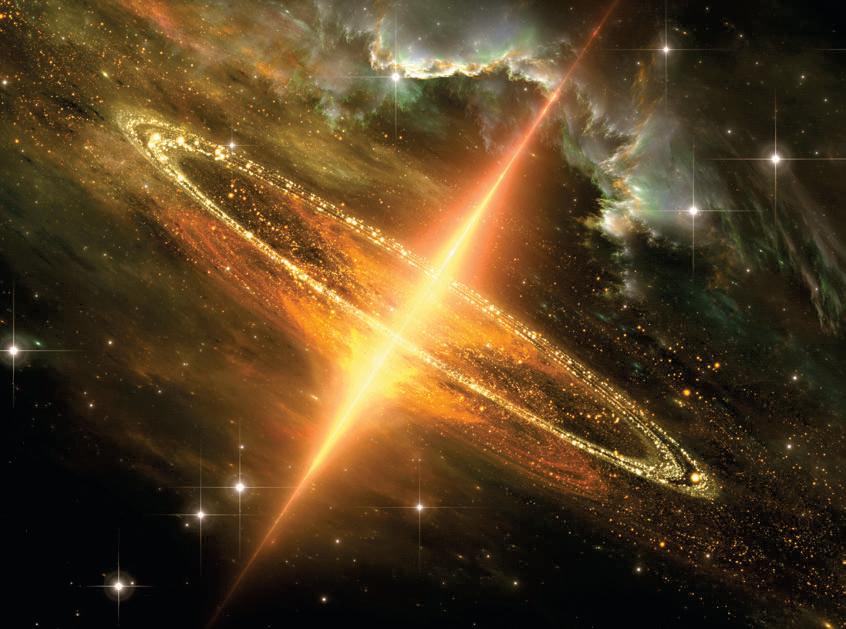
Black holes like the one shown * in this illustration can grow astonishingly massive by feeding on immense amounts of matter.
IN THE EARLY 1960S ASTRONOMERS DISCOVERED a monster. Something in the constellation of Virgo was pouring out radio waves, but no counterpart in visible light was seen initially. After a lengthy effort, that changed when observers glimpsed a faint blue “star” sitting at the radio source’s exact position. Eventually they were able to determine that this object, called 3C 273, was not a star at all but rather something much stranger located a staggering two billion light-years from Earth.
To be visible across such a vast stretch of space, the “quasi-stellar object” (quasar for short) 3C 273 had to be overwhelmingly bright. Scientists ultimately settled on a feeding black hole at the heart of a far-distant galaxy as the most likely engine for 3C 273’s ridiculous luminosity. And it wasn’t just any black hole but a positively Brobdingnagian one, with a mass that was probably 900 million times that of our sun.
Since that time, we’ve found many more such supermassive black holes. In fact, by the 1980s astronomers were starting to suspect that every big galaxy had a supermassive black hole in its center. Thanks to observations from the Hubble Space Telescope and other facilities, we now know that is true—which means there could be as many as a trillion such giants in the observable universe.
And “supermassive” is definitely the right name for them. Many have been found with a billion times the sun’s mass, and the beefiest can be even heavier than that. This fact naturally raises the question: Just how hefty can one get?

Diese Geschichte stammt aus der December 2025-Ausgabe von Scientific American.
Abonnieren Sie Magzter GOLD, um auf Tausende kuratierter Premium-Geschichten und über 9.000 Zeitschriften und Zeitungen zuzugreifen.
Sie sind bereits Abonnent? Anmelden
WEITERE GESCHICHTEN VON Scientific American

Scientific American
Probiotic Hope and Hype
Despite their popularity, supplements with billions of \"good\" microbes help only a few illnesses, research shows

3 mins
January 2026

Scientific American
Mondays Really Are More Stressful
The start of the workweek can be a biologically measurable stressor, with consequences for long-term health that can stretch into retirement
4 mins
January 2026
Scientific American
Tiny Display
An e-paper breakthrough brings extremely high-resolution color
2 mins
January 2026
Scientific American
Fine-Feathered Snack
A bat's tracker documents a dramatic midair hunt
2 mins
January 2026

Scientific American
OUR ROBOTIC PICTURE
Will mechanical helpers ever be commonplace at home, at work and beyond?
11 mins
January 2026

Scientific American
"Use Your Words" Can Be Good for Kids' Health
Writing or expressing feelings can help adults mentally and physically. Kids are no different
5 mins
January 2026
Scientific American
Distant Diplomacy
Unrelated species “talk” and understand one another to avoid threats
2 mins
January 2026
Scientific American
Behind the Nobel
A 2025 winner reflects on the mysterious T cells that won him the prize
5 mins
January 2026

Scientific American
A Suite of Killers
Heart ailments, kidney diseases and type 2 diabetes actually may be part of just one condition. It's called CKM syndrome
10 mins
January 2026
Scientific American
Static Launch
Tiny worms leap toward their fruit fly hosts with an electric “tractor beam”
3 mins
January 2026
Listen
Translate
Change font size