Try GOLD - Free
TOWARDS A LARGER CRUISE MISSILE ARSENAL
Geopolitics
|February 2025
India's cruise missile capabilities and precision-guided missiles have largely evolved as a credible conventional-level deterrence since the turn of the new millennium. But, much more needs to be done
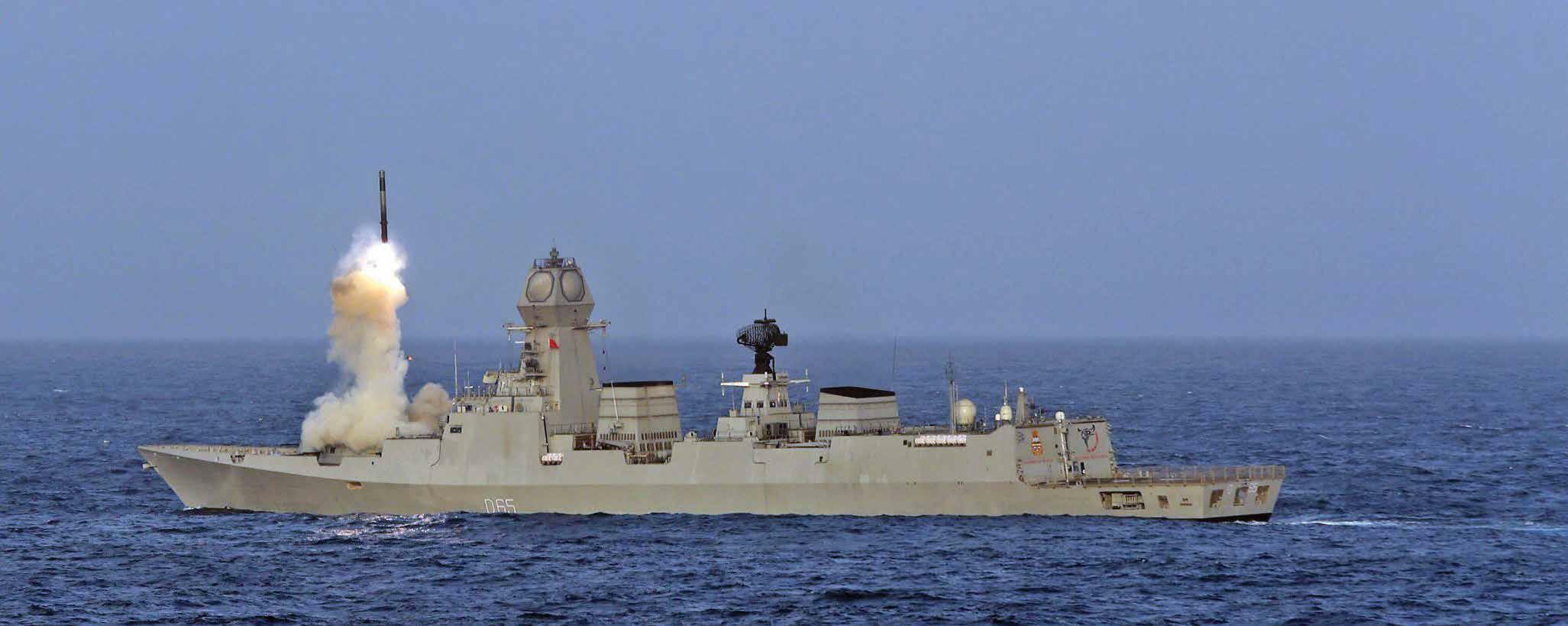
The last century was a transformative and transitional period in the history of contemporary warfare as new generation kinetic strike weapons took to the skies after the Second World War.
Starting right from the first Gulf War in 1990 and ending with the Afghanistan, Iraq, Libya and Syria campaigns in the first two decades of the 21st century, and now as visible in the ongoing Russia-Ukraine War, the world has witnessed the usage of game-changing aerial weapons which tipped the balance in the aggressor's favour in the opening hours of the war. Such weapons play a very critical role not just in maintaining conventional deterrence, but also in executing tactical-level nuclear strikes over the enemy's ground-based infantry battalions and armoured mobile formations in case of an escalation.
The emergence of turbofan engine-powered terrain-hugging cruise missiles which can fly at lower altitudes (below enemy radar coverage) and treetop heights, are some of the most formidable and destructive weapons in the conventional battlefield. A heavy barrage of air-launched, ship-launched, submarine launched and ground-launched cruise missiles during wars can take out the enemy's airfields, dams, bridges, railheads, army garrisons, anti-aircraft positions, heavy-artillery bases, underground nuclear weapons storage facilities and other important strategic installations in the opening hours of the war thus clearing the way for an aerial kinetic bombardment campaign and simultaneous ground incursion inside hostile territory.
Unlike heavyweight ballistic missiles which have larger CEP (Circular Error Probability) and can be used for devastating nuclear strikes on enemy cities, cruise missiles are lightweight, tremendously manoeuvrable and highly accurate.


This story is from the February 2025 edition of Geopolitics.
Subscribe to Magzter GOLD to access thousands of curated premium stories, and 10,000+ magazines and newspapers.
Already a subscriber? Sign In
MORE STORIES FROM Geopolitics
Geopolitics
Navy Flags Critical Engine Dependency Gap
Despite significant advances in indigenous warship construction, India's continued reliance on foreign marine propulsion systems remains a critical vulnerability in its defence framework.

1 mins
April 2026
Geopolitics
GTRE Advances Engine Testing With Su-30
India's aero-engine development programme is set to accelerate as GTRE proceeds to convert two Su-30 MKI fighters into dedicated flying testbeds, enabling real-time validation of indigenous propulsion technologies.
1 mins
April 2026
Geopolitics
Indigenous Anti-Tank Missile Nears Production Clearance
India's indigenous man-portable anti-tank guided missile is approaching final clearance for mass production following successful validation trials against moving targets.
1 min
April 2026
Geopolitics
A RE-LOOK AT INDIAN MILITARY LOGISTICS & THEATRE COMMANDS
JOSEPH P CHACKO explains why logistics systems must be integrated to be capable of seamlessly supporting modern warfare operations, which necessitate rapid, coordinated responses across multiple domains
14 mins
April 2026
Geopolitics
Defence Spending Drives Acquisition Surge
India's defence modernisation programme has entered a phase of rapid implementation, with FY 2025-26 seeing full utilisation of capital expenditure and a clear focus on addressing critical capability gaps across the armed forces.
3 mins
April 2026

Geopolitics
K9 Vajra Hits mega Indigenisation
India's India's flagship tracked artillery programme has reached a crucial turning point, with the K9 Vajra-T now achieving over 82 per cent indigenous content at the work package level, marking a fundamental shift in domestic defence manufacturing capability.
1 min
April 2026

Geopolitics
NUCLEAR SHARKS OF STEEL!
India’s third Arihant-class submarine, INS Aridhaman, was commissioned into the Indian Navy on April 3, 2026, at Visakhapatnam by Defence Minister Rajnath Singh.
2 mins
April 2026

Geopolitics
Army Eyes Tank-Launched Drone Strikes
The Indian Army is advancing a new concept to equip its main battle tanks with indigenous loitering munitions that can be deployed directly from existing 81mm smoke grenade launchers.
1 min
April 2026

Geopolitics
THE ANATOMY OF A POLARISED FRONTIER
West Bengal has changed from a longtime “Red Bastion” to one of the most hotly contested states in Indian politics.
2 mins
April 2026

Geopolitics
Navy Advances Drone-Ready Amphibious Carriers
India's next-generation amphibious warfare programme has entered a crucial -phase as the Navy advances its evaluation of four large-deck platforms designed to revolutionise expeditionary operations.
1 mins
April 2026
Listen
Translate
Change font size