
Go Unlimited with Magzter GOLD
Get unlimited access to 10,000+ magazines, newspapers and Premium stories for just
Try GOLD - Free
The Lives of Dead Trees
Scientific American
|October 2025
Forest ecologist Mark Harmon has been exhaustively examining dead logs for 40 years, and he's found a complex world few people see
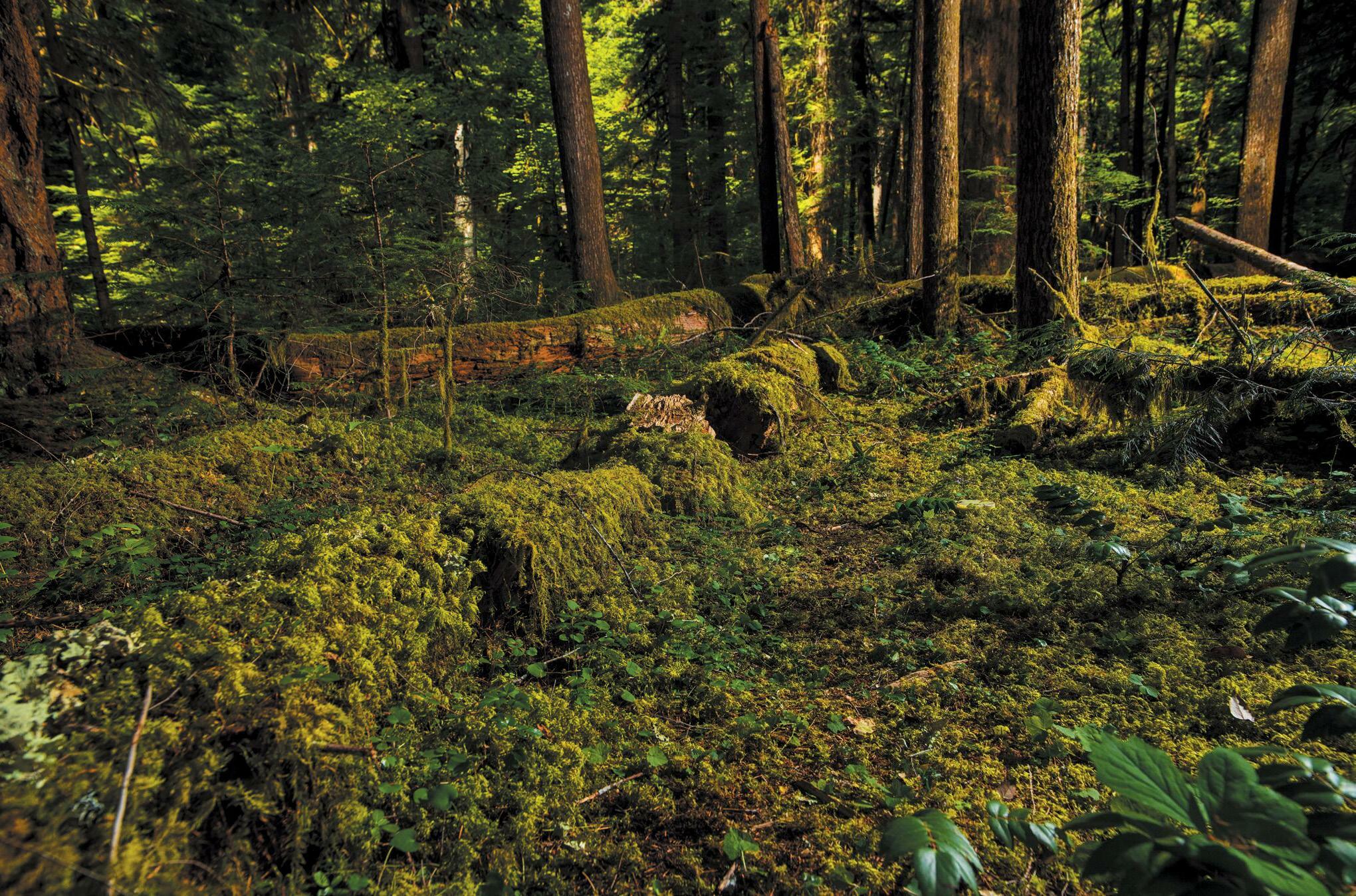
MARK HARMON CROUCHES LOW next to log number 219: a moss-covered western hemlock tree trunk, five meters long, lying dead on the ground in the lush green woods.
It's marked by a thin aluminum tag. The forest ecologist leans in close, his unruly white beard nearly brushing against the decomposing cylinder. Dark, flaky patches on the dull, reddish-brown wood closer to the ground show where fungi have infiltrated the cellulose within. Farther down the trunk, multicolored fungal conks protrude like hard shelves barely big enough for a mouse. A shiny black beetle scurries along the ground, then out of sight under the log. Harmon presses gently on 219 with three fingertips. It's so spongy that he is reluctant to roll back a chunk of it to reveal what lies underneath. “Oh, I don’t want to destroy it,” he says slowly. “It’s all falling apart.”
Harmon, a longtime faculty member at Oregon State University, has been watching number 219, and more than 500 other logs nearby, decay for 40 years. He has trekked to this site in the H. J. Andrews Experimental Forest, a watershed nestled in Oregon’s western Cascade Mountains, at least 100 times. He drives more than two hours on paved and gravel roads from his home in Corvallis, Ore., then hikes in half a mile through the undergrowth, carrying tape measures, scales, saws and a computer to chronicle the relentless changes. His goal: establish an exhaustive baseline dataset that any scientist could use to test hypotheses about tree decomposition or to compare patterns of decomposition in the Pacific Northwest with those in other regions.

This story is from the October 2025 edition of Scientific American.
Subscribe to Magzter GOLD to access thousands of curated premium stories, and 10,000+ magazines and newspapers.
Already a subscriber? Sign In
MORE STORIES FROM Scientific American

Scientific American
The Quiet Math Problem That Runs the Planet
How Diffie-Hellman key exchange secures everything from your text messages to government secrets

7 mins
May 2026

Scientific American
The Fog of Science
Did an adversary just invent a world-changing weapon, or are they making it up? DARPA is building an AI to instantly call their bluff
4 mins
May 2026

Scientific American
The Hubble Space Telescope Is Still Awesome
Hubble is going strong despite its decades in space and next-generation successors
4 mins
May 2026

Scientific American
Meet America's Native Bees
Scientists estimate there are about 4,000 species of native bees in the U.S.
5 mins
May 2026

Scientific American
The Chemistry of Desire
Inside the secretive laboratories where scientists build novel molecules to make luxury fragrance feel like pure emotion
5 mins
May 2026
Scientific American
Scanning the Stone
As ore gets harder to find, the mining industry is turning to subatomic-particle sensors to push deep underground
8 mins
May 2026

Scientific American
YOUR HEART IN FLAMES
Inflammation may be the true cause of cardiovascular diseaseand there's a drug to treat it
13 mins
May 2026
Scientific American
Ancient Lexicon
Stone Age art may reveal a 40,000-year-old precursor to writing
2 mins
May 2026

Scientific American
Thermal Breakthrough
A new super heat conductor challenges fundamental physics
2 mins
May 2026

Scientific American
How to Vacation in Space
Planned orbital hotels promise luxury, but can they deliver?
4 mins
May 2026
Listen
Translate
Change font size