
Mit Magzter GOLD unbegrenztes Potenzial nutzen
Erhalten Sie unbegrenzten Zugriff auf über 9.000 Zeitschriften, Zeitungen und Premium-Artikel für nur
The Lives of Dead Trees
Scientific American
|October 2025
Forest ecologist Mark Harmon has been exhaustively examining dead logs for 40 years, and he's found a complex world few people see
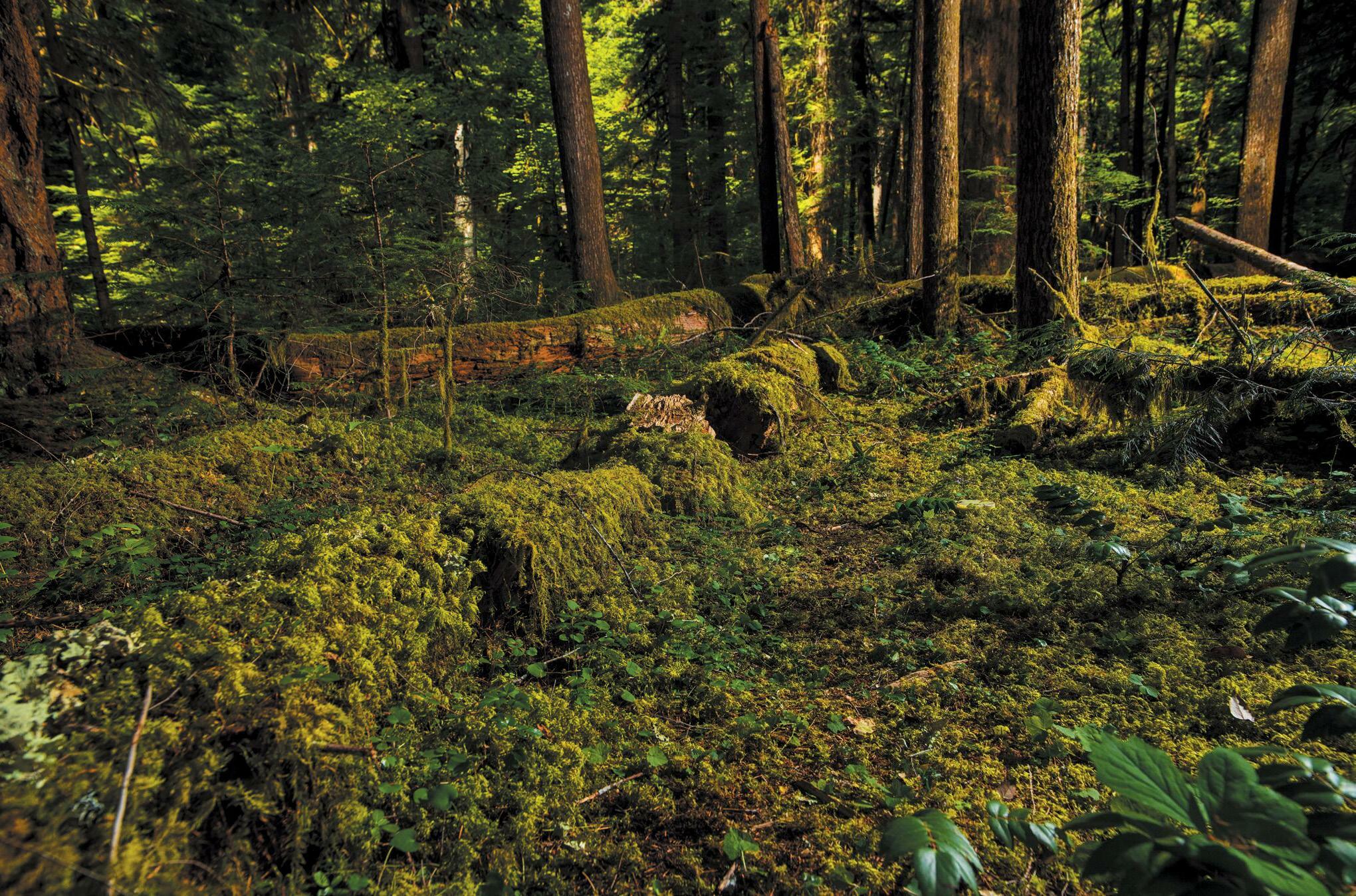
MARK HARMON CROUCHES LOW next to log number 219: a moss-covered western hemlock tree trunk, five meters long, lying dead on the ground in the lush green woods.
It's marked by a thin aluminum tag. The forest ecologist leans in close, his unruly white beard nearly brushing against the decomposing cylinder. Dark, flaky patches on the dull, reddish-brown wood closer to the ground show where fungi have infiltrated the cellulose within. Farther down the trunk, multicolored fungal conks protrude like hard shelves barely big enough for a mouse. A shiny black beetle scurries along the ground, then out of sight under the log. Harmon presses gently on 219 with three fingertips. It's so spongy that he is reluctant to roll back a chunk of it to reveal what lies underneath. “Oh, I don’t want to destroy it,” he says slowly. “It’s all falling apart.”
Harmon, a longtime faculty member at Oregon State University, has been watching number 219, and more than 500 other logs nearby, decay for 40 years. He has trekked to this site in the H. J. Andrews Experimental Forest, a watershed nestled in Oregon’s western Cascade Mountains, at least 100 times. He drives more than two hours on paved and gravel roads from his home in Corvallis, Ore., then hikes in half a mile through the undergrowth, carrying tape measures, scales, saws and a computer to chronicle the relentless changes. His goal: establish an exhaustive baseline dataset that any scientist could use to test hypotheses about tree decomposition or to compare patterns of decomposition in the Pacific Northwest with those in other regions.

Diese Geschichte stammt aus der October 2025-Ausgabe von Scientific American.
Abonnieren Sie Magzter GOLD, um auf Tausende kuratierter Premium-Geschichten und über 9.000 Zeitschriften und Zeitungen zuzugreifen.
Sie sind bereits Abonnent? Anmelden
WEITERE GESCHICHTEN VON Scientific American

Scientific American
Probiotic Hope and Hype
Despite their popularity, supplements with billions of \"good\" microbes help only a few illnesses, research shows

3 mins
January 2026

Scientific American
Mondays Really Are More Stressful
The start of the workweek can be a biologically measurable stressor, with consequences for long-term health that can stretch into retirement
4 mins
January 2026
Scientific American
Tiny Display
An e-paper breakthrough brings extremely high-resolution color
2 mins
January 2026
Scientific American
Fine-Feathered Snack
A bat's tracker documents a dramatic midair hunt
2 mins
January 2026

Scientific American
OUR ROBOTIC PICTURE
Will mechanical helpers ever be commonplace at home, at work and beyond?
11 mins
January 2026

Scientific American
"Use Your Words" Can Be Good for Kids' Health
Writing or expressing feelings can help adults mentally and physically. Kids are no different
5 mins
January 2026
Scientific American
Distant Diplomacy
Unrelated species “talk” and understand one another to avoid threats
2 mins
January 2026

Scientific American
Behind the Nobel
A 2025 winner reflects on the mysterious T cells that won him the prize
5 mins
January 2026

Scientific American
A Suite of Killers
Heart ailments, kidney diseases and type 2 diabetes actually may be part of just one condition. It's called CKM syndrome
10 mins
January 2026
Scientific American
Static Launch
Tiny worms leap toward their fruit fly hosts with an electric “tractor beam”
3 mins
January 2026
Listen
Translate
Change font size