Try GOLD - Free
The Landslide in Your Backyard
Scientific American
|October 2025
As climate change brings more intense rain to the mountains, dangerous debris flows are on the rise
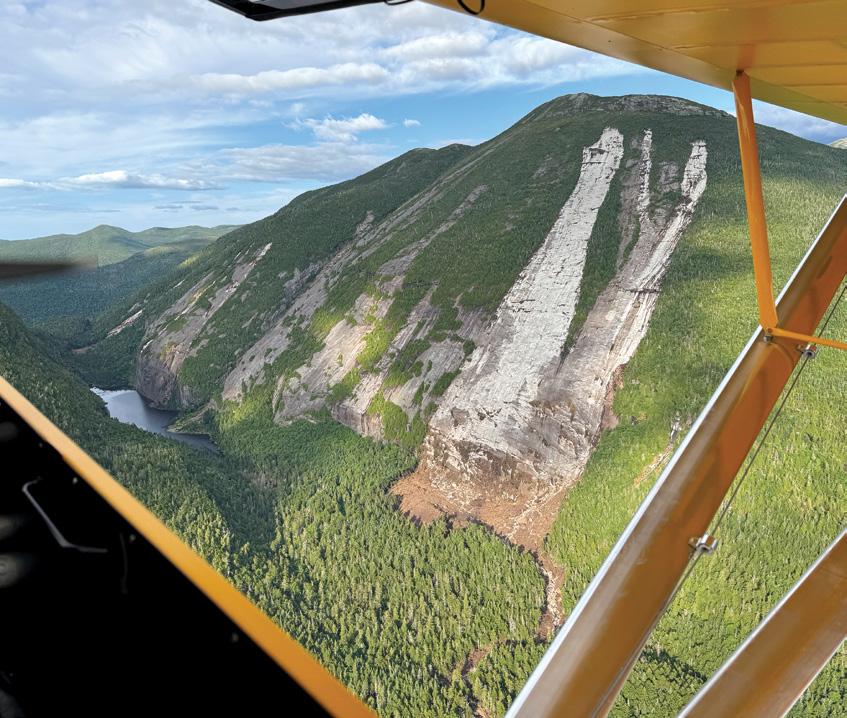
THE LANDSLIDE BEHIND MY NEIGHBOR'S BACKYARD doesn't exist—not according to the New York State landslide map or Greene County's hazard-mitigation plan or the federal inventory managed by the U.S. Geological Survey. But when you're standing in the middle of the debris field, the violence of the event is still evident 14 years after it occurred. The fan of the landslide, where a surge of boulders and mud blasted the forest open after rushing down the steeper slopes of Arizona Mountain in the Catskills, is about 100 feet wide—an undulating plane of rocks, mangled tree trunks, and invasive plants such as Japanese stiltgrass that thrive in disturbed areas.
On a hot July day the seasonal stream that runs through this ravine, named the Shingle Kill, is small enough to step over. When Tropical Storm Irene hovered over these mountains on August 28, 2011, the Shingle Kill swelled like all the otherwise unremarkable streams in the area, frothing downhill in a torrent the color of chocolate milk. This storm was a particularly bad one, dropping up to 18 inches of rain on the northeastern escarpment of the Catskills. Throughout the region explosive rivers eroded their banks, flooding towns and ripping away buildings.
The first house the Shingle Kill passes as it emerges into our community belonged at the time to Diane and Ken Herchenroder, who had lived there for nearly three decades. In the past, when the Shingle Kill occasionally raged, they could hear rocks colliding in the streambed. But this time it was louder—and faster.


This story is from the October 2025 edition of Scientific American.
Subscribe to Magzter GOLD to access thousands of curated premium stories, and 10,000+ magazines and newspapers.
Already a subscriber? Sign In
MORE STORIES FROM Scientific American

Scientific American
Let There Be Weapons
The Department of Energy’s new Genesis Mission promises AI-accelerated discovery. Seven of its first 26 challenges focus on nuclear weapons and national security

4 mins
July/August 2026

Scientific American
How to Fix Science
The federal funding system for scientific research in the U.S. needs reform
9 mins
July/August 2026

Scientific American
Robots Can Now Fold Your Laundry
Home-helper tasks are becoming easier for robotic assistants
4 mins
July/August 2026

Scientific American
50, 100 & 150 Years
NATURAL FISSION REACTOR
3 mins
July/August 2026

Scientific American
Anna Ho
Describing the characteristics of short-lived astrophysical events
1 mins
July/August 2026

Scientific American
THE SOLILOQUY OF SCHRÖDINGER'S CAT
A MEDITATION ON LIFE AND THE VON NEUMANN–WIGNER INTERPRETATION OF QUANTUM MECHANICS
1 min
July/August 2026

Scientific American
Mikhail Kolmogorov
Developing software to reveal large genetic changes that lead to cancer
1 mins
July/August 2026

Scientific American
Jaye Gardiner
Learning how the matrix around cells and tissues impacts cancers
1 mins
July/August 2026

Scientific American
Timnit Gebru
On safeguarding independent research in the age of big tech
3 mins
July/August 2026

Scientific American
A Youthful Illusion Sharpens Memory
By making people feel as if their face is a younger version of itself, researchers can bring childhood memories into sharper focus
4 mins
July/August 2026
Listen
Translate
Change font size