
Mit Magzter GOLD unbegrenztes Potenzial nutzen
Erhalten Sie unbegrenzten Zugriff auf über 9.000 Zeitschriften, Zeitungen und Premium-Artikel für nur
The Landslide in Your Backyard
Scientific American
|October 2025
As climate change brings more intense rain to the mountains, dangerous debris flows are on the rise
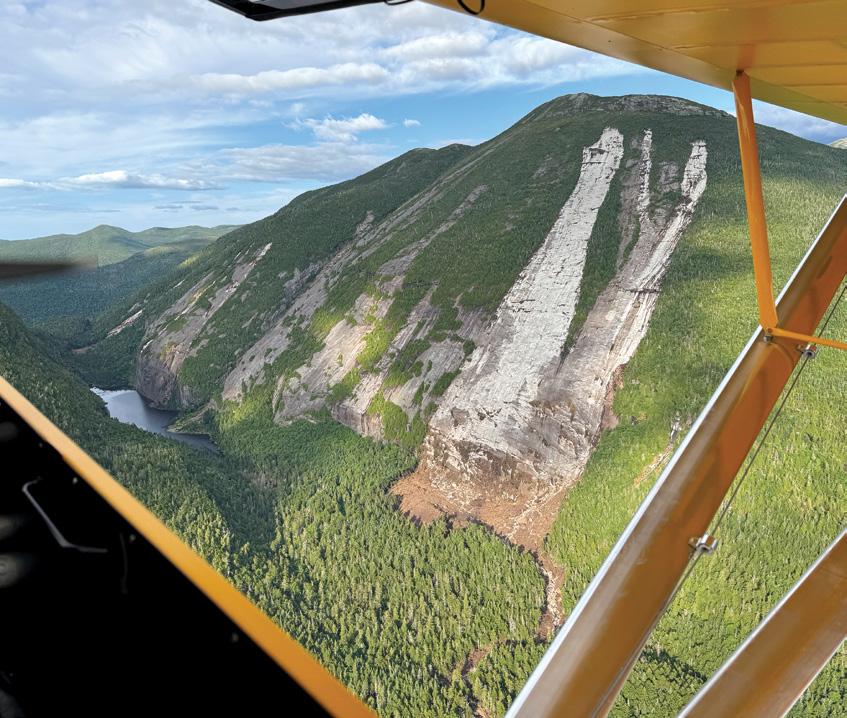
THE LANDSLIDE BEHIND MY NEIGHBOR'S BACKYARD doesn't exist—not according to the New York State landslide map or Greene County's hazard-mitigation plan or the federal inventory managed by the U.S. Geological Survey. But when you're standing in the middle of the debris field, the violence of the event is still evident 14 years after it occurred. The fan of the landslide, where a surge of boulders and mud blasted the forest open after rushing down the steeper slopes of Arizona Mountain in the Catskills, is about 100 feet wide—an undulating plane of rocks, mangled tree trunks, and invasive plants such as Japanese stiltgrass that thrive in disturbed areas.
On a hot July day the seasonal stream that runs through this ravine, named the Shingle Kill, is small enough to step over. When Tropical Storm Irene hovered over these mountains on August 28, 2011, the Shingle Kill swelled like all the otherwise unremarkable streams in the area, frothing downhill in a torrent the color of chocolate milk. This storm was a particularly bad one, dropping up to 18 inches of rain on the northeastern escarpment of the Catskills. Throughout the region explosive rivers eroded their banks, flooding towns and ripping away buildings.
The first house the Shingle Kill passes as it emerges into our community belonged at the time to Diane and Ken Herchenroder, who had lived there for nearly three decades. In the past, when the Shingle Kill occasionally raged, they could hear rocks colliding in the streambed. But this time it was louder—and faster.


Diese Geschichte stammt aus der October 2025-Ausgabe von Scientific American.
Abonnieren Sie Magzter GOLD, um auf Tausende kuratierter Premium-Geschichten und über 9.000 Zeitschriften und Zeitungen zuzugreifen.
Sie sind bereits Abonnent? Anmelden
WEITERE GESCHICHTEN VON Scientific American

Scientific American
Probiotic Hope and Hype
Despite their popularity, supplements with billions of \"good\" microbes help only a few illnesses, research shows

3 mins
January 2026

Scientific American
Mondays Really Are More Stressful
The start of the workweek can be a biologically measurable stressor, with consequences for long-term health that can stretch into retirement
4 mins
January 2026

Scientific American
Tiny Display
An e-paper breakthrough brings extremely high-resolution color
2 mins
January 2026
Scientific American
Fine-Feathered Snack
A bat's tracker documents a dramatic midair hunt
2 mins
January 2026

Scientific American
OUR ROBOTIC PICTURE
Will mechanical helpers ever be commonplace at home, at work and beyond?
11 mins
January 2026

Scientific American
"Use Your Words" Can Be Good for Kids' Health
Writing or expressing feelings can help adults mentally and physically. Kids are no different
5 mins
January 2026

Scientific American
Distant Diplomacy
Unrelated species “talk” and understand one another to avoid threats
2 mins
January 2026

Scientific American
Behind the Nobel
A 2025 winner reflects on the mysterious T cells that won him the prize
5 mins
January 2026

Scientific American
A Suite of Killers
Heart ailments, kidney diseases and type 2 diabetes actually may be part of just one condition. It's called CKM syndrome
10 mins
January 2026

Scientific American
Static Launch
Tiny worms leap toward their fruit fly hosts with an electric “tractor beam”
3 mins
January 2026
Listen
Translate
Change font size