Try GOLD - Free
Science Makes the U.S. a Great Nation
Scientific American
|October 2025
History tells us what happens when great nations attack science

ONE OF HISTORY'S dark jokes is that the Roman Empire, for all its vaunted accomplishments, made only a single great “contribution” to science: the killing of Archimedes. Today the U.S. risks suffering the same kind of shame.
In 212 B.C.E. the Romans sacked the Greek city of Syracuse after a prolonged siege, and a Roman soldier killed Archimedes, then the greatest living mathematician, physicist and engineer—and one of the greatest minds of all time. Exact accounts vary, but according to one, Archimedes was engrossed in sketching a problem in sand when his murderer arrived, sword drawn. Covering his work, the mathematician said, “I beg of you, do not disturb this.” In response, the soldier struck down the 72-year-old man.
American science now faces its own sharpened edge. The Trump administration stands with its sword drawn. It’s choking our universities. It’s stamping out the free flow of ideas. It’s cutting funding to basic science. It’s ready to make the killing blow, all in the name of making America great again.
Despite declines in its favorability since the COVID pandemic, science remains one of the most trusted and best-regarded institutions in the U.S. And although modern science has many flaws, it is one of those few things we can point to as a society and say this, this, is what already makes us great.
Our technological and scientific prowess is the envy of the world, unmatched across the globe and indeed throughout human history. No other country, no other culture, no other civilization has matched what the U.S. has poured into fundamental research in the years since World War II.
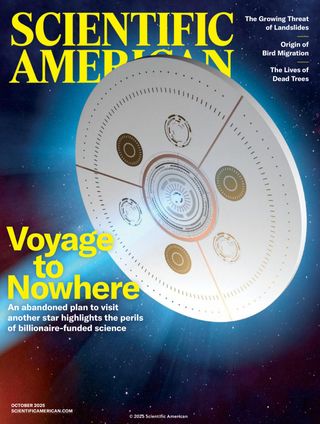

This story is from the October 2025 edition of Scientific American.
Subscribe to Magzter GOLD to access thousands of curated premium stories, and 10,000+ magazines and newspapers.
Already a subscriber? Sign In
MORE STORIES FROM Scientific American
Scientific American
Let There Be Weapons
The Department of Energy’s new Genesis Mission promises AI-accelerated discovery. Seven of its first 26 challenges focus on nuclear weapons and national security

4 mins
July/August 2026

Scientific American
How to Fix Science
The federal funding system for scientific research in the U.S. needs reform
9 mins
July/August 2026

Scientific American
Robots Can Now Fold Your Laundry
Home-helper tasks are becoming easier for robotic assistants
4 mins
July/August 2026

Scientific American
50, 100 & 150 Years
NATURAL FISSION REACTOR
3 mins
July/August 2026

Scientific American
Anna Ho
Describing the characteristics of short-lived astrophysical events
1 mins
July/August 2026

Scientific American
THE SOLILOQUY OF SCHRÖDINGER'S CAT
A MEDITATION ON LIFE AND THE VON NEUMANN–WIGNER INTERPRETATION OF QUANTUM MECHANICS
1 min
July/August 2026

Scientific American
Mikhail Kolmogorov
Developing software to reveal large genetic changes that lead to cancer
1 mins
July/August 2026

Scientific American
Jaye Gardiner
Learning how the matrix around cells and tissues impacts cancers
1 mins
July/August 2026

Scientific American
Timnit Gebru
On safeguarding independent research in the age of big tech
3 mins
July/August 2026

Scientific American
A Youthful Illusion Sharpens Memory
By making people feel as if their face is a younger version of itself, researchers can bring childhood memories into sharper focus
4 mins
July/August 2026
Listen
Translate
Change font size