
Go Unlimited with Magzter GOLD
Get unlimited access to 10,000+ magazines, newspapers and Premium stories for just
Science Makes the U.S. a Great Nation
Scientific American
|October 2025
History tells us what happens when great nations attack science

ONE OF HISTORY'S dark jokes is that the Roman Empire, for all its vaunted accomplishments, made only a single great “contribution” to science: the killing of Archimedes. Today the U.S. risks suffering the same kind of shame.
In 212 B.C.E. the Romans sacked the Greek city of Syracuse after a prolonged siege, and a Roman soldier killed Archimedes, then the greatest living mathematician, physicist and engineer—and one of the greatest minds of all time. Exact accounts vary, but according to one, Archimedes was engrossed in sketching a problem in sand when his murderer arrived, sword drawn. Covering his work, the mathematician said, “I beg of you, do not disturb this.” In response, the soldier struck down the 72-year-old man.
American science now faces its own sharpened edge. The Trump administration stands with its sword drawn. It’s choking our universities. It’s stamping out the free flow of ideas. It’s cutting funding to basic science. It’s ready to make the killing blow, all in the name of making America great again.
Despite declines in its favorability since the COVID pandemic, science remains one of the most trusted and best-regarded institutions in the U.S. And although modern science has many flaws, it is one of those few things we can point to as a society and say this, this, is what already makes us great.
Our technological and scientific prowess is the envy of the world, unmatched across the globe and indeed throughout human history. No other country, no other culture, no other civilization has matched what the U.S. has poured into fundamental research in the years since World War II.
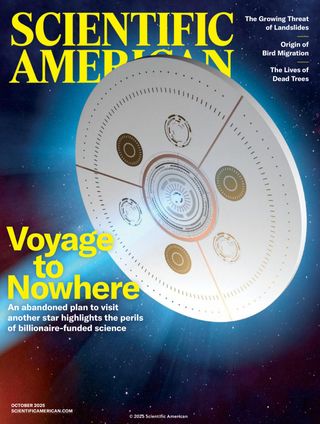

This story is from the October 2025 edition of Scientific American.
Subscribe to Magzter GOLD to access thousands of curated premium stories, and 10,000+ magazines and newspapers.
Already a subscriber? Sign In
MORE STORIES FROM Scientific American

Scientific American
Probiotic Hope and Hype
Despite their popularity, supplements with billions of \"good\" microbes help only a few illnesses, research shows

3 mins
January 2026

Scientific American
Mondays Really Are More Stressful
The start of the workweek can be a biologically measurable stressor, with consequences for long-term health that can stretch into retirement
4 mins
January 2026

Scientific American
Tiny Display
An e-paper breakthrough brings extremely high-resolution color
2 mins
January 2026
Scientific American
Fine-Feathered Snack
A bat's tracker documents a dramatic midair hunt
2 mins
January 2026

Scientific American
OUR ROBOTIC PICTURE
Will mechanical helpers ever be commonplace at home, at work and beyond?
11 mins
January 2026

Scientific American
"Use Your Words" Can Be Good for Kids' Health
Writing or expressing feelings can help adults mentally and physically. Kids are no different
5 mins
January 2026

Scientific American
Distant Diplomacy
Unrelated species “talk” and understand one another to avoid threats
2 mins
January 2026

Scientific American
Behind the Nobel
A 2025 winner reflects on the mysterious T cells that won him the prize
5 mins
January 2026

Scientific American
A Suite of Killers
Heart ailments, kidney diseases and type 2 diabetes actually may be part of just one condition. It's called CKM syndrome
10 mins
January 2026

Scientific American
Static Launch
Tiny worms leap toward their fruit fly hosts with an electric “tractor beam”
3 mins
January 2026
Listen
Translate
Change font size