Try GOLD - Free
My Childhood in Science
Scientific American
|July/August 2026
The story of the author's extremely early career
In late 1957, around my ninth birthday, the Soviet Union launched the world's first artificial satellite, called Sputnik. I became entranced with the idea of building a rocket of my own. I imagined the lift-off, the graceful arc of the craft as it careened through space. By the age of 13 or 14 I had started mixing my own rocket fuels. A fuel that burned too fast would explode like a bomb; a fuel that burned too slow would smolder like a barbecue grill. I settled on a particular mixture of sulfur, charcoal and potassium nitrate. The body of the rocket, I built out of an aluminum tube. For the ignition system, I used the flashbulb of a Kodak Brownie camera embedded within the fuel chamber. The launching pad, I made out of a Coca-Cola crate filled with concrete, anchoring it with a V-shaped steel girder tilted skyward at 45 degrees.
Somehow I had got it into my head that I needed a passenger. So I built a capsule, to be housed in the upper fuselage of the rocket, and recruited a lizard to ride in it as my astronaut. I constructed a parachute out of silk handkerchiefs and carefully wrapped it around the capsule. A small gunpowder charge-ignited by a mercury switch, a AAA battery and a high-resistance wire-would eject the capsule at the highest point of the trajectory.
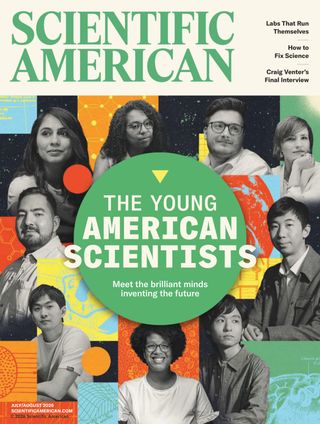

This story is from the July/August 2026 edition of Scientific American.
Subscribe to Magzter GOLD to access thousands of curated premium stories, and 10,000+ magazines and newspapers.
Already a subscriber? Sign In
MORE STORIES FROM Scientific American
Scientific American
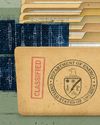
Let There Be Weapons
The Department of Energy’s new Genesis Mission promises AI-accelerated discovery. Seven of its first 26 challenges focus on nuclear weapons and national security

4 mins
July/August 2026

Scientific American
How to Fix Science
The federal funding system for scientific research in the U.S. needs reform
9 mins
July/August 2026

Scientific American
Robots Can Now Fold Your Laundry
Home-helper tasks are becoming easier for robotic assistants
4 mins
July/August 2026
Scientific American
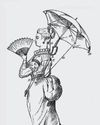
50, 100 & 150 Years
NATURAL FISSION REACTOR
3 mins
July/August 2026

Scientific American
Anna Ho
Describing the characteristics of short-lived astrophysical events
1 mins
July/August 2026
Scientific American
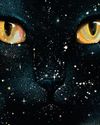
THE SOLILOQUY OF SCHRÖDINGER'S CAT
A MEDITATION ON LIFE AND THE VON NEUMANN–WIGNER INTERPRETATION OF QUANTUM MECHANICS
1 min
July/August 2026

Scientific American
Mikhail Kolmogorov
Developing software to reveal large genetic changes that lead to cancer
1 mins
July/August 2026

Scientific American
Jaye Gardiner
Learning how the matrix around cells and tissues impacts cancers
1 mins
July/August 2026

Scientific American
Timnit Gebru
On safeguarding independent research in the age of big tech
3 mins
July/August 2026

Scientific American
A Youthful Illusion Sharpens Memory
By making people feel as if their face is a younger version of itself, researchers can bring childhood memories into sharper focus
4 mins
July/August 2026
Listen
Translate
Change font size