Try GOLD - Free
Gut Check
Scientific American
|September 2025
Microbes in the human intestines may absorb dangerous PFAS

LURKING IN OUR NONSTICK PANS, our rain jackets and even our drinking water are toxic compounds known as perfluoroalkyl and polyfluoroalkyl substances (PFAS), also called “forever chemicals.” They can take hundreds of years to break down in the environment and are increasingly being detected in human blood and bodily tissues—where, research suggests, they can lead to several cancers and reproductive disorders, as well as thyroid disease and a weakened immune system. Scientists have been scrambling to find ways to remove PFAS from our surroundings before they reach human bodies. But one team may have found a way to tackle them afterward, too.
Bacteria commonly found in the human gut, such as Bacteroides uniformis and Odoribacter splanchnicus, could possibly be used to gather up PFAS and carry them out as waste, scientists suggest in a study published recently in Nature Microbiology.
“I think this research provides us a little glimmer of hope that it’s not all doom and gloom” when it comes to the PFAS problem, says study senior author Kiran Patil, a molecular biologist at the University of Cambridge. “Our bacteria—that have been our companions for thousands of years—may already be helping us do something about it.”
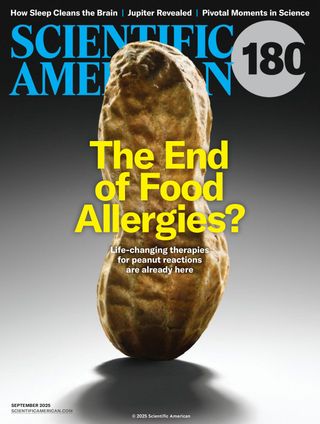

This story is from the September 2025 edition of Scientific American.
Subscribe to Magzter GOLD to access thousands of curated premium stories, and 10,000+ magazines and newspapers.
Already a subscriber? Sign In
MORE STORIES FROM Scientific American
Scientific American
Let There Be Weapons
The Department of Energy’s new Genesis Mission promises AI-accelerated discovery. Seven of its first 26 challenges focus on nuclear weapons and national security

4 mins
July/August 2026

Scientific American
How to Fix Science
The federal funding system for scientific research in the U.S. needs reform
9 mins
July/August 2026

Scientific American
Robots Can Now Fold Your Laundry
Home-helper tasks are becoming easier for robotic assistants
4 mins
July/August 2026

Scientific American
50, 100 & 150 Years
NATURAL FISSION REACTOR
3 mins
July/August 2026

Scientific American
Anna Ho
Describing the characteristics of short-lived astrophysical events
1 mins
July/August 2026
Scientific American
THE SOLILOQUY OF SCHRÖDINGER'S CAT
A MEDITATION ON LIFE AND THE VON NEUMANN–WIGNER INTERPRETATION OF QUANTUM MECHANICS
1 min
July/August 2026

Scientific American
Mikhail Kolmogorov
Developing software to reveal large genetic changes that lead to cancer
1 mins
July/August 2026

Scientific American
Jaye Gardiner
Learning how the matrix around cells and tissues impacts cancers
1 mins
July/August 2026

Scientific American
Timnit Gebru
On safeguarding independent research in the age of big tech
3 mins
July/August 2026

Scientific American
A Youthful Illusion Sharpens Memory
By making people feel as if their face is a younger version of itself, researchers can bring childhood memories into sharper focus
4 mins
July/August 2026
Listen
Translate
Change font size