試す 金 - 無料
Gut Check
Scientific American
|September 2025
Microbes in the human intestines may absorb dangerous PFAS

LURKING IN OUR NONSTICK PANS, our rain jackets and even our drinking water are toxic compounds known as perfluoroalkyl and polyfluoroalkyl substances (PFAS), also called “forever chemicals.” They can take hundreds of years to break down in the environment and are increasingly being detected in human blood and bodily tissues—where, research suggests, they can lead to several cancers and reproductive disorders, as well as thyroid disease and a weakened immune system. Scientists have been scrambling to find ways to remove PFAS from our surroundings before they reach human bodies. But one team may have found a way to tackle them afterward, too.
Bacteria commonly found in the human gut, such as Bacteroides uniformis and Odoribacter splanchnicus, could possibly be used to gather up PFAS and carry them out as waste, scientists suggest in a study published recently in Nature Microbiology.
“I think this research provides us a little glimmer of hope that it’s not all doom and gloom” when it comes to the PFAS problem, says study senior author Kiran Patil, a molecular biologist at the University of Cambridge. “Our bacteria—that have been our companions for thousands of years—may already be helping us do something about it.”
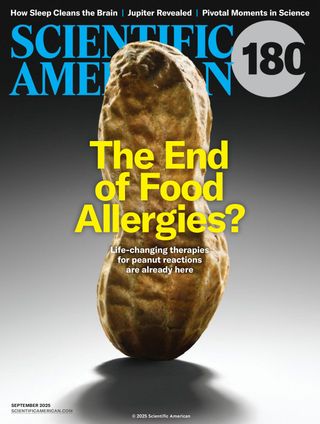

このストーリーは、Scientific American の September 2025 版からのものです。
Magzter GOLD を購読すると、厳選された何千ものプレミアム記事や、10,000 以上の雑誌や新聞にアクセスできます。
すでに購読者ですか? サインイン
Scientific American からのその他のストーリー

Scientific American
The Quiet Math Problem That Runs the Planet
How Diffie-Hellman key exchange secures everything from your text messages to government secrets

7 mins
May 2026

Scientific American
The Fog of Science
Did an adversary just invent a world-changing weapon, or are they making it up? DARPA is building an AI to instantly call their bluff
4 mins
May 2026

Scientific American
The Hubble Space Telescope Is Still Awesome
Hubble is going strong despite its decades in space and next-generation successors
4 mins
May 2026

Scientific American
Meet America's Native Bees
Scientists estimate there are about 4,000 species of native bees in the U.S.
5 mins
May 2026

Scientific American
The Chemistry of Desire
Inside the secretive laboratories where scientists build novel molecules to make luxury fragrance feel like pure emotion
5 mins
May 2026
Scientific American
Scanning the Stone
As ore gets harder to find, the mining industry is turning to subatomic-particle sensors to push deep underground
8 mins
May 2026

Scientific American
YOUR HEART IN FLAMES
Inflammation may be the true cause of cardiovascular diseaseand there's a drug to treat it
13 mins
May 2026

Scientific American
Ancient Lexicon
Stone Age art may reveal a 40,000-year-old precursor to writing
2 mins
May 2026

Scientific American
Thermal Breakthrough
A new super heat conductor challenges fundamental physics
2 mins
May 2026
Scientific American
How to Vacation in Space
Planned orbital hotels promise luxury, but can they deliver?
4 mins
May 2026
Listen
Translate
Change font size