Try GOLD - Free
Care for Family Caregivers
Scientific American
|March 2026
Helping sick, aging loved ones can cause physical illness in the helper. It may be possible to increase resilience
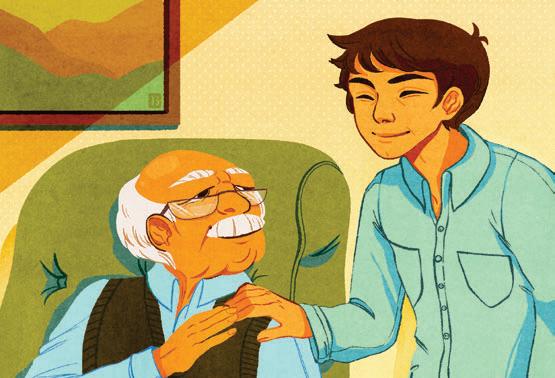
MY MOTHER LIVED WITH Alzheimer’s disease for 12 years.
Even with a lot of help, caregiving took a toll on me. It was physically hard to transfer her from bed to wheelchair, hard on my time when Mom couldn’t be left alone, and emotionally devastating as her decline took away the person I had known and loved. She passed away in 2024.
Roughly one in five American adults is now where I was: responsible for the care of a chronically ill or disabled loved one. About half of them are doing this work for elderly relatives. It is well known that family caregivers are at higher risk than noncaregivers for depression. But such helpers also have more than their share of diabetes, asthma, obesity and a variety of pain conditions. And they tend to die earlier. In a study by the U.S. Centers for Disease Control and Prevention released in 2024, caregivers scored worse than noncaregivers on 13 of 19 health indicators. The root cause, research shows, is chronic stress. It leads not only to mental distress but also, by hampering the immune system, to physical ailments.
Caregivers are finally getting some care, however. Scientists are using what they’ve learned about how stress affects mental and physical function to develop approaches that could strengthen resilience. “It’s important to understand that the caregiving itself, though a strain, does not determine worse mental and physical health,” says psychologist Elissa Epel, who directs the Aging, Metabolism and Emotions Center at the University of California, San Francisco. “There are a lot of resilience factors that can make a difference.”

This story is from the March 2026 edition of Scientific American.
Subscribe to Magzter GOLD to access thousands of curated premium stories, and 10,000+ magazines and newspapers.
Already a subscriber? Sign In
MORE STORIES FROM Scientific American
Scientific American
Let There Be Weapons
The Department of Energy’s new Genesis Mission promises AI-accelerated discovery. Seven of its first 26 challenges focus on nuclear weapons and national security

4 mins
July/August 2026

Scientific American
How to Fix Science
The federal funding system for scientific research in the U.S. needs reform
9 mins
July/August 2026

Scientific American
Robots Can Now Fold Your Laundry
Home-helper tasks are becoming easier for robotic assistants
4 mins
July/August 2026

Scientific American
50, 100 & 150 Years
NATURAL FISSION REACTOR
3 mins
July/August 2026

Scientific American
Anna Ho
Describing the characteristics of short-lived astrophysical events
1 mins
July/August 2026

Scientific American
THE SOLILOQUY OF SCHRÖDINGER'S CAT
A MEDITATION ON LIFE AND THE VON NEUMANN–WIGNER INTERPRETATION OF QUANTUM MECHANICS
1 min
July/August 2026

Scientific American
Mikhail Kolmogorov
Developing software to reveal large genetic changes that lead to cancer
1 mins
July/August 2026

Scientific American
Jaye Gardiner
Learning how the matrix around cells and tissues impacts cancers
1 mins
July/August 2026

Scientific American
Timnit Gebru
On safeguarding independent research in the age of big tech
3 mins
July/August 2026

Scientific American
A Youthful Illusion Sharpens Memory
By making people feel as if their face is a younger version of itself, researchers can bring childhood memories into sharper focus
4 mins
July/August 2026
Listen
Translate
Change font size