Essayer OR - Gratuit
Care for Family Caregivers
Scientific American
|March 2026
Helping sick, aging loved ones can cause physical illness in the helper. It may be possible to increase resilience
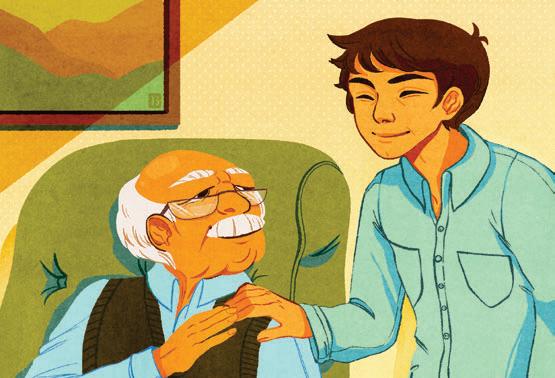
MY MOTHER LIVED WITH Alzheimer’s disease for 12 years.
Even with a lot of help, caregiving took a toll on me. It was physically hard to transfer her from bed to wheelchair, hard on my time when Mom couldn’t be left alone, and emotionally devastating as her decline took away the person I had known and loved. She passed away in 2024.
Roughly one in five American adults is now where I was: responsible for the care of a chronically ill or disabled loved one. About half of them are doing this work for elderly relatives. It is well known that family caregivers are at higher risk than noncaregivers for depression. But such helpers also have more than their share of diabetes, asthma, obesity and a variety of pain conditions. And they tend to die earlier. In a study by the U.S. Centers for Disease Control and Prevention released in 2024, caregivers scored worse than noncaregivers on 13 of 19 health indicators. The root cause, research shows, is chronic stress. It leads not only to mental distress but also, by hampering the immune system, to physical ailments.
Caregivers are finally getting some care, however. Scientists are using what they’ve learned about how stress affects mental and physical function to develop approaches that could strengthen resilience. “It’s important to understand that the caregiving itself, though a strain, does not determine worse mental and physical health,” says psychologist Elissa Epel, who directs the Aging, Metabolism and Emotions Center at the University of California, San Francisco. “There are a lot of resilience factors that can make a difference.”

Cette histoire est tirée de l'édition March 2026 de Scientific American.
Abonnez-vous à Magzter GOLD pour accéder à des milliers d'histoires premium sélectionnées et à plus de 9 000 magazines et journaux.
Déjà abonné ? Se connecter
PLUS D'HISTOIRES DE Scientific American
Scientific American
Scanning the Stone
As ore gets harder to find, the mining industry is turning to subatomic-particle sensors to push deep underground

8 mins
May 2026

Scientific American
YOUR HEART IN FLAMES
Inflammation may be the true cause of cardiovascular diseaseand there's a drug to treat it
13 mins
May 2026

Scientific American
Ancient Lexicon
Stone Age art may reveal a 40,000-year-old precursor to writing
2 mins
May 2026

Scientific American
Thermal Breakthrough
A new super heat conductor challenges fundamental physics
2 mins
May 2026
Scientific American
An Icy Ear
The world's deepest sensors will hear earthquakes anywhere on the planet
2 mins
May 2026

Scientific American
Melting Marvel
A strange substance bends the rules of glass and plastic
2 mins
May 2026
Scientific American
A NEW KIND OF MAGNET
How the discovery of altermagnets could change physics and computing
16 mins
May 2026

Scientific American
Discerning Chicks
A bird-brained \"bouba\" and \"kiki\" study challenges ideas of human language evolution
3 mins
May 2026
Scientific American
Boosting Science
Inside NASA's audacious plan to save a doomed space telescope
4 mins
May 2026

Scientific American
Love Island
Rare berry bonanza spurs a Kākāpō baby boom
3 mins
May 2026
Listen
Translate
Change font size