Try GOLD - Free
A Block-Stacking Problem with a Preposterous Solution
Scientific American
|October 2025
In principle, this impossible math allows for a glue-free bridge of stacked blocks that can stretch across the Grand Canyon- and into infinity
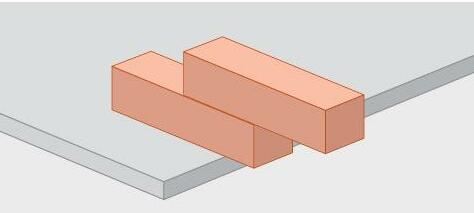
HERE'S A MIND-BLOWING EXPERIMENT you can try at home: Gather some children's blocks and place them on a table. Take one block and slowly push it over the table's edge, inch by inch, until it's on the brink of falling. If you possess patience and a steady hand, you should be able to balance it so that exactly half of it hangs off the edge. Nudge it any farther, and gravity wins. Now take two blocks and start over. With one stacked on top of the other, how far can you get the end of the top block to poke over the table's edge?
Keep going. If you stack as many blocks as you can, what is the farthest overhang you can achieve before the entire structure topples? Is it possible for the tower to extend a full block length beyond the lip of the table? Does physics permit two block lengths? The stunning answer is that the stacked bridge can stretch forever. In principle, a freestanding stack of blocks could span the Grand Canyon, no glue required.
Don't click "checkout" on an infinite pack of Jenga blocks just yet. Real-world practicalities such as irregular block shapes, air currents and the crushing weight of an endless edifice may hamper your engineering aspirations. Still, understanding why the overhang has no limit in an ideal mathematical world is enlightening. The explanation hinges on math's harmonic series and the physics concept of center of mass, two seemingly simple ideas with outsize power.
Your intuition might tell you that a single block can hang half of its mass beyond the table's edge before tipping. But why is that so? Every object has a center of mass—a single point at which we can imagine the entire object's weight to be concentrated when we're thinking about its balance. As long as the center of mass sits above the table, the object stays put. The moment that center of mass passes over an edge, however, gravity will pull the whole thing over.

This story is from the October 2025 edition of Scientific American.
Subscribe to Magzter GOLD to access thousands of curated premium stories, and 10,000+ magazines and newspapers.
Already a subscriber? Sign In
MORE STORIES FROM Scientific American

Scientific American
Let There Be Weapons
The Department of Energy’s new Genesis Mission promises AI-accelerated discovery. Seven of its first 26 challenges focus on nuclear weapons and national security

4 mins
July/August 2026

Scientific American
How to Fix Science
The federal funding system for scientific research in the U.S. needs reform
9 mins
July/August 2026

Scientific American
Robots Can Now Fold Your Laundry
Home-helper tasks are becoming easier for robotic assistants
4 mins
July/August 2026
Scientific American
50, 100 & 150 Years
NATURAL FISSION REACTOR
3 mins
July/August 2026

Scientific American
Anna Ho
Describing the characteristics of short-lived astrophysical events
1 mins
July/August 2026

Scientific American
THE SOLILOQUY OF SCHRÖDINGER'S CAT
A MEDITATION ON LIFE AND THE VON NEUMANN–WIGNER INTERPRETATION OF QUANTUM MECHANICS
1 min
July/August 2026

Scientific American
Mikhail Kolmogorov
Developing software to reveal large genetic changes that lead to cancer
1 mins
July/August 2026

Scientific American
Jaye Gardiner
Learning how the matrix around cells and tissues impacts cancers
1 mins
July/August 2026

Scientific American
Timnit Gebru
On safeguarding independent research in the age of big tech
3 mins
July/August 2026

Scientific American
A Youthful Illusion Sharpens Memory
By making people feel as if their face is a younger version of itself, researchers can bring childhood memories into sharper focus
4 mins
July/August 2026
Listen
Translate
Change font size