
Go Unlimited with Magzter GOLD
Get unlimited access to 10,000+ magazines, newspapers and Premium stories for just
A Block-Stacking Problem with a Preposterous Solution
Scientific American
|October 2025
In principle, this impossible math allows for a glue-free bridge of stacked blocks that can stretch across the Grand Canyon- and into infinity
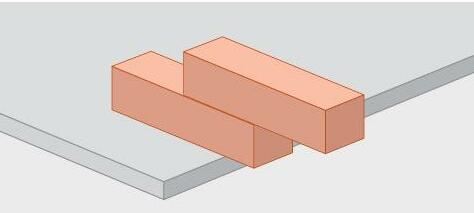
HERE'S A MIND-BLOWING EXPERIMENT you can try at home: Gather some children's blocks and place them on a table. Take one block and slowly push it over the table's edge, inch by inch, until it's on the brink of falling. If you possess patience and a steady hand, you should be able to balance it so that exactly half of it hangs off the edge. Nudge it any farther, and gravity wins. Now take two blocks and start over. With one stacked on top of the other, how far can you get the end of the top block to poke over the table's edge?
Keep going. If you stack as many blocks as you can, what is the farthest overhang you can achieve before the entire structure topples? Is it possible for the tower to extend a full block length beyond the lip of the table? Does physics permit two block lengths? The stunning answer is that the stacked bridge can stretch forever. In principle, a freestanding stack of blocks could span the Grand Canyon, no glue required.
Don't click "checkout" on an infinite pack of Jenga blocks just yet. Real-world practicalities such as irregular block shapes, air currents and the crushing weight of an endless edifice may hamper your engineering aspirations. Still, understanding why the overhang has no limit in an ideal mathematical world is enlightening. The explanation hinges on math's harmonic series and the physics concept of center of mass, two seemingly simple ideas with outsize power.
Your intuition might tell you that a single block can hang half of its mass beyond the table's edge before tipping. But why is that so? Every object has a center of mass—a single point at which we can imagine the entire object's weight to be concentrated when we're thinking about its balance. As long as the center of mass sits above the table, the object stays put. The moment that center of mass passes over an edge, however, gravity will pull the whole thing over.

This story is from the October 2025 edition of Scientific American.
Subscribe to Magzter GOLD to access thousands of curated premium stories, and 10,000+ magazines and newspapers.
Already a subscriber? Sign In
MORE STORIES FROM Scientific American

Scientific American
Probiotic Hope and Hype
Despite their popularity, supplements with billions of \"good\" microbes help only a few illnesses, research shows

3 mins
January 2026

Scientific American
Mondays Really Are More Stressful
The start of the workweek can be a biologically measurable stressor, with consequences for long-term health that can stretch into retirement
4 mins
January 2026
Scientific American
Tiny Display
An e-paper breakthrough brings extremely high-resolution color
2 mins
January 2026

Scientific American
Fine-Feathered Snack
A bat's tracker documents a dramatic midair hunt
2 mins
January 2026

Scientific American
OUR ROBOTIC PICTURE
Will mechanical helpers ever be commonplace at home, at work and beyond?
11 mins
January 2026

Scientific American
"Use Your Words" Can Be Good for Kids' Health
Writing or expressing feelings can help adults mentally and physically. Kids are no different
5 mins
January 2026

Scientific American
Distant Diplomacy
Unrelated species “talk” and understand one another to avoid threats
2 mins
January 2026

Scientific American
Behind the Nobel
A 2025 winner reflects on the mysterious T cells that won him the prize
5 mins
January 2026

Scientific American
A Suite of Killers
Heart ailments, kidney diseases and type 2 diabetes actually may be part of just one condition. It's called CKM syndrome
10 mins
January 2026

Scientific American
Static Launch
Tiny worms leap toward their fruit fly hosts with an electric “tractor beam”
3 mins
January 2026
Listen
Translate
Change font size