Try GOLD - Free
HOW THE IVY LEAGUE BROKE AMERICA
The Atlantic
|December 2024
THE MERITOCRACY ISN'T WORKING. WE NEED SOMETHING NEW.

Every coherent society has a social ideal—an image of what the superior person looks like. In America, from the late 19th century until sometime in the 1950s, the superior person was the Well-Bred Man. Such a man was born into one of the old WASP families that dominated the elite social circles on Fifth Avenue, in New York City; the Main Line, outside Philadelphia; Beacon Hill, in Boston. He was molded at a prep school like Groton or Choate, and came of age at Harvard, Yale, or Princeton.
In those days, you didn't have to be brilliant or hardworking to get into Harvard, but it really helped if you were "clubbable"good-looking, athletic, graceful, casually elegant, Episcopalian, and white. It really helped, too, if your dad had gone there. Once on campus, studying was frowned upon. Those who cared about academics-the "grinds"'-were social outcasts.
But students competed ferociously to get into the elite social clubs: Ivy at Princeton, Skull and Bones at Yale, the Porcellian at Harvard.
These clubs provided the well-placed few with the connections that would help them ascend to white-shoe law firms, to prestigious banks, to the State Department, perhaps even to the White House. (From 1901 to 1921, every American president went to Harvard, Yale, or Princeton.) People living according to this social ideal valued not academic accomplishment but refined manners, prudent judgment, and the habit of command. This was the age of social privilege.
And then a small group of college administrators decided to blow it all up. The most important of them was James Conant, the president of Harvard from 1933 to 1953. Conant looked around and concluded that American democracy was being undermined by a "hereditary aristocracy of wealth."
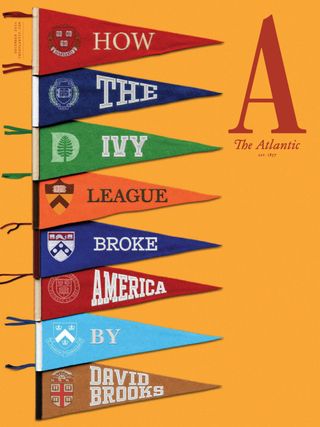

This story is from the December 2024 edition of The Atlantic.
Subscribe to Magzter GOLD to access thousands of curated premium stories, and 10,000+ magazines and newspapers.
Already a subscriber? Sign In
MORE STORIES FROM The Atlantic

The Atlantic
The First 18 Months
A Cabinet meeting with my son, who is exactly as old as the current administration

2 mins
July 2026
The Atlantic
What Dogs See
To understand a painting, look for the canine.
10 mins
July 2026

The Atlantic
Boy George
Finally, an action movie about Washington’s French and Indian War years.
5 mins
July 2026

The Atlantic
Disneyland With No People
When I was 17, I worked at Fantasyland’s magic shop as a magician demonstrating Svengali decks, cups and balls, and the Incredible (their word) Shrinking Die.
4 mins
July 2026

The Atlantic
THE REBELLIOUS ORIGINS OF AMERICAN SPORTS
FROM THE BEGINNING, PATRIOTISM AND PLAY HAVE BEEN INEXTRICABLY LINKED.
12 mins
July 2026

The Atlantic
Queen of the Skies
The Boeing 747, the world’s first jumbo jet, has started its final descent.
18 mins
July 2026

The Atlantic
HOW TO TELL THE AMERICAN STORY
Finding a common history that’s both unsparing and unifying has proved all but impossible in recent years. It shouldn’t be.
17 mins
July 2026

The Atlantic
Nathaniel Hawthorne’s American Horror Story
The author wrote a tale that challenged the nation’s founding myths. Then it disappeared.
13 mins
July 2026

The Atlantic
The Surprising, Liberating History of Marriage
To find a future for the institution, Stephanie Coontz turns to its wildly varying past.
11 mins
July 2026

The Atlantic
USE IT OR LOSE IT
Freedom of speech, and of the press, can be guaranteed only if Americans exercise their rights.
8 mins
July 2026
Listen
Translate
Change font size