
Go Unlimited with Magzter GOLD
Get unlimited access to 10,000+ magazines, newspapers and Premium stories for just
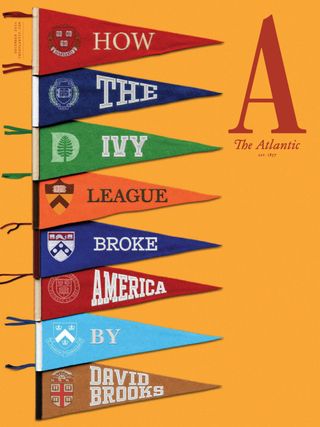
HOW THE IVY LEAGUE BROKE AMERICA
The Atlantic
|December 2024
THE MERITOCRACY ISN'T WORKING. WE NEED SOMETHING NEW.

Every coherent society has a social ideal—an image of what the superior person looks like. In America, from the late 19th century until sometime in the 1950s, the superior person was the Well-Bred Man. Such a man was born into one of the old WASP families that dominated the elite social circles on Fifth Avenue, in New York City; the Main Line, outside Philadelphia; Beacon Hill, in Boston. He was molded at a prep school like Groton or Choate, and came of age at Harvard, Yale, or Princeton.
In those days, you didn't have to be brilliant or hardworking to get into Harvard, but it really helped if you were "clubbable"good-looking, athletic, graceful, casually elegant, Episcopalian, and white. It really helped, too, if your dad had gone there. Once on campus, studying was frowned upon. Those who cared about academics-the "grinds"'-were social outcasts.
But students competed ferociously to get into the elite social clubs: Ivy at Princeton, Skull and Bones at Yale, the Porcellian at Harvard.
These clubs provided the well-placed few with the connections that would help them ascend to white-shoe law firms, to prestigious banks, to the State Department, perhaps even to the White House. (From 1901 to 1921, every American president went to Harvard, Yale, or Princeton.) People living according to this social ideal valued not academic accomplishment but refined manners, prudent judgment, and the habit of command. This was the age of social privilege.
And then a small group of college administrators decided to blow it all up. The most important of them was James Conant, the president of Harvard from 1933 to 1953. Conant looked around and concluded that American democracy was being undermined by a "hereditary aristocracy of wealth."

This story is from the December 2024 edition of The Atlantic.
Subscribe to Magzter GOLD to access thousands of curated premium stories, and 10,000+ magazines and newspapers.
Already a subscriber? Sign In
MORE STORIES FROM The Atlantic
The Atlantic
You Had to Be There
An emerging field of history asks if we can ever really understand how our forebears experienced love, anger, fear, and sorrow.

23 mins
January 2026

The Atlantic
By the Horns
The week before the biggest bullfight of her career, in Cádiz, Spain, this past July, 24-year-old Miriam Cabas posted a carefully produced video on Instagram.
1 mins
January 2026

The Atlantic
The New German War Machine
After World War II, Germany embraced pacifism as a form of atonement. Now the country is arming itself again.
18 mins
January 2026
The Atlantic
The Eloquence
The prime minister was watching a disaster movie when we found him.
4 mins
January 2026

The Atlantic
What's for Dinner, Mom?
The women who want to change the way America eats
12 mins
January 2026

The Atlantic
How Terror Works
A 1947 German novel explores the sometimes corrosive, sometimes energizing nature of fear.
8 mins
January 2026

The Atlantic
Yesterday's Idea of a Modern Man
Sam Shepard, a self-made cowboy, was also a poet of masculine angst.
7 mins
January 2026

The Atlantic
ACCOMMODATION NATION
America's colleges have an extra-time-on-tests problem.
11 mins
January 2026

The Atlantic
Respect the Drummer
A new history of rock, told through its overlooked heroes
5 mins
January 2026

The Atlantic
THE MOST POWERFUL MAN IN SCIENCE
WHY IS ROBERT F. KENNEDY JR. SO CONVINCED HE'S RIGHT?
42 mins
January 2026
Listen
Translate
Change font size