Poging GOUD - Vrij
SILENT FAMINE
Down To Earth
|January 16, 2024
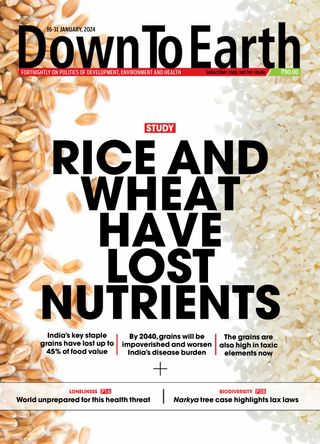
For the past 50 years, the country has introduced high-yielding rice and wheat varieties at breakneck speed to achieve food security. A study led by scientists with the Indian Council of Agricultural Research (ICAR) has for the first time looked at the food value of these modern-bred grains, and delivers some dire warnings: the food grains that we eat have lost food value; instead they are accumulating toxins. Worse, by 2040, the grains will become so "impoverished" that they would worsen the country's growing burden of non-communicable diseases.

YOU ARE what you eat, or, rather, what you grow to eat. Imagine an entire population eating something that has little food value-something that is devoid of nutrients such as a host of vitamins which are essential for growth, disease prevention and maintaining overall health and well-being. "This is the future we are hurtling towards," says Sovan Debnath, a soil scientist at the Indian Council of Agricultural Research (ICAR) under the Union Ministry of Agriculture and Farmers Welfare.
In November 2023, Debnath and 11 other scientists from ICAR, Bidhan Chandra Krishi Viswavidyalayaanother premier agricultural research institute in West Bengal-and the National Institute of Nutrition in Telangana published a seminal study that says the Green Revolution has helped India achieve food security, but by compromising its nutritional security. In a first, the study reports that breeding programmes focused on developing high-yielding varieties have altered the nutrient profiles of rice and wheat, two major staple food grains of India, to the extent that their dietary significance to the population has diminished. While chasing yield, the plant genetics have been tinkered with so much that they no longer do the fundamental job of delivering nutrition from the soil to the grains.


Dit verhaal komt uit de January 16, 2024-editie van Down To Earth.
Abonneer u op Magzter GOLD voor toegang tot duizenden zorgvuldig samengestelde premiumverhalen en meer dan 9000 tijdschriften en kranten.
Bent u al abonnee? Aanmelden
MEER VERHALEN VAN Down To Earth

Down To Earth
CONSERVED BY COMMUNITY
How a desire to make snow leopard tourism sustainable helped a small Ladakhi settlement became the region's first Community Conserved Area

4 mins
May 16, 2026

Down To Earth
An 'open' and 'shut' case of Al's risky trajectory
Elon Musk's lawsuit against Sam Altman, OpenAl, Microsoft is crucially about open-source versus closed technology for corporate profit
4 mins
May 16, 2026
Down To Earth
Burden of transition
Clean energy transition is once again shifting environmental, human costs to the Global South, finds a UN university investigation
4 mins
May 16, 2026
Down To Earth
One step closer
India attains criticality in fast breeder reactor technology, reaching the second stage of the country's three- stage nuclear programme towards energy security
4 mins
May 16, 2026

Down To Earth
ZESTY SEEDS
Coriander seeds are a traditional antidote to summer heat
3 mins
May 16, 2026

Down To Earth
Sahyadri gets a bird village
Residents of Maharashtra's Pisavare village have embarked on a mission to protect birds in their vicinity through simple practices such as documenting species and building nests
2 mins
May 16, 2026

Down To Earth
CONFLICT IN THE BACKYARD
Across India, farmers are abandoning their fields as conflict with wild and stray animals intensifies. Conservation policy must move beyond protection alone to restore a workable coexistence between people and animals.
18 mins
May 16, 2026

Down To Earth
Capital punishment
Adequate compensation and proper rehabilitation remain a mirage for many displaced by the construction of Chhattisgarh's new capital, Nava Raipur, even two decades after the project began
3 mins
May 16, 2026
Down To Earth
Migrant workers are assets
MIGRATION HAS turned into a potent tool of political warfare across the world. For over a decade, domestic electoral politics across regions, from Europe and North America to Asia and Africa, have fuelled anti-immigration sentiments. This is also increasingly fuelling anti-immigrant vigilantism, as seen widely across Europe in 2015-16, coinciding with the refugee crisis.
2 mins
May 16, 2026

Down To Earth
Petri dish to plate
Synthetic meat production has seen a rise globally, even as environmental benefits of growing foods in laboratory remain debatable
10 mins
May 16, 2026
Listen
Translate
Change font size